
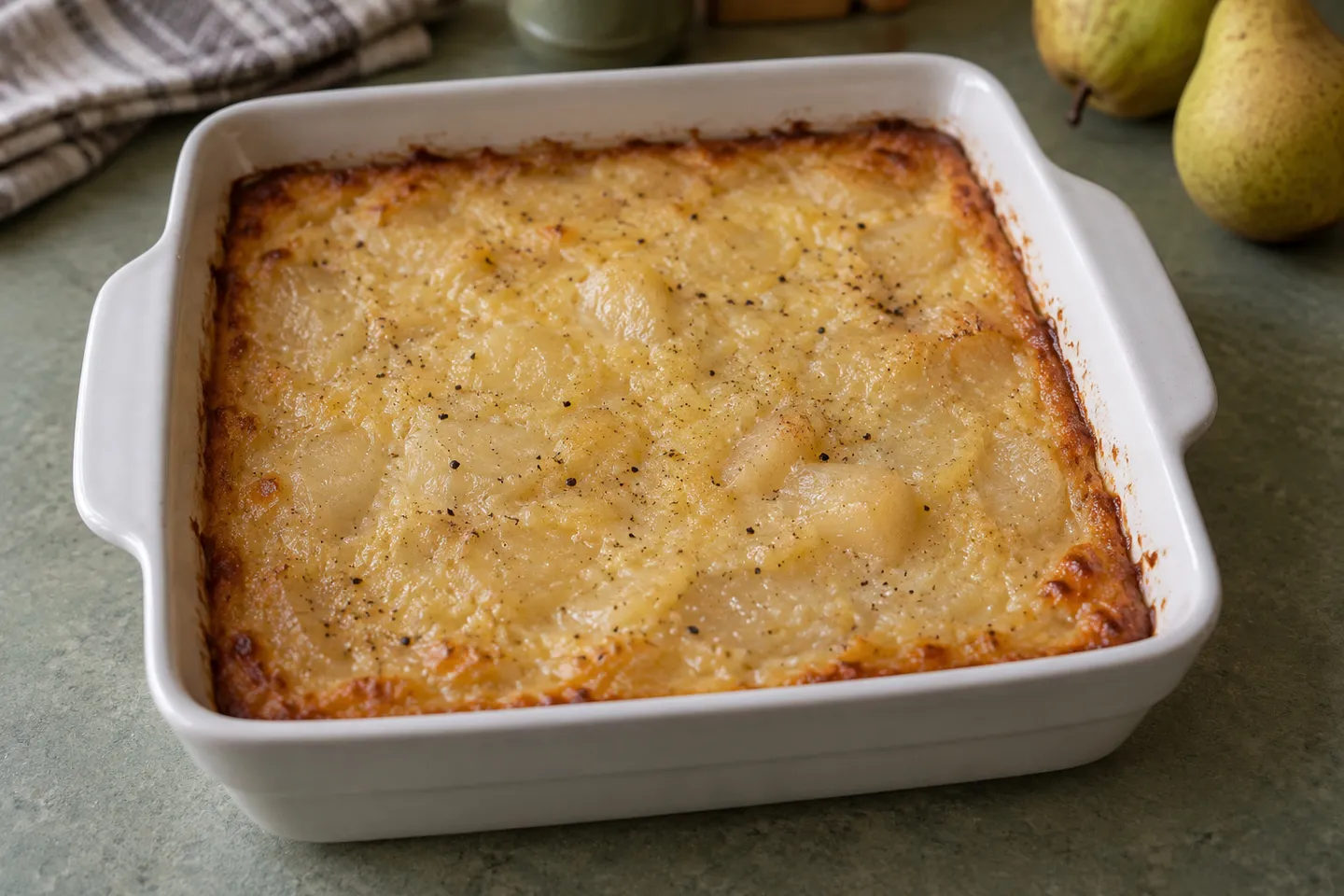
Patina de Piris (Spiced Pear Patina)
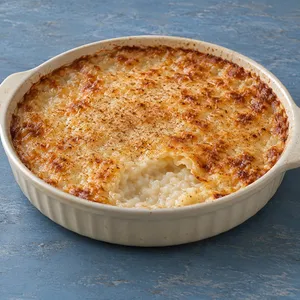
A baked pear and egg dish with honey, sweet wine, cumin, black pepper, and a savory measure of fish sauce.
- Original yieldYield
- 6 servings6 servings
- PrepPrep time
- CookCook time
- TotalTotal time
Includes pear simmering and baking, plus about 10 minutes to cool the puree and a 10-minute rest after baking. Times are estimates; use the center-temperature endpoint.
Published Updated
Original recipe: 6 servings
The story behind the recipe
Pears, honey and sweet wine are seasoned with cumin, pepper and fish sauce in patina de piris. It's a fruit-and-egg bake with more pepper added at the finish. Without milk or cream, this is quite different from a familiar dairy custard.
Sweet fruit, savory seasoning
The pears are cooked and coarsely mashed before the eggs and seasonings go in. Aim for a softly set bake with some fruit texture. Pears, honey, and wine supply sweetness; cumin and fish sauce give the dish a savory side that belongs to its source.
Read more about this recipe
Pepper appears twice
In Book IV of Apicius, boiled pears with their centers removed are pounded with pepper, cumin, honey, passum, fish sauce, and a little oil. Eggs make the mixture into a patina. More pepper is sprinkled over it before serving. Our Apicius article follows the same savory seasoning into dishes of meat, eggs, and seafood.
That second appearance of pepper is a small but revealing detail. It seasons the mixture and remains on the surface of the finished portion. The fish sauce is also part of the original dish, not an extra savory flourish added to a plain pear dessert.
We've placed this version among desserts because sweet fruit makes that a useful choice for today's meal. The passage itself presents the combination without explaining where it belonged in a sequence of courses. A spoonful can be enjoyed without turning one recipe into a claim about every Roman dinner.
Raisin wine and ripe fruit
Passum is a raisin wine. Sweet passito or sweet Marsala is the practical choice here, with its own flavor. Look for a sweet wine as specified; a dry bottle would change the liquid's contribution alongside honey and pears. Southeast Asian fish sauce supplies the savory seasoning, and brands vary in strength.
The formula's quantities, peeled fruit, square pan, and oven guidance are modern choices. Apicius gives no number of eggs or honey-to-pear ratio to preserve. A prepared fruit weight is more useful than counting pears, since size and the amount removed with peel and cores can vary considerably.
Firm pears start the cooking with enough structure to handle, then soften in water before mashing. Drain them well. Excess poaching water would enter a mixture that already has wine, honey, and eggs planned for it. Cooling the mash before adding the eggs keeps that mixing stage distinct from cooking them in the oven.
A spooned portion
A potato masher leaves some variation in the fruit. This is a bake to spoon from its square pan, not a perfectly smooth flan to turn out in one piece. The center's temperature and set matter more than a browned surface.
Serve warm, or cool and refrigerate for a chilled finish to the meal. A small bowl suits the soft fruit texture, with the final pepper sprinkled over the portion rather than hidden beneath a cream topping.
Make it your wayOriginal: 6 servings
Original recipe: 6 servings
Ingredients
For 6 servings. Quantities are shown as written.
Source measurement convention: Metric. Explicit unit definitions take precedence; unconfirmed measures must be checked before conversion.
Original quantities for 6 servings.
- Prepared firm pears, peeled, cored, and quartered (weigh after trimming)600 g
- Wildflower honey45 ml
- Southeast Asian fish sauce15 ml
- Ground cumin2 g
- Extra-virgin olive oil15 ml
- Sweet passito wine (or sweet Marsala)60 ml
- Large eggs3
- Ground black pepper, divided1 g
- Extra olive oil as needed for greasing the pan
Measurement notes
Measurement notes
Original ingredients
- 600 g prepared firm pears, peeled, cored, and quartered (weigh after trimming)
- 45 ml wildflower honey
- 15 ml Southeast Asian fish sauce
- 2 g ground cumin
- 15 ml extra-virgin olive oil
- 60 ml sweet passito wine (or sweet Marsala)
- 3 large eggs
- 1 g ground black pepper, divided
- Extra olive oil as needed for greasing the pan
Equipment
 Potato masher
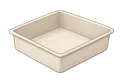 20x20 cm (8x8 inch) square baking pan
 Food thermometer
Instructions
Heat the oven and grease the pan
Heat the oven to 350°F (175°C), conventional setting. Grease a 20x20 cm square baking pan, at least 5 cm deep, with the extra olive oil.
Simmer and mash the pears
Put the prepared pear quarters in a saucepan with enough water to cover them. Bring to a simmer and cook for 10 to 12 minutes, or until a fork passes through easily. Allow extra time for firmer fruit. Drain well and mash with a potato masher into a coarse puree.
Cool the pear puree
Spread the puree in a wide dish and leave for about 10 minutes, stirring occasionally, until lukewarm rather than hot. This helps prevent the eggs from cooking as they are mixed in.
Mix the seasonings and eggs
Stir the honey, fish sauce, ground cumin, 15 ml olive oil, sweet wine, and half the black pepper into the cooled puree. Beat the eggs briefly, then mix them in thoroughly.
Bake the pear patina
Pour into the greased pan and spread evenly. Bake for about 25 to 35 minutes, until the edges are set and the center reaches at least 160°F (71°C) on a food thermometer. A small tremble in the center is acceptable; a liquid center is not. Start checking at 25 minutes and continue as needed.
Rest, finish with pepper and serve
Rest for 10 minutes. Dust with the remaining black pepper and spoon into six portions. Serve warm, or cool promptly and refrigerate to serve chilled.
Estimated calories 150 kcal
Nutrition portion: 1/6 of recipe · Original yield: 6 servings
Source & assumptions
Ingredient-based estimate using CoFID 2021, USDA SR Legacy (April 2018), identified manufacturer information. Approximately 150 kcal per nutrition portion. Uses the sweet Marsala alternative and counts its full input energy despite baking; alcohol loss can lower the estimate. Includes peeled pear input and excludes unmeasured pan-greasing oil. Ingredients, brands and preparation affect values.
Recipe notes
Original recipe notes
These notes describe the original recipe. Quantities mentioned here do not change when you adjust servings.
Pear weight: Buy enough fruit to give 600 g after removing peel and cores; the number of pears varies with size. Drain well so extra poaching water does not thin the egg mixture. Keep the fish sauce for the source-close version; it contributes salt and savory flavor, and its strength varies by brand.
Pan and scaling: The baseline is one square 20x20 cm pan, not an interchangeable round pan of the same width. When increasing yield, use additional pans at a similar filling depth and check each center; changing servings does not automatically change baking time.
Storage: Refrigerate in shallow containers within 2 hours of cooking, or within 1 hour above 90°F (32°C), at 40°F (4°C) or below. Keep covered for up to 3 days. If reheating, heat to 165°F (74°C).
Read the scaling guide. Times, temperatures and equipment need their own consideration. Open the recipe tool to review and correct individual amounts.
Sources and attribution
Apicius IV.2.35: Latin text and Vehling 1936, recipe 161. The ingredient combination follows the passage; amounts and modern cooking guidance are adaptations.
For the drinking side of the Roman table, explore what Romans drank besides wine on our sister site, Forgotten Drink.
Recipe details
- Recipe tradition
- Vintage
- Cuisine
- Ancient Roman
- Historical period
- Roman
- Browse category
- Baking & Desserts