

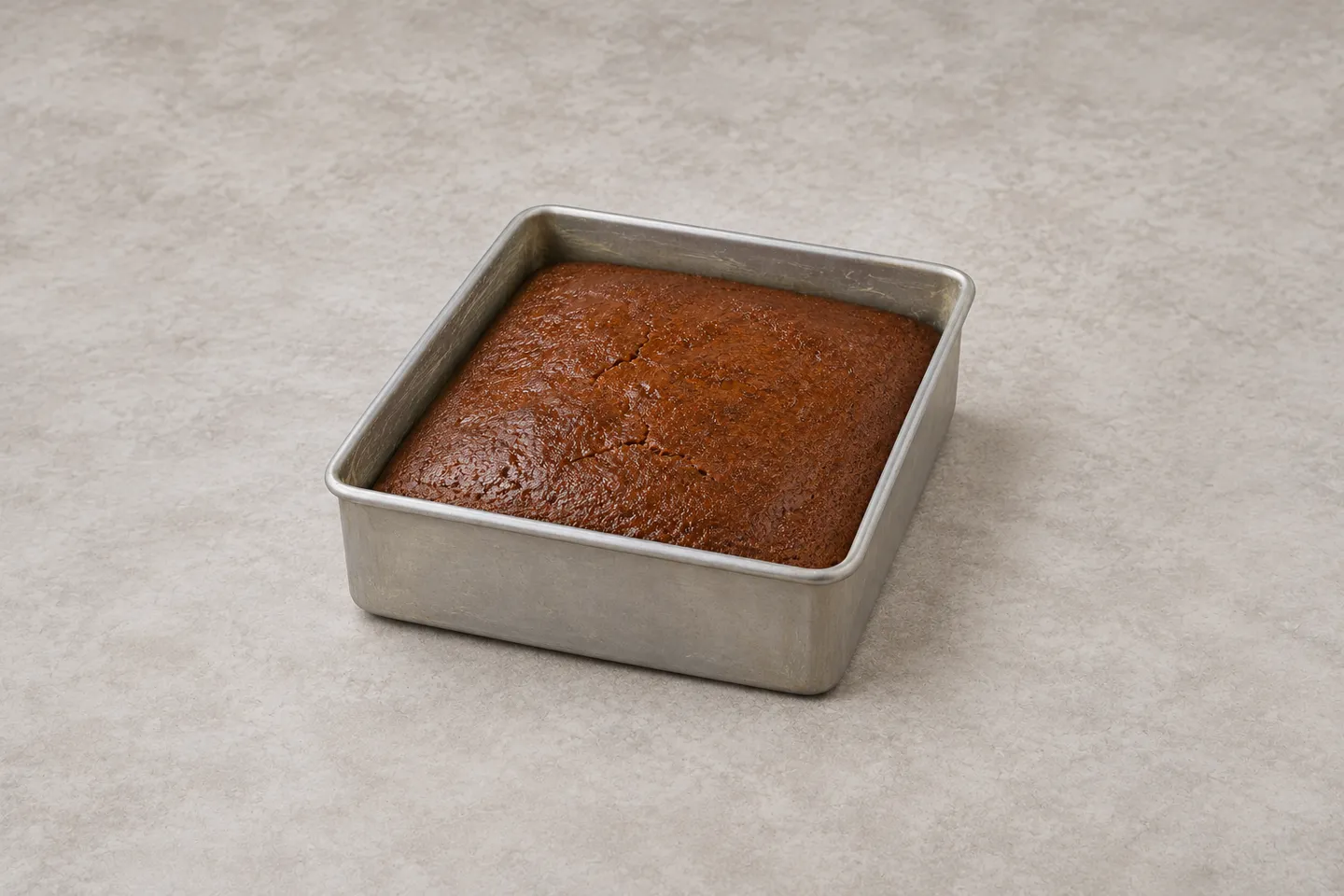
Thick Black-Treacle Gingerbread (1861)
Beeton's substantial gingerbread adapted with black treacle, brown sugar, ginger and allspice, with an egg-yolk wash near the end of baking.
- Original yieldYield
- 1 thick square cake, cut into 16 pieces1 thick square cake, cut into 16 pieces
- PrepPrep time
- CookCook time
- TotalTotal time
Estimated: 20 minutes preparation, about 50–65 minutes baking including the late wash, and 15 minutes cooling in the pan before further cooling on a rack. A thick center may need longer.
Published
Original recipe: 1 thick square cake, cut into 16 pieces
The story behind the recipe
The shiny top is a separate operation. Near the end of baking, Beeton asks for gingerbread to be brushed with egg yolk beaten with a little milk, then returned to the oven. The three eggs in the mixture are already accounted for. This extra yolk is a finishing wash, not one to save from the batter.
Thick means a different sort of cake
Beeton's recipe has a pound and a half of flour to a pound of treacle, with a full ounce of ginger and half an ounce of allspice. Those substantial amounts distinguish it from a lightly spiced, thin batter cake. The warm milk is a relatively small addition to a mixture that also contains butter, sugar and eggs.
Read more about this recipe
Read the spice weights before opening the jars
Ginger and allspice aren't interchangeable measures of one spice blend. The ginger is the larger allowance, while the allspice is separately specified as ground. This version chooses ground ginger as well. Weigh both rather than judging them by the spoonfuls used in another gingerbread recipe.
The quantities may look large beside a modern cake you already know. Reducing them to a casual pinch would be a deliberate change to Beeton's proportions, not an ordinary conversion. Here the rounded ounce weights remain visible in grams, so the cake keeps that particular source relationship.
Demerara is the chosen coarse brown sugar. Black treacle is the modern syrup selection. These ingredient names help you shop for this version; neither recovers a nineteenth-century brand from a recipe that didn't name one.
Treacle doesn't identify the whole formula
Elsewhere in her 1861 book, Beeton places treacle and molasses under a shared explanatory heading. That vocabulary overlap is useful, but it doesn't make every modern dark syrup the same ingredient. Her gingerbread says simply treacle, leaving its particular grade unnamed.
The eggs and milk are just as important when choosing between recipes. Farmer's later hot-water molasses gingerbread has neither egg nor sour milk in its list and goes into a shallow pan. Borrowing its liquid or mixing order here would create another formula. A shared gingerbread name doesn't require the cakes to have matching thickness, spice balance or finish.
The milk has two places in the recipe
The warm milk in the batter carries the soda. The small milk allowance for the wash is kept apart until the cake is nearly baked. Separating those ingredients at the measuring stage prevents a finishing mixture from silently using liquid intended for the batter.
An old pint also needs a stated modern interpretation. The recipe gives a quarter pint for the batter; this version chooses about 140 ml under an Imperial-pint convention. Beeton discusses a wine-pint measure elsewhere in the book, so that modern allowance shouldn't be mistaken for a historically calibrated certainty.
Let the center decide
The source allows three-quarters of an hour to an hour, or longer when the gingerbread is very thick. That last qualification matters more than a neat timer total. Pan depth determines how far the heat must reach through the mixture, and a browned surface doesn't establish that the middle is baked.
A modern square pan and numerical oven setting make the instruction more concrete. The final check still belongs at the center, followed by enough baking to cook the wash. Cut the cake after cooling so its sixteen planned pieces are a portioning choice, rather than a claim about the source's unspecified square.
Make it your wayOriginal: 16 servings · Makes 1 thick square cake, cut into 16 pieces
Original recipe: 1 thick square cake, cut into 16 pieces
Ingredients
For 1 thick square cake, cut into 16 pieces. Quantities are shown as written.
Source measurement convention: Metric. Explicit unit definitions take precedence; unconfirmed measures must be checked before conversion.
Original quantities for 1 thick square cake, cut into 16 pieces.
- Black treacle454 g
- Unsalted butter113 g
- Demerara sugar113 g
- All-purpose flour680 g
- Ground ginger28 g
- Ground allspice14 g
- Baking soda1 metric tsp
- Whole milk, for the batter140 ml
- Large eggs, beaten3
- Large egg yolk, for the wash1
- Whole milk, for the wash15 ml
- Unsalted butter, for greasing the pan5 g
Measurement notes
- baking soda: tsp: 1 = 5 ml.
Measurement notes
Original ingredients
- 454 g black treacle
- 113 g unsalted butter
- 113 g demerara sugar
- 680 g all-purpose flour
- 28 g ground ginger
- 14 g ground allspice
- 1 tsp baking sodatsp: 1 = 5 ml.
- 140 ml whole milk, for the batter
- 3 large eggs, beaten
- 1 large egg yolk, for the wash
- 15 ml whole milk, for the wash
- 5 g unsalted butter, for greasing the pan
Equipment
- 23 cm (9-inch) square metal baking pan, at least 5 cm deep
- Large mixing bowl
 Small saucepan
 Pastry brush
 Wire cooling rack
Instructions
Prepare the deep square pan
Heat a conventional oven to 325°F (165°C). Use the specified deep square pan for the original batch. Grease it with the butter for greasing and line the base with baking parchment.
Combine dry ingredients and warm treacle
Mix the flour, demerara sugar, ginger and allspice in the large bowl. Gently melt the butter for the batter in a small saucepan, remove from the heat and stir in the black treacle. Let the syrup mixture cool until warm rather than hot, then stir it into the dry ingredients. Keep hands clear of the warmed syrup.
Add soda milk and eggs
Warm the milk for the batter gently until just warm. Stir in the baking soda, then add this mixture and the beaten eggs to the bowl. Mix until evenly combined; the mixture should be thick. Don't taste the raw batter.
Bake the thick cake
Transfer the mixture to the pan and level the top. At the original batch, use the specified pan and leave at least one-third of its depth clear; if the mixture won't fit below that limit, stop and divide it between matching pans rather than overfill. Bake for 45 minutes before checking the center, then continue as needed until it is nearly baked and no longer visibly wet in the middle.
Apply and cook the yolk wash
Beat the wash yolk with the milk for the wash. When the cake is nearly baked, brush a thin layer over the top. Return it to the oven for at least 5 minutes, then continue as needed until the wash is set and fully cooked and a skewer inserted into the center comes out without wet batter. Discard any unused wash.
Cool and cut
Cool in the pan for 15 minutes, then loosen carefully and transfer to the wire cooling rack. Let it cool before cutting into 16 pieces at the original batch, or the selected number after scaling.
Recipe notes
When adjusting quantities
Keep the original cake depth by dividing a larger batch among matching pans. Use an appropriately smaller pan for a smaller batch, with pan choice reviewed separately; don't keep the full-batch time automatically. Beat and weigh eggs and yolks when a scaled amount is fractional. Keep the wash separate from the batter.
Original recipe notes
These notes describe the original recipe. Quantities mentioned here do not change when you adjust servings.
Adapted from Beeton's full recipe with rounded weight conversions. Black treacle, demerara, ground ginger, large eggs and unsalted butter are modern choices. The 140 ml batter milk uses a provisional Imperial-pint convention; the separate wash uses an added 15 ml milk. The pan, 165°C oven setting, handling cues and sixteen-piece division are modern specifications; the source allows extra baking for a thick cake.
At the original batch, the three large eggs are about 150 g without shells.
Contains wheat, milk and egg. Keep the batter eggs, wash yolk and their two milk allowances separate. This recipe specifies black treacle; no universal replacement with golden syrup or blackstrap is established.
Storage
Let the cake cool on a rack, then cover and refrigerate any portion not being served. Discard unused raw egg wash and wash its brush before using it on ready-to-eat food. No prolonged keeping period is assigned.
Read the scaling guide. Times, temperatures and equipment need their own consideration. Open the recipe tool to review and correct individual amounts.
Sources and attribution
Isabella Beeton, The Book of Household Management (London: S.O.Beeton, 1861), no. 1760, Thick Gingerbread, p. 857.
Isabella Beeton, The Book of Household Management, London: S.O.Beeton, 1861, no. 1760, Thick Gingerbread, p. 857; Treacle, or Molasses, p. 621; measures discussion, p. 40.
Recipe details
- Recipe tradition
- Vintage
- Cuisine
- British
- Cooking method
- Oven
- Browse category
- Baking & Desserts