
- Vintage
- Cocktails
- Measurements
The Glass You Poured With and the Glass You Drank From
In Jerry Thomas's 1862 bar book, a wineglass can measure the brandy or hold the finished drink. The recipe tells you which job it has.
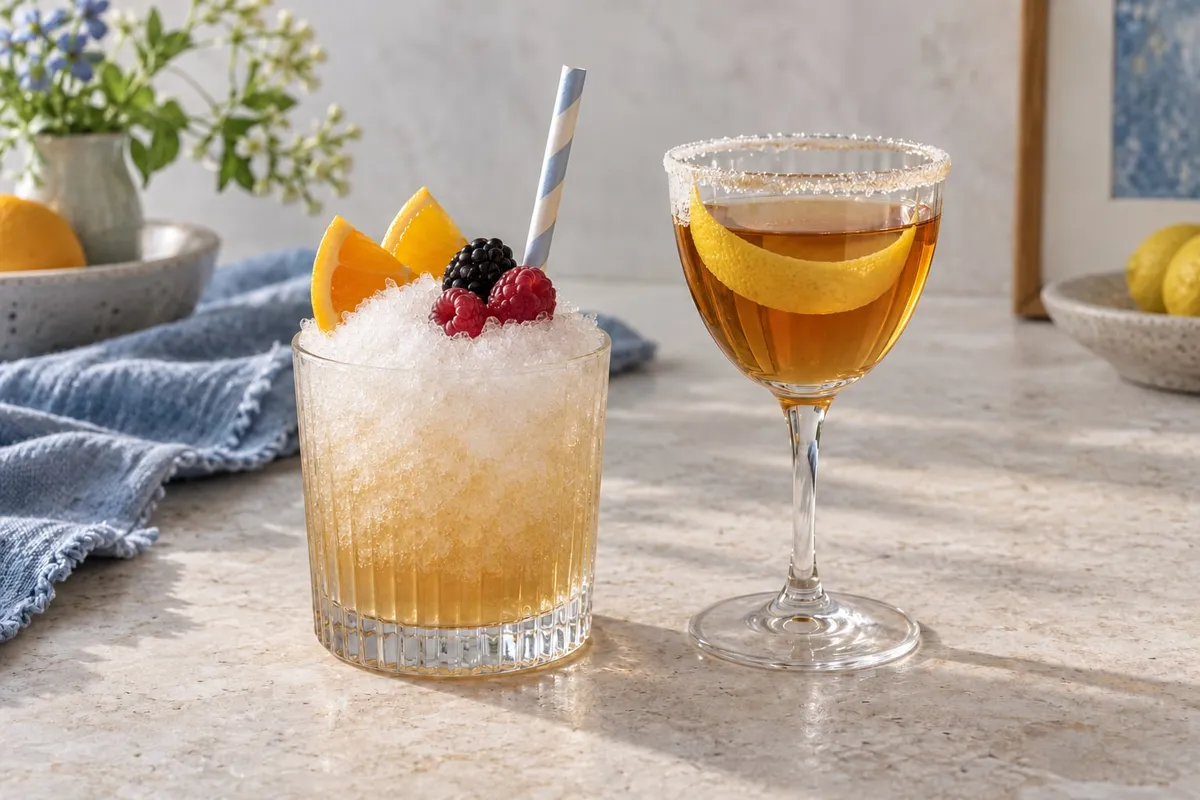
The Sherry Cobbler in Jerry Thomas’s 1862 bar book starts with two wineglasses of sherry. The bartender needs a tumbler as well. That one is filled with shaved ice, shaken, and dressed with berries in season. Thomas sends the straw to the tumbler. The two wineglasses tell the bartender how much wine to use.
Read a few pages further and a wineglass does the opposite job. The Fancy Brandy Cocktail is strained into one. Thomas’s ordinary Brandy Cocktail already uses a wineglass of brandy, so the fancy version calls on the same word twice. One glass appears in the amount you pour. The other catches the finished drink.
A tumbler has to hold the ice
The Cobbler makes the distinction easy to see. Thomas lists sherry, sugar, and slices of orange. The ice, seasonal berries, and straw appear in the instructions, where the drink takes its shape. Two wineglasses are a quantity of sherry. The tumbler has to accommodate the sherry, the shaved ice, and the fruit at the same time. A tumbler’s useful size here is partly a question of what goes into it and how it will be served.
Look at Thomas’s Champagne Cobbler alongside it. Instead of giving a number of wineglasses of Champagne, he divides a bottle among four large bar glasses and tells the reader to put shaved ice into the tumbler before filling it with wine. He uses a bottle to express the amount for the group and the glass to describe each serving. A cook who only pulls the noun glass out of each recipe loses the part of the sentence that says how to divide the wine.
Our Sherry Cobbler adaptation uses 75 milliliters of sherry. You can choose a tumbler that leaves room for the ice and fruit without needing its capacity to determine the amount you pour.
The Crusta starts with the glass
Thomas’s Brandy Crusta sends the reader back to the Fancy Brandy Cocktail, which in turn sends the reader to the ordinary Brandy Cocktail. Follow that trail and you find the brandy quantity in the ordinary recipe. Go back to the Crusta and the wineglass is being prepared for service. A piece of lemon moistens the rim so sugar will adhere. A long strip of peel goes inside the glass before the mixed drink is strained into it.
Here the glass governs the work on the garnish. The peel has to sit against the bowl, and the sugar has to stay where the next sip will reach it. That is why the choice of serving glass still matters even when the liquids are measured separately. For the Brandy Crusta adaptation, choose a stemmed glass that will hold the coil comfortably and let the listed amounts do the measuring.
When the books do give a size
Some writers did say what they meant by a wineglass. In the 1822 edition of The Cook’s Oracle, William Kitchiner describes a graduated wine pint with sixteen liquid-ounce divisions and assigns two of those ounces to a wineglass. Beeton’s 1906 table gives its wineglassful of water or milk as one-eighth of an Imperial pint. The two writers use the same fraction of a pint, with different systems behind the word pint. Beeton’s value comes to about 71 milliliters, or 2.4 US fluid ounces.
Those entries explain why a wineglass can function as a unit. They also show why you need to keep the definition beside its source. A named measure in another cookbook gives a useful comparison. It doesn’t tell us the capacity of the glass Thomas had in mind. Our wineglass measurement guide walks through the two definitions side by side.
Suppose you choose two modern US fluid ounces as your working measure for one glass. Two measures would give you four fluid ounces of sherry. Borrow Beeton’s equivalent and the same two measures would give you about 4.8 fluid ounces. Those are two hypothetical pours. The quantity of wine changes by about a fifth while Thomas’s spoonful of sugar stays where it was. That difference belongs in the adaptation notes, where the next person can see what you chose.
One more vessel in the pantry
Thomas’s Cherry Shrub has a different problem. He calls for a gill of brandy in each bottle. A gill is a quarter pint, and modern US and Imperial definitions give different volumes. Even after choosing which gill to use, you still have a bottle of unstated size. To reconstruct the proportion, you would need both quantities. Our story on Thomas’s three shrubs explains the decisions behind the modern batches. Follow its modern handling directions if you make the drinks.
The next time a glass appears in an old drink recipe, read the words around it. A wineglass of sherry is a quantity. A cocktail strained into a wineglass is ready to serve. A bottle that receives a gill tells you where the brandy goes, while leaving a separate question about the bottle. Working through the sentence first lets you preserve the shape of the drink even when you have to choose a modern amount.
Sources
- Jerry Thomas, How to Mix Drinks, or The Bon-Vivant’s Companion (New York, 1862), recipes 98–99, 107–108, 116 and 154.
- William Kitchiner, The Cook’s Oracle, fourth edition (London, 1822), p. 31.
- Mrs. Beeton’s Book of Household Management, revised edition (London, 1906), p. 127.