
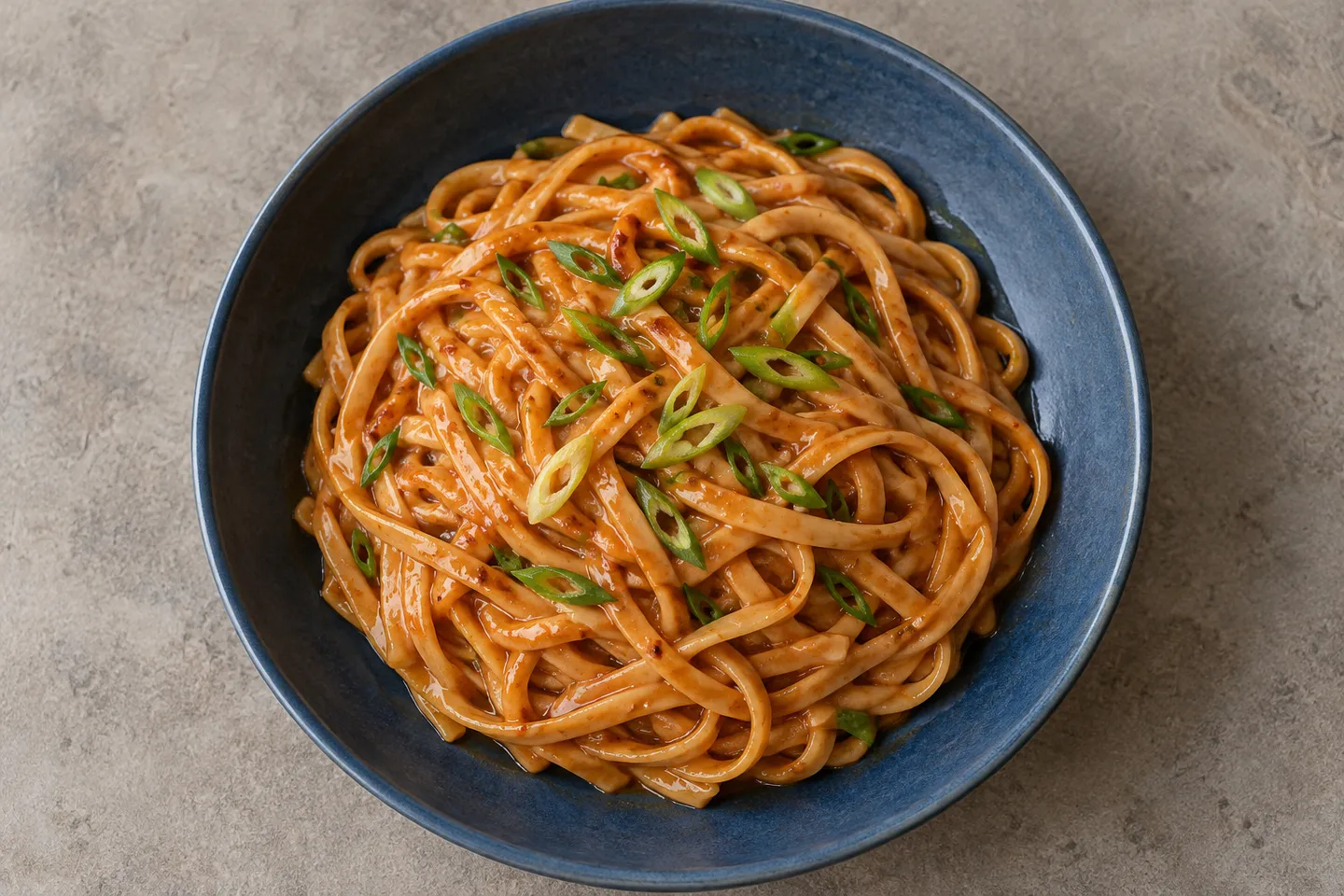
Gochujang Butter Linguine
Tender linguine coated in a glossy emulsion of melted butter and savory Korean chili paste, balanced with garlic and Parmesan.
- Original yieldYield
- 2 servings2 servings
- PrepPrep time
- CookCook time
- TotalTotal time
Published Updated
Original recipe: 2 servings
The story behind the recipe
Butter carries the red of gochujang all the way around a strand of linguine. The sauce has chili heat, but also the sweetness and savory depth of a fermented paste. Garlic, Parmesan and scallions make it a generous bowl of pasta from a short ingredient list.
Get to know the red tub
Gochujang is a Korean fermented chili paste made with grains and soybean ingredients. Thick enough to spoon, it supplies much of this sauce's seasoning before the garlic or cheese goes in.
Read more about this recipe
Fermentation supplies some of the sweetness
The sweetness isn't all about added sugar. As the Korean Tourism Organization explains in its account of gochujang, fermentation breaks starch down into sugars and proteins into amino acids, developing sweet and savory flavors alongside the chili heat.
Rice is one possible grain; barley is another. Check the ingredient list on your tub, because commercial preparations vary. A different brand can change the flavor of the next bowl even when you measure the same spoonful.
Gochujang and gochugaru are different products. The first is the paste in this sauce; the second is the Korean chili flakes offered in the notes for extra heat. The similar names are easy to mix up when shopping, but flakes alone won't provide the paste's body or its fermented seasoning.
For less heat, start with the milder variation in the notes. Reducing the paste and increasing the butter changes the balance of the sauce before it coats the pasta; rescuing an already dressed bowl is harder.
A butter sauce with something to hold it together
This is a contemporary pasta built around that Korean ingredient. Butter and Parmesan supply the familiar richness of a pasta sauce, while gochujang gives it a much stronger seasoning than a plain butter coating. There's no cream in the formula.
Cheese adds salt as well as richness, joining the seasoning already in the soy sauce and chili paste. Low-sodium soy sauce leaves room for the Parmesan, which goes in off the heat for a gentler finish. For a vegetarian meal, check the cheese's rennet as well as the condiment labels.
Save the cloudy pasta water.
It loosens the butter-and-paste mixture while its starch helps the coating cling to the noodles. If the pasta gathers into a tight clump, reach for that water before adding more gochujang or soy sauce: the coating needs loosening, and both condiments bring more seasoning with them.
Make it your wayOriginal: 2 servings
Original recipe: 2 servings
Ingredients
For 2 servings. Quantities are shown as written.
Source measurement convention: Metric. Explicit unit definitions take precedence; unconfirmed measures must be checked before conversion.
Original quantities for 2 servings.
- Dry linguine250 g
- Salt, as needed for pasta cooking water
- Unsalted butter45 g
- Gochujang (Korean fermented chili paste)30 mlAuthor measures: 2 metric tbsp (1 metric tbsp = 15 ml).
- Garlic, finely minced2 cloves
- Low-sodium soy sauce15 mlAuthor measures: 1 metric tbsp (1 metric tbsp = 15 ml).
- Reserved starchy pasta cooking water (divided)120 ml
- Finely grated Parmesan cheese25 g
- Medium scallions, thinly sliced on a bias (for garnish)2
Measurement notes
Measurement notes
Original ingredients
- 250 g dry linguine
- Salt, as needed for pasta cooking water
- 45 g unsalted butter
- 30 ml (2 tbsp) gochujang (Korean fermented chili paste)
- 2 cloves garlic, finely minced
- 15 ml (1 tbsp) low-sodium soy sauce
- 120 ml reserved starchy pasta cooking water (divided)
- 25 g finely grated Parmesan cheese
- 2 medium scallions, thinly sliced on a bias (for garnish)
Equipment
 4-liter pasta pot
 12-inch stainless steel skillet
- Tongs
 Fine-mesh skimmer or colander
Instructions
Cook the linguine and reserve cooking water
Fill a 4-liter pasta pot with water, add salt for the cooking water, and bring to a rolling boil over high heat while you prepare the garlic and scallions. Add the dry linguine and cook according to the package until al dente, about 8 to 9 minutes. Before draining, reserve at least 120 ml of the cloudy pasta cooking water.
Cook the garlic and gochujang in butter
While the pasta cooks, set a 12-inch stainless steel skillet over medium heat and melt the unsalted butter. When the butter begins to foam gently, stir in the finely minced garlic and gochujang. Cook for 2 minutes, stirring continuously, until the garlic softens, the paste turns a deep reddish-brown, and fragrant chili-infused oil begins to separate around the edges.
Whisk the sauce and add the pasta
Once the pasta is nearly ready, add the low-sodium soy sauce and 60 ml of the reserved pasta cooking water to the skillet. Whisk briskly until the butter and liquid form a smooth emulsion. Drain the linguine and add it to the skillet.
Toss until the sauce coats the noodles
Toss continuously with tongs over medium-low heat for 1 to 2 minutes, splashing in additional reserved pasta water as needed until the sauce thickens into a glossy coat that clings to the noodles.
Add Parmesan, garnish and serve
Remove the skillet from the heat. Scatter the finely grated Parmesan cheese over the pasta and toss until fully melted into the sauce. Transfer immediately to warm bowls, scatter the thinly sliced scallions over the top, and serve warm.
Estimated calories 680 kcal
Nutrition portion: 1/2 of recipe · Original yield: 2 servings
Source & assumptions
Ingredient-based estimate using CoFID 2021, USDA SR Legacy (2018), representative labels for Maeil Shin Gochujang. About 680 kcal per nutrition portion (1/2 of the recipe). Uses a representative gochujang label with 20 g per tablespoon and 45 kcal. Pasta uses a representative dry durum cooking-loss model. The returned pasta water is not added again as a separate calorie source. Actual ingredients and preparation affect the estimate.
Recipe notes
Original recipe notes
These notes describe the original recipe. Quantities mentioned here do not change when you adjust servings.
Heat control: For a milder dish, reduce the gochujang to 1 tablespoon (15 ml) and increase the butter to 60 g. For pronounced heat, add 1/2 teaspoon of gochugaru (Korean coarse chili flakes) along with the garlic.
Substitutions: Spaghetti, bucatini, or fettuccine make ideal substitutes. To make vegetarian, verify that the Parmesan uses microbial rennet.
Storage and reheating: Best enjoyed immediately after tossing. Refrigerate leftovers promptly in an airtight container at 4°C (40°F) or below for up to 3 days. Reheat gently in a skillet with 1 to 2 tablespoons of water until hot throughout, reaching 74°C (165°F).
Read the scaling guide. Times, temperatures and equipment need their own consideration. Open the recipe tool to review and correct individual amounts.
Recipe details
- Course or meal
- DinnerMain course
- Cuisine
- Other / International
- Browse category
- Main Dishes
- More details
- gochujang butter linguineParmesan