

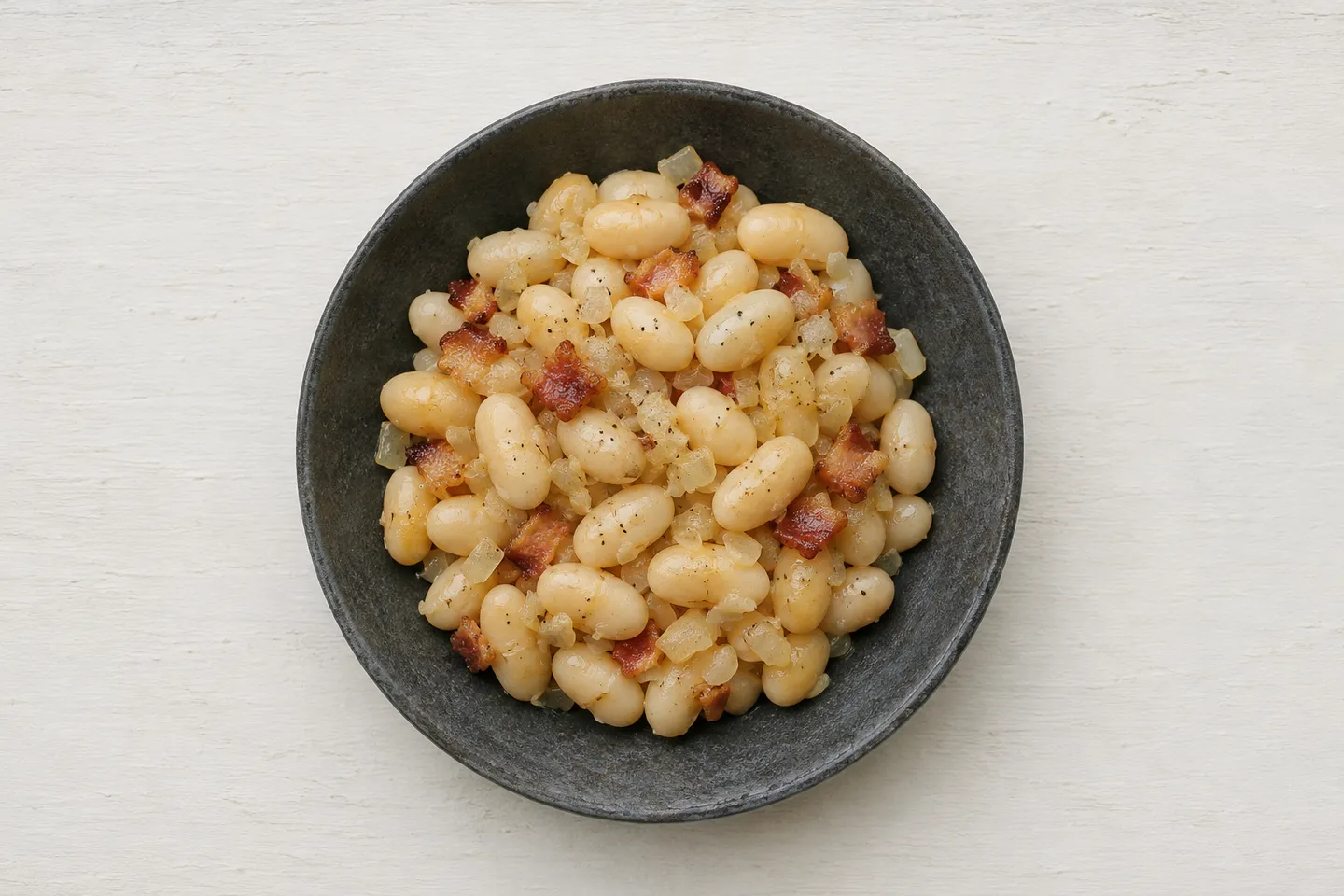
Hot Bean Salad (1943)
Whole white beans simmered with bacon, onion, mustard and cider vinegar, adapted from a 1943 USDA wartime leaflet.
- Original yieldYield
- 3 side portions3 side portions
- PrepPrep time
- CookCook time
- TotalTotal time
Estimated: 10 minutes preparation and 20–25 minutes cooking, including the bacon, onion and final bean simmer. Starts with cooked canned beans.
Published
Original recipe: 3 side portions
The story behind the recipe
The vinegar goes into the skillet with the beans, not over a cold salad at the table. Bacon is lightly browned first, then onion, before the whole beans simmer in a mustard-and-vinegar mixture. The liquid reduces around them until the pan holds a warm side dish rather than beans in a pool of dressing.
Whole beans, ready for a short simmer
Hot Bean Salad appears in the USDA's Dried Beans and Peas in Wartime Meals, issued in June 1943. Its first assumption is that the beans are already boiled or baked. That starting point matters: the short finishing method isn't an instruction to cook dried beans from scratch in vinegar.
Read more about this recipe
The bacon stays in the dish
The original offers bacon or salt pork, cut into half-inch pieces. The meat is fried lightly brown, and chopped onion is added to the same pan. This version chooses bacon and gives it a weight so that a thick strip and a thin one don't quietly become the same allowance.
There is no separate oil in the ingredient list. The bacon's fat is used for the onion, and the cooked pieces remain among the beans. Stir often while browning, keeping the heat moderate enough that the small onion pieces don't scorch before the liquid is added.
The finished dish is distinct from Baked Mashed Navy Beans, another American household adaptation from a different source. That recipe mashes its beans before an oven finish. Here they remain whole, and the stovetop dressing contains vinegar and mustard. Neither recipe should lend the other its date or its method.
A cup of cooked beans needs a preparation state
The leaflet gives three cups of boiled or baked beans. It doesn't name a bean variety, tell us how wet that measure was or supply a gram weight. This adaptation selects canned cooked white beans, weighed after draining and rinsing, at 510 g for the batch.
That is an explicit kitchen choice, not a claim that every three-cup measure of cooked beans weighs the same. Canning liquid is excluded from the prepared weight and replaced by the measured water and vinegar in the ingredient list. A dry-bean weight can't be substituted directly for that cooked amount.
Using canned beans also changes where the earlier cooking happened. The simmer here heats and dresses beans that are already tender. It doesn't demonstrate how much fuel the complete meal saves, because the initial cooking has taken place elsewhere.
Mustard and vinegar keep their separate measures
The source says mustard without specifying its form. Dry mustard powder is chosen for this version. It is dispersed into the measured vinegar and water before the mixture reaches the skillet, rather than left as a dry pocket among the beans.
Cider vinegar is another modern selection. The leaflet gives a quarter cup each of vinegar and water; this version uses a declared 240 ml cup convention, making each allowance 60 ml. Neither the vinegar type nor that exact metric number is a recovered historical specification.
Simmer gently so the beans stay recognizable while the loose liquid reduces. The bacon and canned beans already provide some seasoning, so the ingredient list doesn't add salt automatically. Pepper remains the small final seasoning named in the original.
Serve the portion you have planned
The leaflet says to double the recipe for a main dish. It doesn't give a measured yield or a number of diners. The three side portions here are a modern division, based on 170 g prepared beans per person before the bacon, onion and dressing.
That makes the serving basis clear without turning the leaflet's advice into a recovered wartime ration. June 1943 identifies this American publication, separate from the 1930s bean recipes and British wartime dishes elsewhere on the site.
Make it your wayOriginal: 3 servings · Makes 3 side portions
Original recipe: 3 side portions
Ingredients
For 3 side portions. Quantities are shown as written.
Source measurement convention: Metric. Explicit unit definitions take precedence; unconfirmed measures must be checked before conversion.
Original quantities for 3 side portions.
- Canned cooked white beans, drained and rinsed510 g
- Bacon, cut into 1 cm pieces40 g
- Onion, peeled and finely chopped50 g
- Dry mustard powder1/2 metric tsp
- Cider vinegar60 ml
- Water, plus a little only if needed to prevent sticking60 ml
- Small pinch ground black pepper1
Measurement notes
- dry mustard powder: tsp: 1 = 5 ml.
Measurement notes
Original ingredients
- 510 g canned cooked white beans, drained and rinsed
- 40 g bacon, cut into 1 cm pieces
- 50 g onion, peeled and finely chopped
- 1/2 tsp dry mustard powdertsp: 1 = 5 ml.
- 60 ml cider vinegar
- 60 ml water, plus a little only if needed to prevent sticking
- 1 small pinch ground black pepper
Equipment
 12-inch heavy skillet
 Food thermometer
Instructions
Prepare beans and mustard dressing
Drain and rinse the cooked beans, then weigh the prepared amount listed. Mix the mustard powder with the vinegar, water and pepper in a small bowl.
Brown bacon and onion
Put the bacon in the skillet over medium heat and cook, stirring, until cooked through and lightly browned, about 5–7 minutes. Add the onion and cook in the bacon fat for about 4–5 minutes, stirring, until softened and lightly colored.
Simmer the beans in dressing
Stir in the beans and the mustard mixture. Bring to a gentle simmer, then cook for about 10–15 minutes, stirring carefully, until most of the loose liquid has reduced and the beans are coated. Reduce the heat if the pan starts to catch; add a little water only if needed to prevent sticking before the beans are heated through.
Check heat and serve
Check several places through the bean mixture with the food thermometer, aiming for at least 165°F (74°C) throughout. Divide into three side portions at the original quantity, or the selected number after scaling, and serve hot.
Recipe notes
When adjusting quantities
Scale beans and dressing together. Use a suitable skillet or cook separate batches so the bacon can brown and the beans heat evenly. Keep a gentle simmer and judge the remaining liquid; cooking time doesn't multiply with the ingredients.
Original recipe notes
These notes describe the original recipe. Quantities mentioned here do not change when you adjust servings.
Adapted from the leaflet's complete Hot Bean Salad, choosing bacon instead of salt pork and drained canned white beans instead of unspecified boiled or baked beans. Bean, bacon and onion weights, dry mustard, cider vinegar, the 60 ml liquid allowances, timings, temperature check and three side portions are modern specifications.
Contains mustard; check the bacon and canned-bean labels for other ingredients and allergens. Any extra water used to prevent sticking is a conditional cooking adjustment, not an additional dressing allowance. A doubled batch doesn't establish a historical main-course portion count.
Storage
Serve hot. Refrigerate leftovers in shallow containers within 2 hours, or 1 hour above 90°F (32°C), at 40°F (4°C) or below. Reheat to 165°F (74°C), stirring and adding a little water if needed to prevent sticking.
Read the scaling guide. Times, temperatures and equipment need their own consideration. Open the recipe tool to review and correct individual amounts.
Sources and attribution
USDA Bureau of Human Nutrition and Home Economics, Dried Beans and Peas in Wartime Meals, AWI-47 (June 1943), Hot Bean Salad, unnumbered salad leaf.
USDA Bureau of Human Nutrition and Home Economics, Dried Beans and Peas in Wartime Meals, AWI-47, June 1943, Hot Bean Salad, unnumbered salad leaf. A digitized copy of the leaflet preserves the recipe and its main-dish doubling note.
Recipe details
- Recipe tradition
- Vintage
- Course or meal
- Side dish
- Cuisine
- American
- Source decade
- 1940s
- Cooking method
- Stovetop
- Occasion
- Wartime cooking
- Browse category
- Main Dishes