
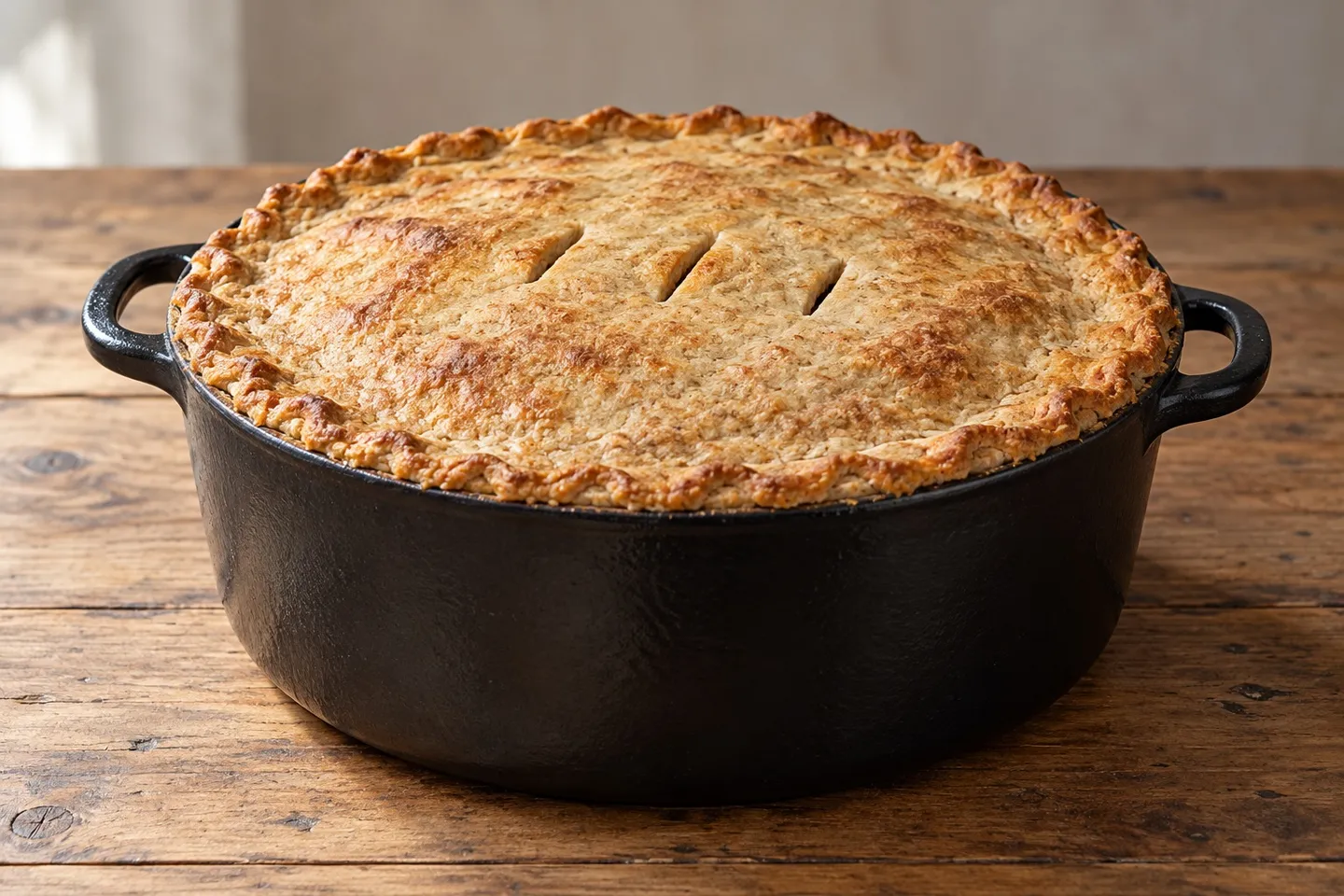
Woolton Pie with a Pastry Lid (1941 Adaptation)
Potatoes, carrots, swede and cauliflower beneath a whole-wheat potato-pastry lid, with brown gravy served alongside.
- Original yieldYield
- 4 generous servings4 generous servings
- PrepPrep time
- CookCook time
- TotalTotal time
This includes at least 1 hour chilling and variable filling cooling. Timings are untested planning estimates. Start with the pastry potato cooked, mashed and cold, and prepared gravy ready to heat.
Published Updated
Original recipe: 4 generous servings
The story behind the recipe
The pastry is part of the point of Woolton Pie. A thin, browned lid gives a dish of vegetables something to break through before the spoon reaches the filling. This version follows that pastry-lid direction, with potatoes, carrots, swede and cauliflower beneath the crust and a little brown gravy to serve alongside.
A pie built around vegetables
The Ministry of Food recipe reproduced from April 1941 gives vegetables the whole dish to themselves. Oatmeal thickens their cooking liquid, vegetable extract seasons it, and parsley goes in before the lid. The original instruction allows a crust of potato or wheatmeal pastry. Here, the rolled cover gives the pie a baked pastry edge around its softer center.
Read more about this recipe
What the short recipe leaves to the cook
The published directions are brief. They name a pound each of potatoes, cauliflower, swede and carrots, with a few spring onions, then leave room for the vegetables in season. There is no elaborate sauce to make separately for the filling. The vegetables cook with oatmeal and a small amount of extract in enough water to cover them.
That combination explains more about the pie than a general promise of wartime thrift. Potatoes and swede give the spoonful substance; carrots add sweetness, while cauliflower brings a different texture from the roots. Spring onions contribute flavor without taking over the dish. The ingredients are familiar, but putting them together under a pastry lid makes them a complete pie filling.
Woolton Pie is associated with the Ministry's wartime food advice and the Savoy kitchens under François Latry. It takes its name from Lord Woolton, the Minister of Food. The 1941 date identifies this published version.
Potato pastry still needs dough
A potato crust can mean more than a layer of mash. Potato pastry incorporates potato into a dough that can be rolled. Winterbourne House and Garden's modern Woolton recipe, for example, combines cooked potato with flour and fat before making a lid. It provides a useful comparison when imagining how a potato-containing crust differs from a soft potato topping.
Wheatmeal pastry points toward another rolled cover. The historical name doesn't give us a complete modern flour specification, a fat ratio or a reliable baking time on its own. Those details belong to the chosen pastry recipe. Plain mashed potato and potato-containing pastry have different ingredients and handling, even though both can give a vegetable filling a lid.
The lid supplies a baked surface above a moist filling. The original calls for filling in a pie dish and a crust over it; it doesn't require a pastry case around every side of the vegetables. Leaving the sides to the dish makes the contrast between crust and filling easy to see in each spoonful.
Keep the gravy in view
Oatmeal and vegetable extract are small entries in the source list, but they help explain the filling. The oats give the cooking liquid body. The extract supplies concentrated savory seasoning; it isn't interchangeable spoon for spoon with a bowl of vegetable stock. This is still a vegetable pie, with recognizable pieces beneath the crust.
The old directions also tell the cook to cool the filling before covering it and to serve the finished pie with brown gravy. The gravy is offered alongside the pie, giving the cook a way to moisten a serving without filling the baking dish with a deep pool of liquid. A little sauce can reach both the vegetables and the broken edge of pastry.
The wider setting appears in Cooking on the Kitchen Front. Woolton Pie has its own source, separate from the Heath recipes discussed there. That short source leaves a clear image: vegetables in a dish, a browned crust, and gravy offered with the spoonful.
Make it your wayOriginal: 4 servings · Makes 4 generous servings
Original recipe: 4 generous servings
Ingredients
For 4 generous servings. Quantities are shown as written.
Source measurement convention: Imperial (UK). Explicit unit definitions take precedence; unconfirmed measures must be checked before conversion.
Original quantities for 4 generous servings.
- Whole-wheat flour (for the pastry, plus extra for rolling)8 oz
- Cooked mashed potato (plain, cold, for the pastry; separate from the filling potatoes)4 oz
- Firm baking margarine (cold, for the pastry)3 oz
- Baking powder2 metric tsp
- Salt (for the pastry)1 pinch
- Cold water (as needed, a little if needed to bring the pastry together)
- Milk (as needed, a little for brushing the lid)
- Potatoes (prepared weight, peeled and cut into 1 cm dice, for the filling)1 lb
- Carrots (prepared weight, peeled and cut into 1 cm dice)1 lb
- Swede (rutabaga; prepared weight, peeled and cut into 1 cm dice)1 lb
- Cauliflower (prepared weight, cut into small florets and diced tender stems)1 lb
- Spring onions (trimmed and sliced)3
- Yeast extract2 metric tsp
- Rolled oats1 metric tbsp
- Water (as needed, enough to just cover the filling vegetables)
- Salt (to taste, for the filling)
- Ground black pepper (to taste)
- Fresh parsley (finely chopped)1 metric tbsp
- Prepared vegetarian brown gravy (enough for four servings, for serving alongside)
Measurement notes
- baking powder, yeast extract: tsp: 1 = 5 ml.
- rolled oats, fresh parsley (finely chopped): tbsp: 1 = 15 ml.
Measurement notes
Original ingredients
- 8 oz whole-wheat flour (for the pastry, plus extra for rolling)
- 4 oz cooked mashed potato (plain, cold, for the pastry; separate from the filling potatoes)
- 3 oz firm baking margarine (cold, for the pastry)
- 2 metric tsp baking powdertsp: 1 = 5 ml.
- 1 pinch salt (for the pastry)
- Cold water (as needed, a little if needed to bring the pastry together)
- Milk (as needed, a little for brushing the lid)
- 1 lb potatoes (prepared weight, peeled and cut into 1 cm dice, for the filling)
- 1 lb carrots (prepared weight, peeled and cut into 1 cm dice)
- 1 lb swede (rutabaga; prepared weight, peeled and cut into 1 cm dice)
- 1 lb cauliflower (prepared weight, cut into small florets and diced tender stems)
- 3 spring onions (trimmed and sliced)
- 2 metric tsp yeast extracttsp: 1 = 5 ml.
- 1 metric tbsp rolled oatstbsp: 1 = 15 ml.
- Water (as needed, enough to just cover the filling vegetables)
- Salt (to taste, for the filling)
- Ground black pepper (to taste)
- 1 metric tbsp fresh parsley (finely chopped)tbsp: 1 = 15 ml.
- Prepared vegetarian brown gravy (enough for four servings, for serving alongside)
Equipment
- Large pot (6-liter)
 4-liter heavy Dutch oven
 Rolling pin
 Pastry brush
 Baking sheet
Instructions
Choose the cookware
Use a 4-liter heavy Dutch oven, about 24 cm across inside the rim, for baking. Check that the pot and its handles are oven-safe at 200°C; its lid is not used. Keep the separate large pot for cooking the filling.
Mix flour and baking powder
Mix the whole-wheat flour, baking powder and pinch of salt in a bowl. Rub in the cold baking margarine with your fingertips until it is dispersed through the flour in small crumbs.
Make and chill the potato pastry
Work in the cold cooked mashed potato. Bring the mixture together into a dough, adding a little cold water only if it will not hold together. Knead briefly, just until cohesive. Wrap and refrigerate for at least 1 hour.
Combine the filling ingredients
While the dough chills, put the prepared potatoes, carrots, swede, cauliflower and spring onions in the large pot. Add the yeast extract and rolled oats, then enough water to just cover the vegetables. Stir to distribute the extract and oats.
Simmer and thicken the filling
Bring to a boil, then simmer, stirring occasionally so the oats do not catch on the bottom. Allow about 30 to 45 minutes as a guide, checking the vegetables as they cook. The roots should be tender when pierced, and the liquid should thicken enough to coat the vegetables rather than leave them floating. If the vegetables are tender while the filling is still watery, continue uncovered to reduce it, stirring gently. Taste before adding salt and ground black pepper, since the extract is already salty.
Cool the filling and fill the Dutch oven
Spread the cooked filling in a shallow heatproof dish to let heavy steam escape. Assemble the pie once the filling is no longer steaming; for longer cooling or preparation ahead, refrigerate it promptly in shallow containers. Transfer the cooled filling to the 4-liter heavy Dutch oven, leaving at least 2 cm below the rim. Reserve any filling that would exceed that level to serve separately; do not heap it above the rim. Sprinkle the fresh parsley over the filling.
Heat the oven
Heat the oven to 200°C conventional or 180°C fan (about 400°F conventional). Set the Dutch oven on a baking sheet to catch any drips.
Roll and fit the pastry lid
Roll the chilled dough on a lightly floured surface to about 3 to 4 mm thick. Cut a round about 28 cm across, checking it against the pot before lifting it. Lay it over the filling without stretching, press it against the rim and trim the overhang. Save the offcuts for another use; this is a lid only, with no pastry lining underneath. Cut a few small steam vents in the center and brush lightly with milk.
Bake until browned and hot
Bake for about 30 minutes, until the pastry is golden brown and cooked through and the filling is hot in the center. Check as it bakes; a cold filling or a different dish may need longer. If the edges brown before the center is ready, protect them loosely with foil.
Heat the gravy and serve
Heat the prepared vegetarian brown gravy according to its own instructions. Spoon the pie into servings, taking vegetables and pastry together, and pass the hot gravy separately.
Estimated calories 360 kcal
Nutrition portion: 1/4 of recipe · Original yield: 4 generous servings
Source & assumptions
Rough estimate per original serving (1/4 pie), including 50 ml prepared vegetarian gravy. Lid pastry uses the recipe dimensions and a published scratch-pastry density proxy; all vegetable filling and small brushing/dusting allowances are included. Potato dough, trimming, gravy and seasoning vary; not measured or validated for this specific recipe. The modeled pastry lid and gravy are assumptions, not measured amounts used.
Recipe notes
When adjusting quantities
Scaling changes ingredient amounts only. Choose cookware with enough capacity and check that the dough covers its rim without stretching. Judge cooking by tenderness and browning rather than multiplying the times.
Original recipe notes
These notes describe the original recipe. Quantities mentioned here do not change when you adjust servings.
This is a modern adaptation, using Winterbourne House and Garden's whole-wheat potato pastry and filling proportions. Compared with the reproduced 1941 directions, it uses rolled oats, two teaspoons of yeast extract rather than one teaspoon of vegetable extract, and a specified pastry formula and oven setting. The filling is cooked to tenderness instead of relying on the historical ten-minute instruction; it is cooled before covering, as the older directions specify.
Dish and pastry: Use a deep 4-liter round Dutch oven with an internal opening of about 24 cm. Capacity and opening width both matter: a wide, shallow dish needs a larger pastry lid even when it holds the same volume. The 28 cm pastry round allows an edge for sealing and trimming. Keep 2 cm of headroom, with thickened cooking liquid coating the vegetables instead of a deep pool of broth. Reserve any excess filling to serve alongside. These cookware dimensions are a practical adaptation informed by comparable published pies; this recipe has not been kitchen tested.
The four-serving yield follows Winterbourne's modern recipe and makes generous main-course portions. The three-hour-fifteen-minute total is a planning allowance with some filling work overlapping the pastry rest. It excludes cooking and cooling the separate potato for the dough and making gravy from scratch. Let the pastry's full rest and the filling's actual cooling needs set the pace.
The teaspoon and tablespoon measures here mean 5 ml and 15 ml. Ounces and pounds are weights. Weigh the filling vegetables after peeling and trimming. Use firm margarine intended for baking, rather than a low-fat spread. The plain mashed potato is a prepared ingredient, without added milk, butter or seasoning. This version contains wheat and uses milk for the glaze; margarine, yeast extract and prepared gravy may bring additional allergens. Check their labels. No gluten-free, dairy-free or vegan suitability is claimed.
Revision note, October 20, 2026: This page now presents the pastry-lid adaptation. Earlier ratings may refer to the previous mashed-potato version, which is now published separately as Woolton Pie with Mashed Potato Topping.
Read the scaling guide. Times, temperatures and equipment need their own consideration. Open the recipe tool to review and correct individual amounts.
Sources and attribution
Modern adaptation of the Ministry of Food recipe reproduced from The Times, April 26, 1941, via Foods of England, using the potato-pastry formula from Winterbourne House and Garden's 2024 Woolton pie.
Historical reference: the Ministry of Food recipe attributed to The Times, April 26, 1941, as reproduced by Foods of England. The reproduction was consulted; an original newspaper printing has not been inspected. The 1941 text names the crust options without giving a pastry formula. The quantities below use Winterbourne House and Garden's modern potato-pastry recipe.
Recipe details
- Recipe tradition
- Vintage
- Course or meal
- Dinner
- Cuisine
- British
- Source decade
- 1940s
- Occasion
- Wartime cooking
- Browse category
- Main Dishes