
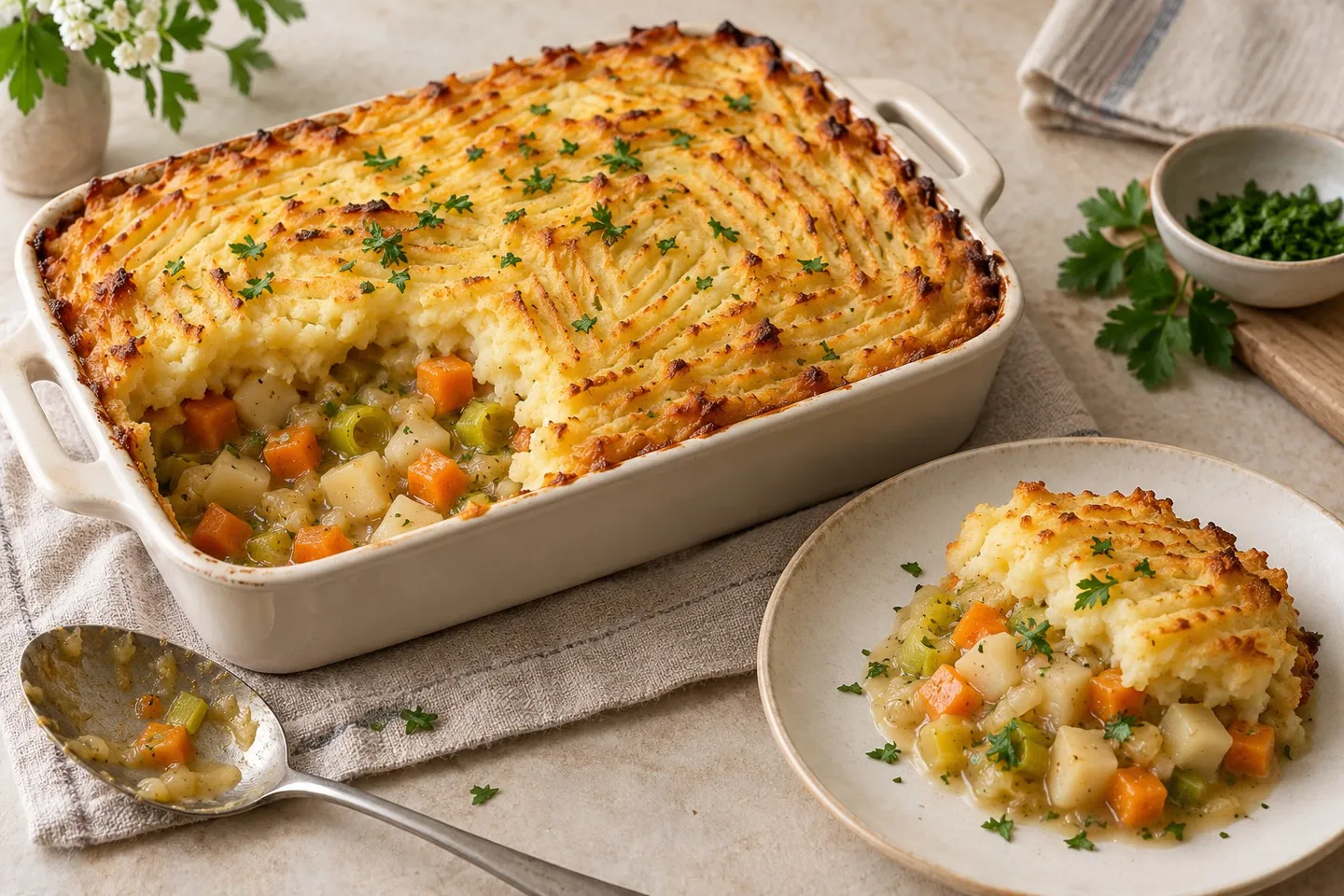
Woolton Pie with Mashed Potato Topping (1941 Adaptation)
A mashed-potato-topped adaptation of Woolton Pie, with root vegetables and rolled oats in savory yeast-extract gravy.
- Original yieldYield
- 6 servings6 servings
- PrepPrep time
- CookCook time
- TotalTotal time
The 70-minute total starts with cooked mashed potatoes ready for the topping. Allow extra time if making the mash from raw potatoes.
Published Updated
Original recipe: 6 servings
The story behind the recipe
This Woolton Pie has a mashed-potato topping, with browned fork ridges over a filling of root vegetables, oats and savory cooking juices. There is no pastry dough to mix or roll. Start with the topping potatoes already cooked and mashed: that is what makes the written preparation different from beginning with a bag of raw potatoes.
The mash is a separate layer
Potato appears twice in this recipe. Diced raw potato cooks with carrots, parsnips and turnips in the filling; a separate quantity of cooked mash makes the lid. The two have different jobs. The pieces beneath give the spoonful substance, while the softer topping spreads across the vegetables and browns at the ridges.
This is a modern mashed-potato adaptation of Woolton Pie. The topping is part of its identity, rather than an alternative left for the cook to guess from the picture.
Read more about this recipe
What remains of the wartime idea
The Ministry of Food recipe reproduced from April 1941 calls for four vegetables, spring onions, oatmeal and vegetable extract. Its filling is meatless, with the vegetables carrying the dish rather than filling space around a more expensive center. The source also allows changes according to what is in season.
Our filling uses potatoes, carrots, parsnips and turnips. The historical list specifies potatoes, cauliflower, swede and carrots. Turnip and swede are different vegetables, so the substitution belongs in the description of this adaptation instead of disappearing under a general label such as mixed roots.
Woolton Pie takes its name from Lord Woolton, Britain's Minister of Food, and is associated with the Savoy kitchens under François Latry. The wartime context is explored in Cooking on the Kitchen Front, although this pie has a separate source from the Heath recipes discussed there.
The oats belong in the filling
Rolled oats give the cooking liquid body without a separately made flour sauce. They sit among the vegetables, not on the surface as a crisp oat topping. The carrots remain recognizable, and the pale roots are diced rather than mashed into the gravy.
Yeast extract brings a concentrated savory flavor. A spoonful is an ingredient to measure, not a mild stock to pour freely. The recipe also specifies stock or water, so the extract and the cooking liquid should not be mistaken for two interchangeable ways of adding the same amount of seasoning.
This filling is a stronger adaptation than a simple change of lid. The historical formula gives one tablespoon of oatmeal and one teaspoon of extract for four pounds of vegetables. Our smaller vegetable mixture uses 30 g rolled oats and two teaspoons of extract. That changes the thickening and seasoning proportions; these are modern choices, not exact conversions of the source spoonfuls.
A forked surface, a spooned serving
The published method asks for warm mash spread over hot filling, with fork marks across the surface. A little of the listed butter or oil is brushed over the top. The raised ridges give the browning somewhere to show, while the potato underneath stays a soft lid.
This preparation is different from rolling a potato-containing pastry dough. The 1941 reproduction names a crust of potato or wheatmeal pastry; our spread mash is an interpretation, and isn't evidence that every historical potato crust meant mashed potato on its own.
The cooking juices stay with the vegetables in this version. The old directions cool the filling before covering it and offer brown gravy alongside the finished pie. Here, the pie goes together hot and is served in spoonfuls that take both the browned mash and the vegetables beneath it. It needn't hold a sharply cut wedge to be ready for the table.
Make it your wayOriginal: 6 servings
Original recipe: 6 servings
Ingredients
For 6 servings. Quantities are shown as written.
Source measurement convention: Metric. Explicit unit definitions take precedence; unconfirmed measures must be checked before conversion.
Original quantities for 6 servings.
- Russet potatoes (peeled and diced into 2 cm cubes)300 g
- Carrots (peeled and sliced into 1 cm rounds)200 g
- Parsnips (peeled and diced into 2 cm cubes)200 g
- Turnips (peeled and diced into 1.5 cm cubes)150 g
- Spring onions (or leeks, chopped fine)100 g
- Rolled oats (for thickening)30 gAuthor measures: about 1/3 metric cup (250 ml per cup).
- Yeast extract (Marmite or Vegemite)10 gAuthor measures: about 2 metric tsp (1 metric tsp = 5 ml).
- Vegetable stock (or hot water)500 ml
- Fresh parsley (finely chopped)15 g
- Fine salt1 metric tsp
- Ground black pepper1/4 metric tsp
- Cooked mashed potatoes (warm, for topping)400 g
- Melted unsalted butter (or vegetable oil, for brushing)15 g
Measurement notes
- fine salt, ground black pepper: tsp: 1 = 5 ml.
Measurement notes
Original ingredients
- 300 g russet potatoes (peeled and diced into 2 cm cubes)
- 200 g carrots (peeled and sliced into 1 cm rounds)
- 200 g parsnips (peeled and diced into 2 cm cubes)
- 150 g turnips (peeled and diced into 1.5 cm cubes)
- 100 g spring onions (or leeks, chopped fine)
- 30 g rolled oats (approx. 1/3 cup, for thickening)
- 10 g yeast extract (Marmite or Vegemite, approx. 2 tsp)
- 500 ml vegetable stock (or hot water)
- 15 g fresh parsley (finely chopped)
- 1 tsp fine salttsp: 1 = 5 ml.
- 1/4 tsp ground black peppertsp: 1 = 5 ml.
- 400 g cooked mashed potatoes (warm, for topping)
- 15 g melted unsalted butter (or vegetable oil, for brushing)
Equipment
 Large saucepan (4-quart)
 Casserole or baking dish (approx. 20x30 cm)
 Potato masher
Instructions
Prepare the oven and dish
Before you start, have the listed cooked mashed potatoes ready and warm for the topping. Preheat your oven to 200°C (400°F). Use a little of the melted unsalted butter or listed oil alternative to grease a deep baking dish (approx. 20x30 cm), reserving the rest for the topping.
Combine the vegetables
In a large saucepan, combine the diced russet potatoes, carrots, parsnips, turnips, and chopped spring onions.
Add stock and seasonings
Pour in the vegetable stock and stir in the yeast extract, fine salt, and ground black pepper.
Simmer the vegetables
Bring the saucepan to a boil over medium-high heat, then reduce to a gentle simmer. Cover and cook for 15 minutes until the root vegetables are just tender when pierced with a fork.
Thicken with oats and parsley
Stir the rolled oats and most of the chopped fresh parsley into the simmering vegetables, reserving a little parsley for serving. Cook uncovered for 3 to 4 minutes, stirring constantly as the oats hydrate and thicken the broth into a rich, glossy gravy.
Transfer the filling to the dish
Transfer the hot vegetable mixture into the prepared baking dish.
Spread the mashed-potato topping
Spoon the warm cooked mashed potatoes over the top, spreading evenly to seal the edges of the dish. Use the tines of a fork to drag decorative ridges across the potato surface.
Brush the topping with fat
Brush the top lightly with the remaining melted unsalted butter or oil to promote browning.
Bake until bubbling and browned
Bake for 25 to 30 minutes until the filling bubbles vigorously around the edges and the potato ridges turn a rich golden brown.
Garnish with reserved parsley
Garnish with the reserved parsley and serve hot from the baking dish.
Estimated calories 180 kcal
Nutrition portion: 1/6 of recipe · Original yield: 6 servings
Source & assumptions
Ingredient-based estimate using CoFID 2021, identified manufacturer information. Approximately 180 kcal per nutrition portion. Uses spring onions, vegetable stock, plain boiled mashed potatoes and butter. Enriched mash changes the estimate. Ingredients, brands and preparation affect values.
Recipe notes
When adjusting quantities
Scale root vegetables and broth proportionally. Bake until the potato crust is deeply browned and the gravy bubbles around the edges.
Original recipe notes
These notes describe the original recipe. Quantities mentioned here do not change when you adjust servings.
The listed time begins with the mashed-potato topping already cooked. Prepare it before starting, or allow additional time for boiling and mashing the topping potatoes.
The historical recipe also offers wheatmeal pastry, which isn't the same as modern whole-wheat flour. For a modern pastry lid, choose a complete pastry recipe and follow its filling preparation, assembly and baking instructions. The oven setting and timing above are for the mashed-potato topping.
Read the scaling guide. Times, temperatures and equipment need their own consideration. Open the recipe tool to review and correct individual amounts.
Sources and attribution
Ministry of Food recipe reproduced from The Times, April 26, 1941, via Foods of England; traditionally credited to the Savoy kitchens under François Latry.
Adapted from the Ministry of Food recipe attributed to The Times, April 26, 1941, as reproduced by Foods of England. The reproduction was consulted; an original newspaper printing has not been inspected. The mashed-potato lid, changed vegetable selection, oat and extract proportions, hot assembly and retained cooking juices identify this modern adaptation.
Recipe details
- Recipe tradition
- Vintage
- Course or meal
- Dinner
- Cuisine
- British
- Source decade
- 1940s
- Occasion
- Wartime cooking
- Browse category
- Main Dishes