

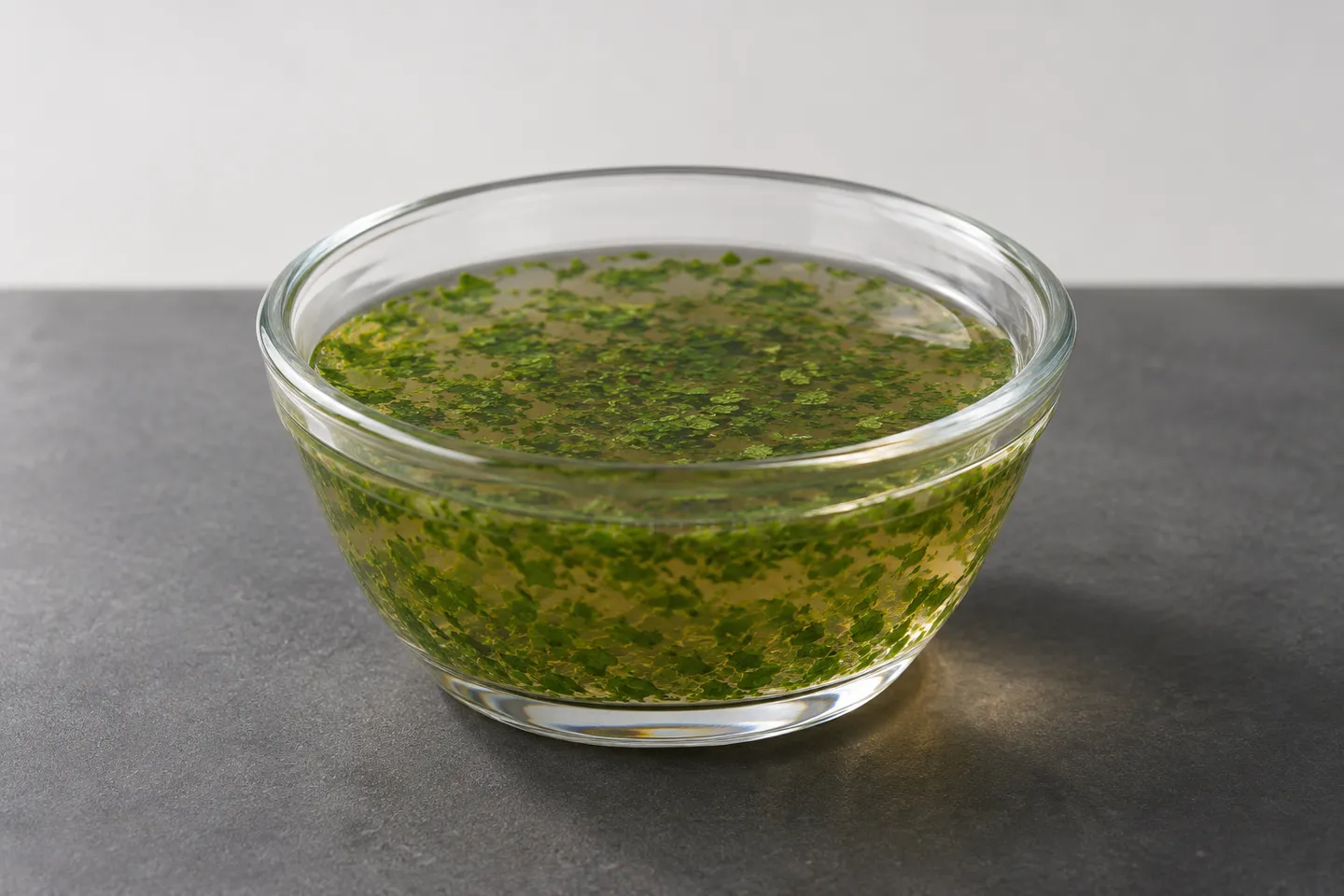
Mint Sauce (1861)
Finely chopped fresh mint, sugar and wine vinegar, infused in the refrigerator for a loose sauce adapted from Beeton's roast-lamb accompaniment.
- Original yieldYield
- 1 small batch, about 160–180 ml (estimated)1 small batch, about 160–180 ml (estimated)
- PrepPrep time
- TotalTotal time
Estimated: 10 minutes preparation plus 2–3 hours infusing in the refrigerator.
Published
Original recipe: 1 small batch, about 160–180 ml (estimated)
The story behind the recipe
This mint sauce is loose enough to spoon, with finely chopped leaves suspended in sweetened vinegar. It doesn't need a blender or a pan. The fresh leaves remain in the sauce, so each spoonful includes both mint and the sharp liquid around it. Stir before serving rather than pouring the clear vinegar off the top.
An accompaniment with its own recipe
Beeton names roast lamb in the heading of her 1861 Mint Sauce. The sauce receives a complete entry of its own: ingredients, preparation, a waiting period and a note about mint vinegar when fresh leaves aren't available.
Read more about this recipe
The leaves and the vinegar
The book asks for young, fresh-gathered mint, washed free of grit and picked from its stalks. The leaves are minced very finely. In a sauce this spare, large pieces of stalk would be conspicuous, and a coarse chop would produce a different spoonful from the fine particles described on the page.
This version uses fresh culinary mint leaves and white wine vinegar of a stated acidity. Beeton doesn't name the vinegar type or strength in the ingredient list. Choosing one makes the modern recipe more specific; it doesn't establish which vinegar every reader of the old book would have used. A dark malt vinegar would also change the appearance and flavor, so it isn't silently folded into the same ingredient description.
The sugar is measured, but the source doesn't treat sweetness as beyond discussion. Beeton says some people would prefer more and explains that the printed proportion reflects the taste she chose for the recipe. That comment leaves a glimpse of editorial judgment beside the quantities. A sauce can have precise amounts while its author still acknowledges different preferences at the table.
Time without cooking
Beeton recommends making the sauce two or three hours ahead so the vinegar takes on the mint flavor. This is an infusion, with chopped leaves left in the liquid. It differs from heating flour in a white sauce or softening bread in milk: there is no cooked thickener here and no reason to expect the sauce to become creamy.
The waiting period is retained, with the covered sauce kept in the refrigerator. It can therefore be prepared before the rest of a meal, leaving just a stir before serving. That is a more useful planning detail than calling a three-ingredient sauce instant and overlooking the time its source actually asks for.
Dessertspoons don't give a serving count
The old ingredient list uses dessertspoonfuls of chopped mint and pounded white sugar, followed by a quarter pint of vinegar. A named spoon identifies a utensil, while a pint also needs its measurement system. Neither supplies a weight for chopped leaves, whose packing changes how a spoon is filled.
Her yield is expressed through a middling-sized joint of lamb. That doesn't tell us the finished liquid volume or a fixed number of sauce portions. This recipe therefore gives an estimated small batch independently of any meat recipe. Spoon out what the meal needs and keep the remaining sauce chilled.
Make it your wayOriginal recipe: 1 small batch, about 160–180 ml (estimated)
Original recipe: 1 small batch, about 160–180 ml (estimated)
Ingredients
For 1 small batch, about 160–180 ml (estimated). Quantities are shown as written.
Source measurement convention: Metric. Explicit unit definitions take precedence; unconfirmed measures must be checked before conversion.
Original quantities for 1 small batch, about 160–180 ml (estimated).
- Finely chopped fresh mint leaves40 ml
- Caster sugar4 metric tsp
- White wine vinegar (5% acidity)140 ml
Measurement notes
- caster sugar: tsp: 1 = 5 ml.
Measurement notes
Original ingredients
- 40 ml finely chopped fresh mint leaves
- 4 tsp caster sugartsp: 1 = 5 ml.
- 140 ml white wine vinegar (5% acidity)
Instructions
Chop and measure the mint
Rinse the mint under running water, dry it well and remove the stalks. Chop the leaves very finely, then measure the amount in the ingredient list without pressing the leaves into a dense paste.
Dissolve and infuse
Combine the chopped leaves, caster sugar and white wine vinegar. Stir until the sugar dissolves. Cover and refrigerate at 40°F (4°C) or below for 2–3 hours.
Stir and serve
Stir thoroughly before serving so each spoonful includes leaves and liquid. Keep the sauce refrigerated until needed and return leftovers promptly to the refrigerator.
Recipe notes
When adjusting quantities
Scale mint, sugar and vinegar together and keep the same chop and measured-spoon convention. Use a covered container with room to stir. Infusion time doesn't multiply with the batch. Finished volume is an estimate, not the sum of the ingredient volumes.
Original recipe notes
These notes describe the original recipe. Quantities mentioned here do not change when you adjust servings.
Four source dessertspoonfuls of mint and two of sugar are interpreted as 40 ml and 20 ml. Four modern 5 ml teaspoons supply the sugar volume. A quarter Imperial pint is about 142 ml, rounded here to 140 ml. These conventions and the 5% wine vinegar are explicit modern choices. The finished yield is estimated because chopped leaves and dissolved sugar don't contribute their bulk volumes unchanged.
Fresh herb sauce isn't a preserving method. Refrigeration guidance follows FDA safe food handling advice.
Storage
Make on the day it is needed, cover and refrigerate at 40°F (4°C) or below throughout the infusion. Keep refrigerated until serving and return leftovers promptly. This is a fresh sauce, not a shelf-stable preserve.
Read the scaling guide. Times, temperatures and equipment need their own consideration. Open the recipe tool to review and correct individual amounts.
Sources and attribution
Isabella Beeton, The Book of Household Management (London: S. O. Beeton, 1861), no. 469, Mint Sauce, to serve with Roast Lamb, p. 225
No. 469, Mint Sauce, to serve with Roast Lamb, p. 225, in Isabella Beeton, The Book of Household Management, London, 1861.
Recipe details
- Recipe tradition
- Vintage
- Course or meal
- Sauce / condiment
- Cuisine
- British
- Cooking method
- No-cook
- Browse category
- Snacks & Dips