

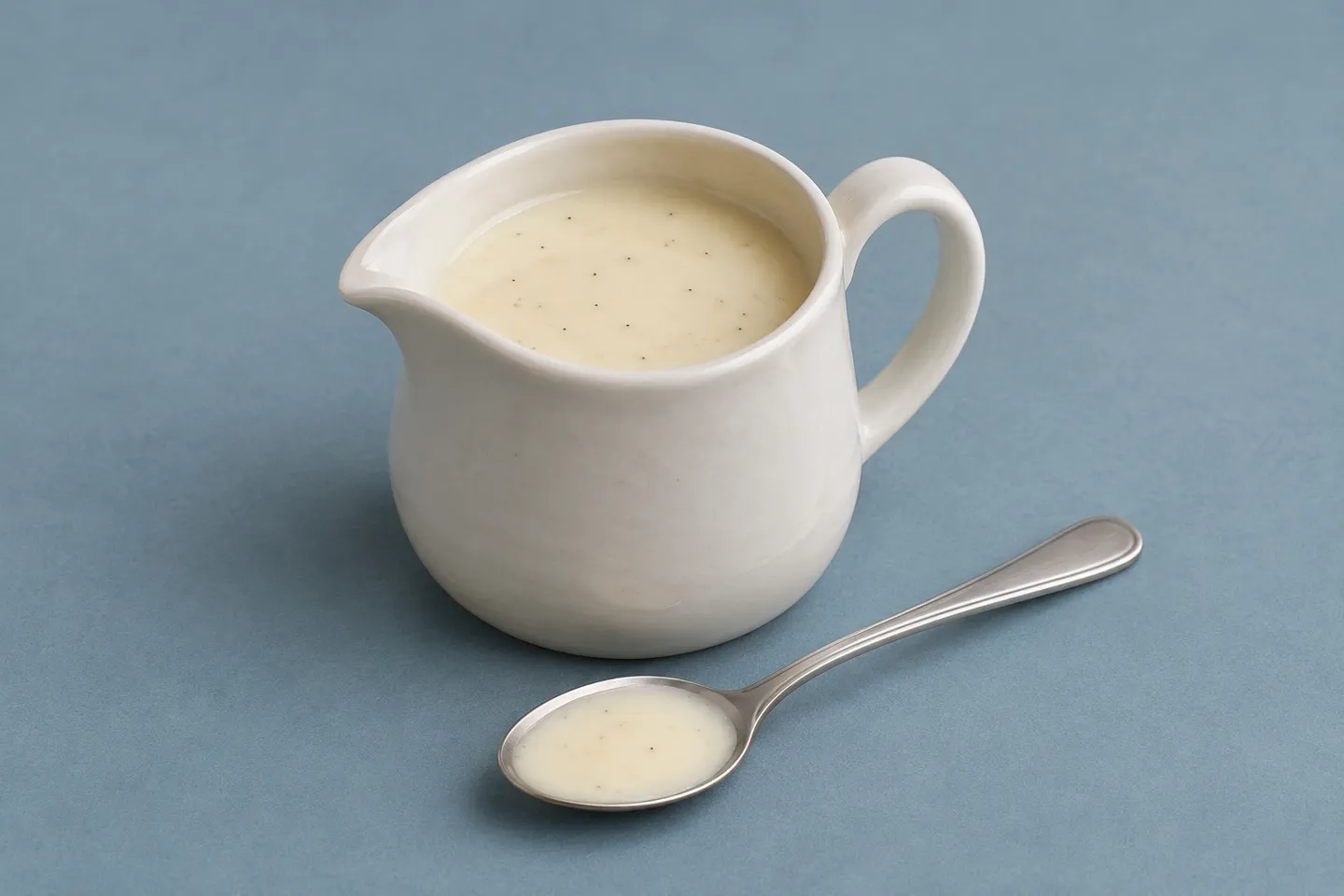
White Sauce I (1896)
A small batch of plain butter, flour and milk sauce, adapted from Farmer's White Sauce I with gradual milk additions.
- Original yieldYield
- 1 small batch, about 250 ml (estimated)1 small batch, about 250 ml (estimated)
- PrepPrep time
- CookCook time
- TotalTotal time
Estimated: 5 minutes measuring and 6–8 minutes cooking; serve promptly.
Published
Original recipe: 1 small batch, about 250 ml (estimated)
The story behind the recipe
White Sauce I sits between two other sauces on Farmer's page: Thin White Sauce above it and White Sauce II below. All three use a cup of milk and two tablespoons of butter. The flour changes. For Sauce I, it's two tablespoons, enough to distinguish this plain coating sauce from the thinner version whose method it borrows.
A short recipe with a dependency
Farmer's 1896 entry ends with “Make same as Thin White Sauce.” That sends the reader up the page for the sequence of melting butter, blending in flour and adding milk. The quantities still belong to Sauce I. Following the earlier method doesn't mean copying its smaller flour amount as well.
Read more about this recipe
Keep the sauce pale
This sauce is useful when the food needs moisture and a mild coating without a browned flavor. Butter and milk are prominent because the ingredient list is so short. Unsalted butter lets the added salt be measured separately, and whole milk gives this version a defined starting point rather than leaving the dairy choice open.
The flour is stirred into melted butter before the milk is added. At that stage, the mixture should be smooth and pale. Browning it would change the sauce's flavor and color. A brief cook over gentle heat is the modern method used below, followed by a simmer once the milk has been incorporated.
Scrape the pan's corners as well as its middle. With a small batch, a little flour left against the side can escape the first stir and become a lump later. A saucepan that's comfortable to whisk in matters more here than a large collection of equipment.
Read the neighboring choices
Farmer's Thin White Sauce has one and a half tablespoons of flour; White Sauce I has two; White Sauce II has three. The milk quantity stays the same across those entries. The page offers different consistencies through an ingredient choice, rather than asking the cook to reduce one sauce indefinitely until it becomes another.
There are method choices too. The printed instructions allow the milk to be added all at once if a wire whisk is used, and say scalding it isn't necessary. The method below takes the gradual route, adding roughly a third at a time. That gives the cook a chance to smooth each addition before diluting it further. Neither an extra saucepan nor a separate milk-scalding stage is required.
A batch before a serving count
One cup of milk is an ingredient amount. It doesn't guarantee one cup of finished sauce: butter and flour add material, while heat removes some moisture. The approximate yield below is therefore a planning estimate. The useful finishing cue is a smooth sauce that coats a spoon and can still be poured.
Farmer uses White Sauce I elsewhere for creamed potatoes, specifying the amount of finished sauce separately from the potatoes. The plain batch here can be spooned over cooked vegetables or folded into another preparation, with that dish deciding how much is needed. It isn't a complete soup or a seasoning formula for everything it might accompany.
A sauce made ahead will need attention on reheating. Warm it while stirring and add a little milk if necessary. That is a texture adjustment, not another historical ratio to apply automatically to a freshly made batch.
Make it your wayOriginal recipe: 1 small batch, about 250 ml (estimated)
Original recipe: 1 small batch, about 250 ml (estimated)
Ingredients
For 1 small batch, about 250 ml (estimated). Quantities are shown as written.
Source measurement convention: US customary. Explicit unit definitions take precedence; unconfirmed measures must be checked before conversion.
Original quantities for 1 small batch, about 250 ml (estimated).
- Unsalted butter2 tbspAuthor measures: 28 g.
- All-purpose flour2 tbspAuthor measures: 16 g.
- Whole milk, plus a little for reheating if needed1 cupAuthor measures: 237 ml.
- Fine salt1/4 tsp
- Small pinch ground black pepper1
Measurement notes
- unsalted butter, all-purpose flour: US tbsp: 1 = 14.7868 ml (rounded).
- whole milk, plus a little for reheating if needed: US cup: 1 = 236.5882 ml (rounded).
- fine salt: US tsp: 1 = 4.9289 ml (rounded).
Measurement notes
Original ingredients
- 2 tbsp (28 g) unsalted butterUS tbsp: 1 = 14.7868 ml (rounded).
- 2 tbsp (16 g) all-purpose flourUS tbsp: 1 = 14.7868 ml (rounded).
- 1 cup (237 ml) whole milk, plus a little for reheating if neededUS cup: 1 = 236.5882 ml (rounded).
- 1/4 tsp fine saltUS tsp: 1 = 4.9289 ml (rounded).
- 1 small pinch ground black pepper
Equipment
 Small saucepan
 Whisk
Instructions
Blend the butter and flour
Melt the butter in a small saucepan over medium-low heat until melted and beginning to bubble. Stir in the flour, salt and pepper. Cook, stirring, for about 1 minute, keeping the mixture pale.
Add milk gradually
Add about one-third of the milk, whisking and scraping the corners until smooth. Add the remaining milk in two more additions, smoothing the sauce after each.
Simmer until smooth
Bring to a gentle simmer over medium-low heat, stirring frequently. Cook for about 2–4 minutes, until the sauce is smooth, coats a spoon and remains pourable. Lower the heat if it catches or boils vigorously. Serve promptly; follow the storage note if keeping it for later.
Recipe notes
When adjusting quantities
For a larger batch, use a pan with room for whisking and scrape its corners. Add milk gradually and judge the finished consistency; the cooking time doesn't multiply with the ingredients. For less than a half batch, use a suitably small pan to limit rapid evaporation.
Original recipe notes
These notes describe the original recipe. Quantities mentioned here do not change when you adjust servings.
The source's two tablespoons of flour are retained; Thin White Sauce's one and a half tablespoons aren't used. The 16 g flour and 28 g butter are practical modern equivalents, not a calibration of Farmer's spoons. Whole milk, unsalted butter, the small pepper pinch and cooking times are modern specifications. The milk uses a defined US cup. Evaporation affects the approximate finished yield.
Contains wheat and milk. Refrigeration and reheating guidance follows FDA safe food handling advice.
Storage
Serve promptly or transfer to a shallow container and refrigerate within 2 hours, or 1 hour above 90°F (32°C), at 40°F (4°C) or below. Reheat while stirring until the sauce boils; add a little milk only if needed to loosen it.
Read the scaling guide. Times, temperatures and equipment need their own consideration. Open the recipe tool to review and correct individual amounts.
Sources and attribution
Fannie Merritt Farmer, The Boston Cooking-School Cook Book (Boston: Little, Brown, and Company, 1896), White Sauce I and Thin White Sauce method, p. 237
White Sauce I and its Thin White Sauce method, p. 237, in Fannie Merritt Farmer, The Boston Cooking-School Cook Book, Boston, 1896.
Recipe details
- Recipe tradition
- Vintage
- Course or meal
- Sauce / condiment
- Cuisine
- American
- Cooking method
- Stovetop
- Browse category
- Snacks & Dips