

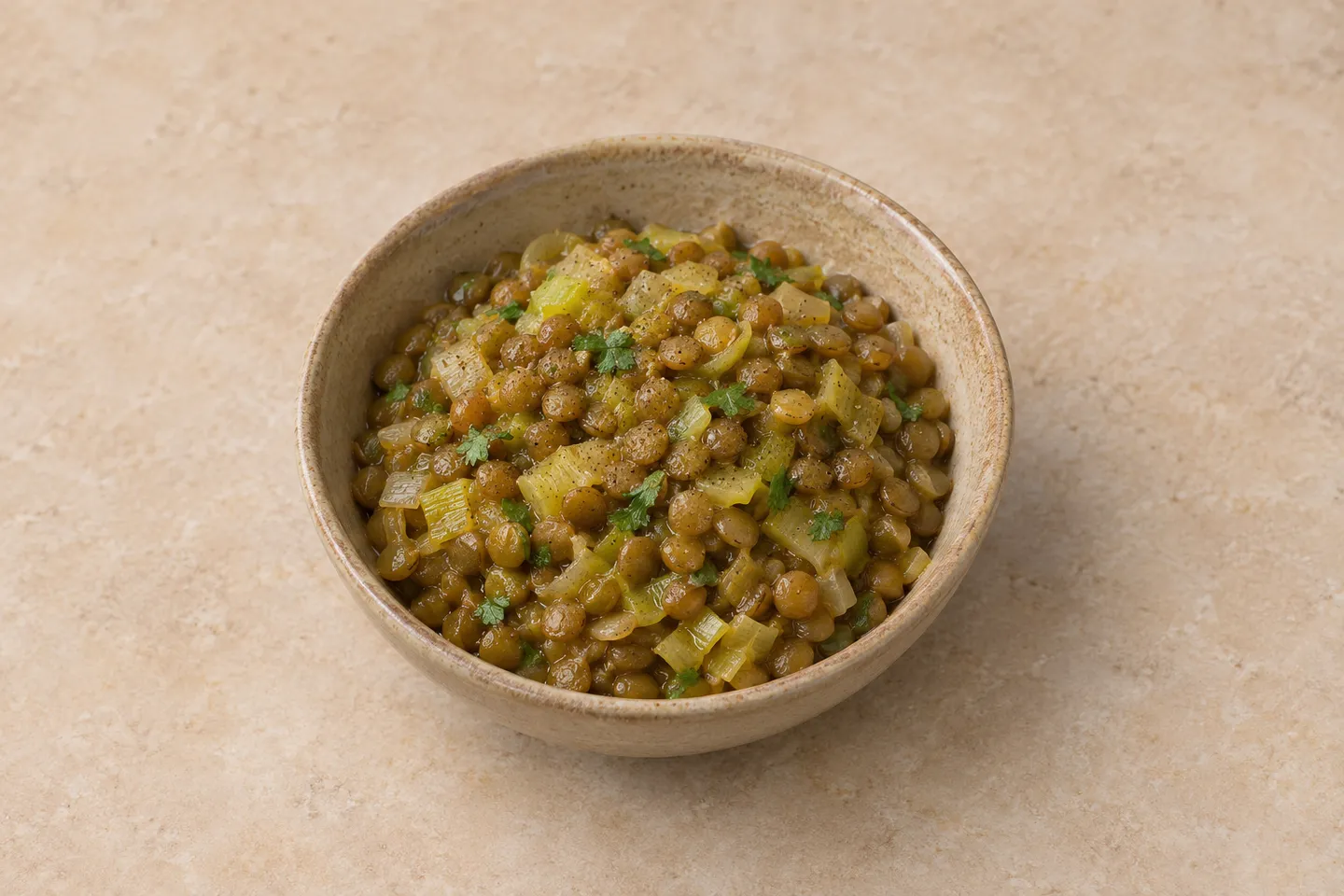
Lentils with Leek and Coriander (Roman)
A modern Apicius-based lentil dish with leek, fresh cilantro, ground coriander, fish sauce and grape saba, lightly thickened and finished with olive oil.
- Original yieldYield
- 4 side portions4 side portions
- PrepPrep time
- CookCook time
- TotalTotal time
Estimated: 15 minutes preparation and 25–40 minutes cooking, depending on the lentils. Uses prepared grape saba; no separate syrup-making time is included.
Published
Original recipe: 4 side portions
The story behind the recipe
Fresh coriander and coriander seed appear in the same lentil recipe in Apicius. The green herb enters with leek after the first foam has subsided; the seed is ground for a separate seasoning mixture. That distinction is still worth keeping. The chopped leaves in the pot and the spice in the dressing aren't duplicate lines to combine into one measure.
A little sauce around the lentils
The dish ends with starch and a final pour of oil. This version aims for tender lentils with a light coating of seasoned liquid, not a puree or a bowl of broth. Leek remains among the lentils, and pepper is sprinkled over the finished dish.
Read more about this recipe
Read the recipe before the Roman label
The selected text is Book V, section II, recipe 3, Aliter lenticulam, in Giarratano and Vollmer's 1922 Latin edition of De re coquinaria. It tells the cook to boil lentils, add leek and green coriander, grind a seasoning mixture, balance liquids, thicken and serve. It doesn't supply ingredient quantities or a serving count.
That leaves considerable work for a modern recipe. A measured batch has to choose a lentil, a saucepan, water and portions as well as the small seasonings. Green or brown lentils can remain recognizable in this version; red split lentils would call for a different approach to texture. The modern weights describe the adaptation, not an ancient Roman household's batch.
The preceding recipe is a useful warning against reading by title alone. It is associated with lentils but describes cooking and pounding chestnuts without clearly introducing lentils into the operation. This recipe names and cooks the lentils directly. Its leek, herbs and seasoning are enough to make a distinct dish without borrowing chestnuts or cumin from its neighbor.
Green herbs, sweet syrup and a savory dressing
The original has a more extensive herb and spice mixture than the bowl here. It includes pennyroyal, rue seed and laser root. Those are omitted, while fresh mint leaves take the place of the printed mint-seed wording. The result is a deliberately narrower flavor combination, with no claim to recover every ancient plant or the original balance.
Commercial fish sauce is the modern stand-in for liquamen. Grape saba represents the reduced grape must named as defritum in the text. Choose plain cooked grape must, rather than a balsamic glaze with vinegar already incorporated. Honey and a separately measured wine vinegar complete this version's seasoning mixture.
The Latin repeats vinegar in its directions, but that repetition doesn't give us two measured additions. Here there is one allowance in the ingredient list. Likewise, cornstarch is a modern choice for the unspecified thickening starch, not evidence that Roman cooks used maize.
A gift poem is another kind of evidence
Martial's food-gift poems include lentils from Pelusium. That offers an interesting point of contact with a Roman ingredient, but a poem naming a gift doesn't establish how those lentils were prepared. It doesn't turn this later compiled recipe into the contents of a particular Saturnalia parcel.
The useful connection is modest: lentils could be named and valued in one text, while a culinary text supplies an elaborate way to season them. For other preparations from the collection, Dining in Imperial Rome follows the same distinction between source ingredients and measured modern cooking.
Make it your wayOriginal: 4 servings · Makes 4 side portions
Original recipe: 4 side portions
Ingredients
For 4 side portions. Quantities are shown as written.
Source measurement convention: Metric. Explicit unit definitions take precedence; unconfirmed measures must be checked before conversion.
Original quantities for 4 side portions.
- Dried green or brown lentils, picked over and rinsed200 g
- Water, plus more if needed during cooking750 ml
- Leek, white and light-green parts, washed and finely sliced100 g
- Fresh cilantro leaves and tender stems, chopped5 g
- Coriander seeds1 metric tsp
- Finely chopped fresh mint leaves1 metric tsp
- White wine vinegar15 ml
- Honey1 metric tsp
- Fish sauce10 ml
- Plain grape saba (cooked grape must, not balsamic glaze)15 ml
- Extra-virgin olive oil, divided equally30 ml
- Cornstarch1 metric tsp
- Cold water, for the starch slurry15 ml
- Ground black pepper1/4 metric tsp
Measurement notes
- coriander seeds, finely chopped fresh mint leaves, honey, cornstarch, ground black pepper: tsp: 1 = 5 ml.
Measurement notes
Original ingredients
- 200 g dried green or brown lentils, picked over and rinsed
- 750 ml water, plus more if needed during cooking
- 100 g leek, white and light-green parts, washed and finely sliced
- 5 g fresh cilantro leaves and tender stems, chopped
- 1 tsp coriander seedstsp: 1 = 5 ml.
- 1 tsp finely chopped fresh mint leavestsp: 1 = 5 ml.
- 15 ml white wine vinegar
- 1 tsp honeytsp: 1 = 5 ml.
- 10 ml fish sauce
- 15 ml plain grape saba (cooked grape must, not balsamic glaze)
- 30 ml extra-virgin olive oil, divided equally
- 1 tsp cornstarchtsp: 1 = 5 ml.
- 15 ml cold water, for the starch slurry
- 1/4 tsp ground black peppertsp: 1 = 5 ml.
Equipment
 Medium saucepan (2-quart)
 Fine-mesh strainer
- Mortar and pestle
Instructions
Cook lentils with leek and cilantro
Put the lentils and the listed cooking water in the saucepan. Bring to a boil, skim the surface foam, then reduce to a gentle simmer. When the foaming has subsided, add the leek and cilantro.
Check tenderness and cooking water
Simmer until the lentils and leek are tender, usually 20–35 minutes from the start of simmering. Stir occasionally and add more water in small amounts if needed to keep the lentils moist while they cook.
Grind the seasoning and mix the slurry
Grind the coriander seeds in the mortar. Mix them with the mint, vinegar, honey, fish sauce and grape saba. In a separate small bowl, mix the cornstarch with the cold water until smooth.
Drain and season the lentils
Set the strainer over a heatproof jug and drain any excess cooking liquid from the tender lentils, reserving it. Return the moist lentils and leek to the saucepan. Stir in the seasoning mixture and half the olive oil, then simmer gently for about 2 minutes. Add a little reserved liquid if needed so a small amount of sauce remains around the lentils.
Thicken lightly
Stir the starch slurry again and add it gradually while the mixture gently bubbles, stopping when the sauce lightly coats the lentils. You may not need it all. Cook for 1–2 minutes after the final addition, stirring; add a little reserved liquid if the mixture becomes stiff.
Finish with oil and pepper
Divide into four side portions at the original quantity, or the selected portions after scaling. Finish with the remaining half of the olive oil and the pepper, and serve warm.
Recipe notes
When adjusting quantities
Scale the ingredients together and use a saucepan with room for simmering. Keep half the olive oil for the finish. Add the proportional starch slurry only until a light coating forms; times and water top-ups depend on the lentils and pan, rather than multiplying automatically.
Original recipe notes
These notes describe the original recipe. Quantities mentioned here do not change when you adjust servings.
Adapted from Apicius V.2.3 using chosen modern quantities. Pennyroyal, rue seed and laser root are omitted; fresh mint leaves replace mint seed. Fish sauce and plain grape saba represent liquamen and defritum, while cornstarch replaces an unspecified starch. Lentil variety, water, timing, texture and four side portions are modern decisions.
Contains fish. Check the fish-sauce and grape-saba labels for other ingredients and allergens. No salt is added automatically because the fish sauce supplies seasoning. Plain grape saba is used as purchased; balsamic glaze isn't the ingredient specified here.
Storage
Serve warm. Refrigerate leftovers in shallow containers within 2 hours, or 1 hour above 90°F (32°C), at 40°F (4°C) or below. Reheat to 165°F (74°C), stirring and loosening with a little water if needed.
Read the scaling guide. Times, temperatures and equipment need their own consideration. Open the recipe tool to review and correct individual amounts.


Sources and attribution
Apicius, De re coquinaria V.2.3, Aliter lenticulam, in Giarratano and Vollmer's edited Latin (Leipzig: Teubner, 1922), p. 37, recipe 192.
Apicii librorum X qui dicuntur De re coquinaria quae extant, edited by C. Giarratano and Fr. Vollmer, Leipzig: Teubner, 1922, p. 37, V.2.3, continuous recipe 192. The recipe is separate from Martial, Xenia XIII.9, the lentil gift poem.
Recipe details
- Recipe tradition
- Vintage
- Course or meal
- Side dish
- Cuisine
- Ancient Roman
- Historical period
- Roman
- Cooking method
- Stovetop
- Browse category
- Main Dishes