

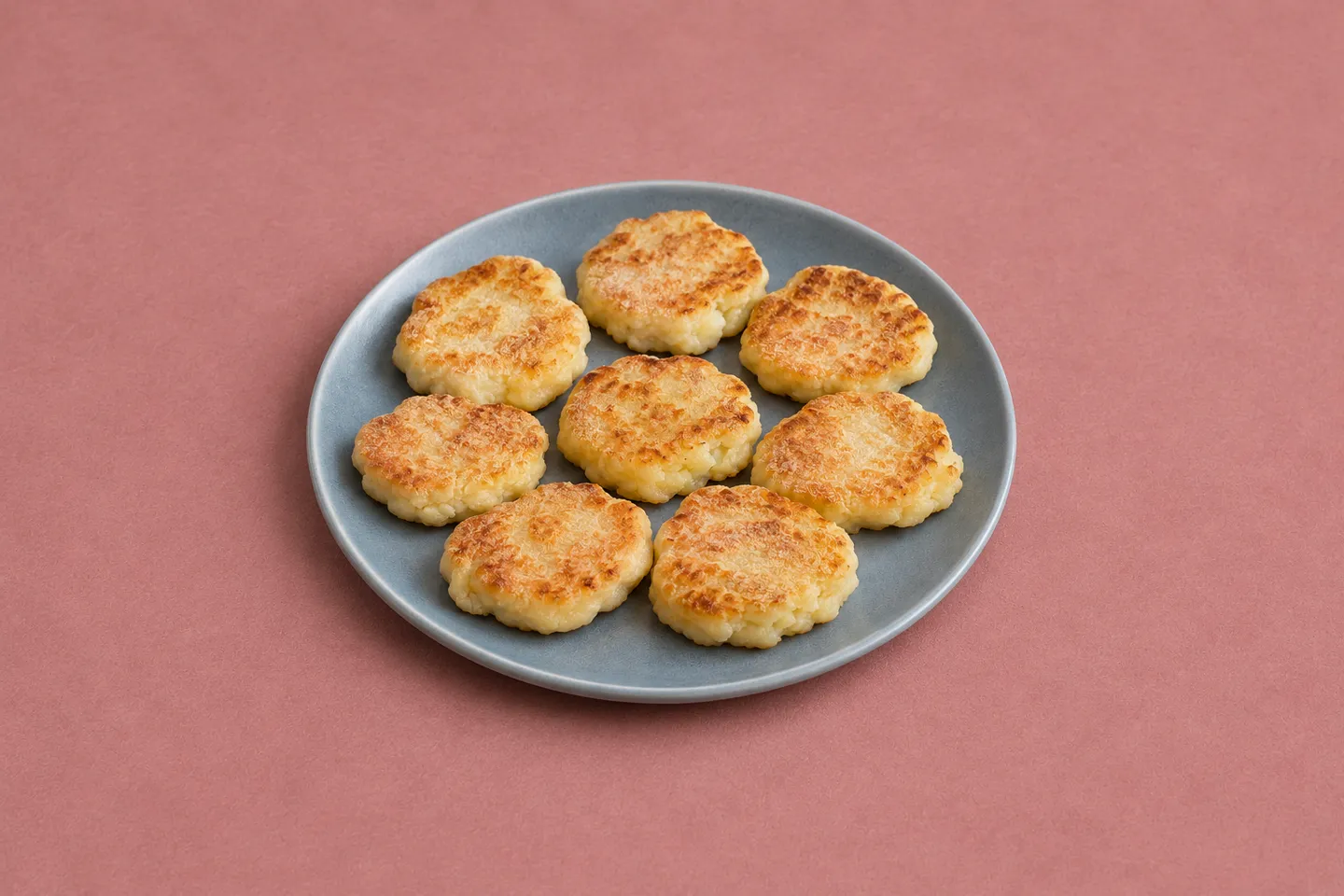
Salsify Mock Oyster Cakes (1883)
Small flour-dredged cakes of cooked salsify mash, egg and butter, adapted from Marion Harland's 1883 Fried Salsify, or Mock Oysters.
- Original yieldYield
- Approximately 8 small cakes, divided into 3 side portionsApproximately 8 small cakes, divided into 3 side portions
- PrepPrep time
- CookCook time
- TotalTotal time
Planning estimate: 25 minutes preparation, 15 minutes soaking, up to 35 minutes boiling, 45 minutes draining and cooling, 30 minutes chilling and 30 minutes frying, including the first small portion. Cooling and chilling may take longer; use the coldness and handling cues rather than the clock.
Published
Original recipe: Approximately 8 small cakes, divided into 3 side portions
The story behind the recipe
A browned outside surrounds cooked salsify mash in these small fried cakes. The roots are boiled, cooled and worked smooth before egg and butter are mixed in. Flour stays on the surface as a light dredge. This is a root-based side dish with a soft interior, rather than an oyster hidden under a coating.
Buy the root for the dish
Use purchased culinary salsify from a food supplier. Begin with whole fresh roots, then measure the cooked mash the recipe needs. The shopping weight is an estimate: peeling, trimming and removing fibers happen before the final cup is filled. There's no reliable raw-root count hidden in that prepared measure.
Read more about this recipe
An oyster name without shellfish
Marion Harland calls this Fried Salsify, or Mock Oysters in the 1883 printing of Common Sense in the Household. Her method makes round cakes. It doesn't ask for an oyster's outline, and no oysters enter the mixture. The old name identifies the comparison without proving diners would mistake one food for the other.
The neighboring stewed-salsify entry keeps root pieces and compares their taste with stewed oysters. Here the treatment is smooth mash, egg, a flour coating and frying. One ingredient could be prepared in several ways under an oyster association. That history is more useful than promising an exact seafood flavor from a vegetable cake.
Follow the heading onto the next page
The heading begins on page 223, but most work continues on page 224. Roots stand in cold water, boil until tender, drain, cool and are mashed with fibers removed. Milk, butter and beaten eggs enter afterward. The long route from root to cake disappears if a heading is copied without its continuation.
Harland's title leaf gives 1883; her revised-edition introduction is dated October 1880, and copyright history reaches earlier. This recipe follows the 1883 edition. It doesn't establish that the same wording appeared in every earlier edition or that Harland invented the preparation that year.
Measure after mashing
The egg allowance is tied to a cupful of salsify. Uncooked roots aren't that ingredient yet. Drain thoroughly, cool completely, then work smooth and remove tough strands before measuring. You need a cold paste that holds a soft mound, without liquid pooling around it. The quantity belongs to that prepared stage, after discarded peel, fibers and free water have left the mixture.
Weighed beaten egg makes the one-and-a-half-egg allowance practical. Beat whole eggs and weigh the portion instead of dividing yolk and white separately. With changed quantities, keep prepared mash and egg together; don't calculate from the raw shopping weight. Extra cooked root belongs outside this batch unless the entire mixture is adjusted.
A gentle turn in the pan
The mixture is soft, so add measured milk only if needed. Flour belongs outside each cake, rather than mixed through as a binder. Spoons and a thin spatula support the small portions; these aren't firm croquettes to roll by hand. Thorough chilling helps with handling, but the first small portion still needs to set and turn in the pan before you commit the rest.
These offer another small fried shape beside the bean rolls and walnut loaf in Nuts, Bread and Beans. Their cooked root base and egg mixture need their own handling; the coating doesn't turn them into the same preparation as a bean roll. Serve the cakes after frying rather than letting them wait while another course is prepared.
Make it your wayOriginal: 3 servings · Makes Approximately 8 small cakes, divided into 3 side portions
Original recipe: Approximately 8 small cakes, divided into 3 side portions
Ingredients
For Approximately 8 small cakes, divided into 3 side portions. Quantities are shown as written.
Source measurement convention: Metric. Explicit unit definitions take precedence; unconfirmed measures must be checked before conversion.
Original quantities for Approximately 8 small cakes, divided into 3 side portions.
Salsify preparation
- Fresh culinary salsify roots, approximate shopping amount450 g
- Water, as needed for soaking and boiling
Cake mixture and frying
- Cooked salsify mash, cooled, smooth and free of fibers, from the preparation above237 ml
- Unsalted butter, softened14 g
- Beaten whole egg75 g
- Whole milk, use only as needed10 ml
- Fine salt1/4 tsp
- Ground black pepper1/8 tsp
- All-purpose flour, for dredging30 g
- Neutral cooking oil, for frying30 ml
Measurement notes
- fine salt, ground black pepper: US tsp: 1 = 4.9289 ml (rounded).
Measurement notes
Original ingredients
- 450 g fresh culinary salsify roots, approximate shopping amount
- Water, as needed for soaking and boiling
- 237 ml cooked salsify mash, cooled, smooth and free of fibers, from the preparation above
- 14 g unsalted butter, softened
- 75 g beaten whole egg
- 10 ml whole milk, use only as needed
- 1/4 US tsp fine saltUS tsp: 1 = 4.9289 ml (rounded).
- 1/8 US tsp ground black pepperUS tsp: 1 = 4.9289 ml (rounded).
- 30 g all-purpose flour, for dredging
- 30 ml neutral cooking oil, for frying
Equipment
 3-liter heavy saucepan
 Colander
 Mixing bowl
 12-inch non-stick or cast-iron skillet
 Thin spatula
 Food thermometer
Instructions
Clean and soak salsify
Scrub the salsify roots under running water, scrape or peel, and place in cold soaking water for about 10 to 15 minutes. Use purchased culinary roots; this isn't a guide to identifying or gathering wild plants.
Boil drain chill and mash the roots
Drain and transfer to a saucepan with fresh boiling water to cover. Bring to a boil, then simmer until readily pierced, about 20 to 35 minutes depending on thickness. Drain thoroughly, spread in a shallow dish and refrigerate promptly until thoroughly cold. Mash smooth, removing tough fibers. The paste should hold a soft mound on a spoon, with no free liquid pooling around it; if wet, drain further before measuring.
Measure cold mash and mix
Measure the listed cooked salsify mash only after it is cold and well drained. Reserve excess outside the recipe; if short, prepare more roots before completing the mixture. Stir in butter, beaten egg, salt and pepper. Leave out the milk unless the mixture needs a little to combine; if needed, add it gradually, using no more than the listed allowance. Don't taste raw mixture.
Chill and check handling
Cover and refrigerate until thoroughly cold and handleable, checking first after 20 minutes and allowing longer as needed. A spoonful should remain a soft mound long enough to be supported on a thin spatula. If the cold mixture still flows or immediately flattens into a puddle, don't proceed with the cakes. Chilling time alone doesn't establish readiness.
Coat and transfer one small portion
Put the flour on a plate and heat some measured oil over medium heat in a non-stick or seasoned cast-iron skillet. Start with one small portion. Use spoons and a thin spatula to coat its outside lightly and nudge it into a shallow round about 1 cm thick, then lower it into the pan with the spatula. Don't roll it in your hands. If it can't be flour-coated and transferred with that support, stop; don't stir the dredging flour into the mixture.
Cook and check the first portion
Let this first portion set underneath before gently turning it with the thin spatula. Allow about 3 to 4 minutes per side as an initial guide, continuing until cooked through and the center reaches 160°F (71°C). Reduce the heat if it browns before the center cooks. Check that it holds together through turning and cooking. If it runs apart or can't be turned as a cake, don't fry the remaining mixture as cakes.
Fry remaining portions if supported
If the first portion holds, keep the remaining mixture cold and coat and fry further small portions in uncrowded batches, adding the remaining measured oil as needed. Use the same shallow thickness, gentle support and center-temperature check. The original batch is estimated to make about 8 cakes; changed quantities need more or fewer portions and may need additional frying batches.
Serve the salsify cakes
Serve hot on a clean plate. Divide the original batch's approximately 8 cakes among 3 side portions. Preserve cake thickness and the temperature check with changed quantities; allow more frying batches instead of multiplying each cake's cooking time.
Recipe notes
When adjusting quantities
Measure thoroughly cold, well-drained smooth mash; raw roots are a shopping estimate. Weigh beaten egg for fractions. Check one small portion before frying the rest. Keep cakes about 1 cm thick and allow more frying batches, not longer cooking per cake. Cooling and chilling depend on the actual mixture.
Original recipe notes
These notes describe the original recipe. Quantities mentioned here do not change when you adjust servings.
The source gives a cupful of prepared salsify with an egg and a half, without total roots or cake yield. This uses a modern US cup represented by 237 ml, 75 g beaten egg at approximately 50 g per large egg, and an approximate 450 g root shopping allowance. Only measured cooked mash enters. Mash weight and raw-to-cooked yield remain unmeasured; no conversion ratio is claimed.
The 14 g butter follows a modern tablespoon assumption. Milk up to 10 ml, seasonings, dredging flour, oil, chilling, thickness, timing and three side portions are supplied. Root moisture can leave a delicate mixture even at the source's egg ratio. The drainage, cold-paste cues and first-portion check guide handling; the flour remains an outside coating, and additional chilling isn't a promise that every mixture will hold.
Egg, milk and wheat are present; no shellfish is specified, although labels and cross-contact matter. Don't taste raw egg or flour. FDA food handling gives 160°F (71°C) for egg dishes and 165°F (74°C) for leftovers. Refrigerate cooked cakes promptly in shallow containers within 2 hours, or 1 hour above 90°F (32°C), and reheat thoroughly. No particular storage life is established.
Storage
Serve freshly fried. Refrigerate cooked cakes promptly within 2 hours, or 1 hour above 90°F (32°C), and reheat leftovers to 165°F (74°C).
Read the scaling guide. Times, temperatures and equipment need their own consideration. Open the recipe tool to review and correct individual amounts.
Sources and attribution
Marion Harland, Common Sense in the Household (New York: Charles Scribner's Sons, 1883 imprint, revised edition), Fried Salsify, or Mock Oysters, pp. 223–224.
Adapted from Fried Salsify, or Mock Oysters, pp. 223–224, in Marion Harland's Common Sense in the Household, 1883 imprint, revised edition.
Recipe details
- Recipe tradition
- Vintage
- Course or meal
- Side dish
- Cooking method
- Stovetop
- Browse category
- Snacks & Dips