
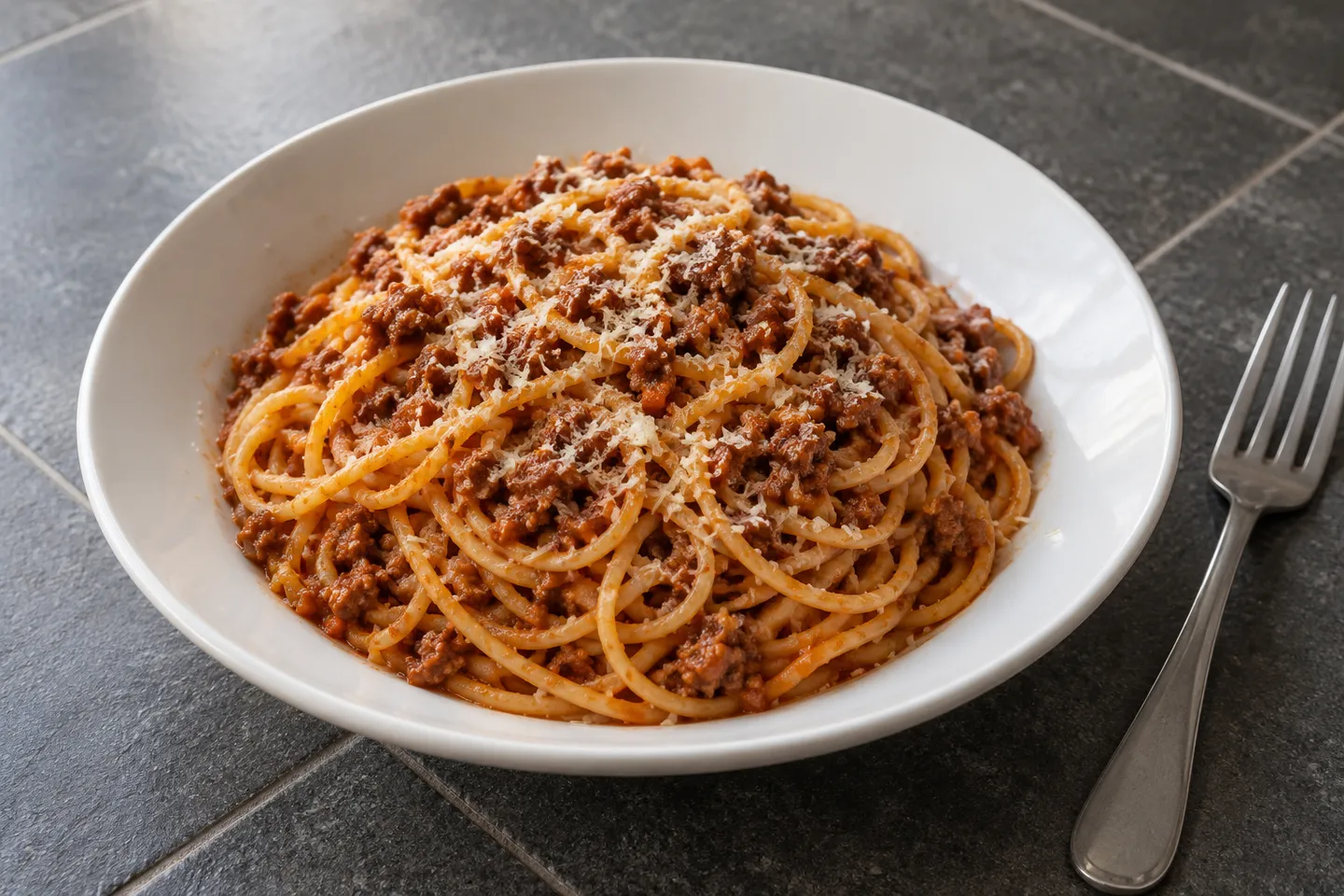
Spaghetti Bolognese
Spaghetti with a beef-and-pork tomato sauce, slowly simmered with red wine and milk. Allow two hours for the sauce before cooking the pasta.
- Original yieldYield
- 6 servings6 servings
- PrepPrep time
- CookCook time
- TotalTotal time
Includes 2 hours of simmering.
Published Updated
Original recipe: 6 servings
The story behind the recipe
The pasta water can wait. Beef, pork and finely chopped vegetables need a slow simmer with wine, milk and tomatoes before the spaghetti has anything to do. This is dinner to decide on early, with a busy beginning and a quieter stretch while the sauce thickens.
Before the familiar red sauce
Pellegrino Artusi's Maccheroni alla bolognese looks different from this pot. In recipe 87 of *La scienza in cucina e l'arte di mangiar bene*, veal, cured pork, butter and broth join onion, carrot and celery. Tomatoes are absent. Mushrooms, truffles and a little cream appear among the possible additions.
That earlier recipe makes the meat-and-vegetable foundation easier to see. Bolognese isn't simply a name for any tomato sauce with some meat in it: the finely chopped ingredients and the way they're cooked give the sauce its character. The beef, pork, red wine, milk and spaghetti below make a contemporary home version, with tomatoes taking a much larger role than they do in Artusi's recipe.
Read more about this recipe
The vegetables should belong to the sauce
Small pieces of onion, carrot and celery soften into the mixture while the meat cooks and the pot simmers. A large carrot chunk would stand apart from the rest; fine chopping lets the sweetness and texture spread through the sauce. This is preparation that pays you back at the table.
Beef and pork give the sauce substance, and breaking them apart prevents large clumps from dominating a forkful. After that, the liquids have separate turns. Wine cooks down first, then milk, before the tomatoes begin the long simmer. Having them measured nearby makes the beginning less rushed.
The partly covered pot loses moisture gradually. You want a gentle simmer with an occasional stir, giving the ingredients time to soften together while the sauce gains body. A hard boil would reduce the liquid more aggressively without supplying the same elapsed cooking time.
Save the short job for last
Spaghetti belongs near the end of the schedule. Cooking it while the sauce is still far from ready creates a waiting problem that this dinner doesn't need. Once the sauce is nearly there, the pasta's package directions give you the final stretch, with Parmesan ready for the bowls.
Making the sauce ahead is a sensible use of that long simmer. Follow the cooling and reheating guidance, then cook fresh pasta when you're ready to eat. A slow dinner can have a short finish.
Keep the sauce generous enough to coat the spaghetti when the two meet in the pot. Artusi also cared about pasta arriving with enough sauce around it; even across quite different ingredients, dry noodles would miss much of the pleasure.
Make it your wayOriginal: 6 servings
Original recipe: 6 servings
Ingredients
For 6 servings. Quantities are shown as written.
Source measurement convention: US customary. Explicit unit definitions take precedence; unconfirmed measures must be checked before conversion.
Original quantities for 6 servings.
- Olive oil2 tbsp
- Medium onion, finely chopped1
- Carrots, finely chopped2
- Celery, finely chopped2 stalks
- Ground beef1 lb
- Ground pork0.5 lb
- Garlic, minced3 cloves
- Dry red wine1 cup
- Whole milk1 cup
- Crushed tomatoes28 oz
- Dry spaghetti1 lb
- Grated parmesan cheese1/2 cup
- Salt (as needed for pasta water)
Measurement notes
- olive oil: US tbsp: 1 = 14.7868 ml (rounded).
- dry red wine, whole milk, grated parmesan cheese: US cup: 1 = 236.5882 ml (rounded).
Measurement notes
Original ingredients
- 2 tablespoons olive oilUS tbsp: 1 = 14.7868 ml (rounded).
- 1 medium onion, finely chopped
- 2 carrots, finely chopped
- 2 celery stalks, finely chopped
- 1 pound ground beef
- 1/2 pound ground pork
- 3 cloves garlic, minced
- 1 cup dry red wineUS cup: 1 = 236.5882 ml (rounded).
- 1 cup whole milkUS cup: 1 = 236.5882 ml (rounded).
- 28 ounces crushed tomatoes
- 1 pound dry spaghetti
- 1/2 cup grated parmesan cheeseUS cup: 1 = 236.5882 ml (rounded).
- salt (as needed for pasta water)
Equipment
 Large heavy pot or Dutch oven
 Large pasta pot
 Colander
Instructions
The Bolognese Sauce
Heat the olive oil
Heat the olive oil in a large pot or Dutch oven over medium heat.
Soften onion, carrots and celery
Add the chopped onion, carrots, and celery, cooking until they are soft and the onion is translucent.
Brown the ground meats
Stir in the ground beef and ground pork, breaking it apart with a wooden spoon as it cooks.
Add garlic
Once the meat is browned, add the minced garlic and cook for another minute.
Reduce the wine
Pour in the dry red wine and let it simmer until the liquid has mostly evaporated.
Reduce the milk
Stir in the whole milk and let it cook down just like the wine.
Add tomatoes and bring to a simmer
Add the crushed tomatoes and bring the pot to a gentle simmer.
Simmer the sauce slowly
Lower the heat, cover partially, and let the sauce cook for at least two hours, stirring occasionally.
The Pasta
Cook the spaghetti
When the sauce is nearly done, boil a large pot of salted water and cook the dry spaghetti according to the package directions.
Combine pasta and sauce
Drain the pasta and toss it directly in the pot with the hot sauce.
Serve with parmesan
Serve with plenty of grated parmesan cheese on top.
Estimated calories 650 kcal
Nutrition portion: 1/6 of recipe · Original yield: 6 servings
Source & assumptions
Ingredient-based estimate using CoFID 2021, USDA SR Legacy (2018), USDA preparation-retention factors (2007). About 650 kcal per nutrition portion (1/6 of the recipe). Uses representative 85% lean raw ground beef and raw ground pork, with their fat retained. Wine alcohol uses the USDA two-hour simmering factor. Dry pasta uses a representative cooking-loss model; milk, tomatoes and Parmesan are included. Actual ingredients and preparation affect the estimate.
Recipe notes
When adjusting quantities
Use a pot large enough for the sauce to simmer gently. Keep the two-hour simmer as a starting point and judge the sauce consistency; time does not multiply with servings.
Original recipe notes
These notes describe the original recipe. Quantities mentioned here do not change when you adjust servings.
The two-hour simmer is part of the cooking time. This is a slow sauce, so start it well before you need to cook the pasta.
Cook the spaghetti toward the end of the sauce simmer, following its package directions. The pasta cooking time does not increase when you make more sauce.
Storage
Refrigerate in shallow covered containers within 2 hours, or within 1 hour above 90 degrees F (32 degrees C). Keep at 40 degrees F (4 degrees C) or below and use within 3 to 4 days. Reheat to 165 degrees F (74 degrees C).
Make ahead
Make the sauce ahead and refrigerate it using the storage guidance below. Reheat the sauce thoroughly and cook the spaghetti just before serving.
Read the scaling guide. Times, temperatures and equipment need their own consideration. Open the recipe tool to review and correct individual amounts.
Sources and attribution
Recipe details
- Course or meal
- Main courseDinner
- Cuisine
- Italian
- Cooking method
- Stovetop
- Browse category
- Main Dishes