

- Baking
- Ingredients
- Vintage
- Measurement
Baking Soda, Baking Powder and Cream of Tartar
Read a baking recipe's complete leavening system, distinguish soda from powder and cream of tartar, and keep ingredient changes in proportion.
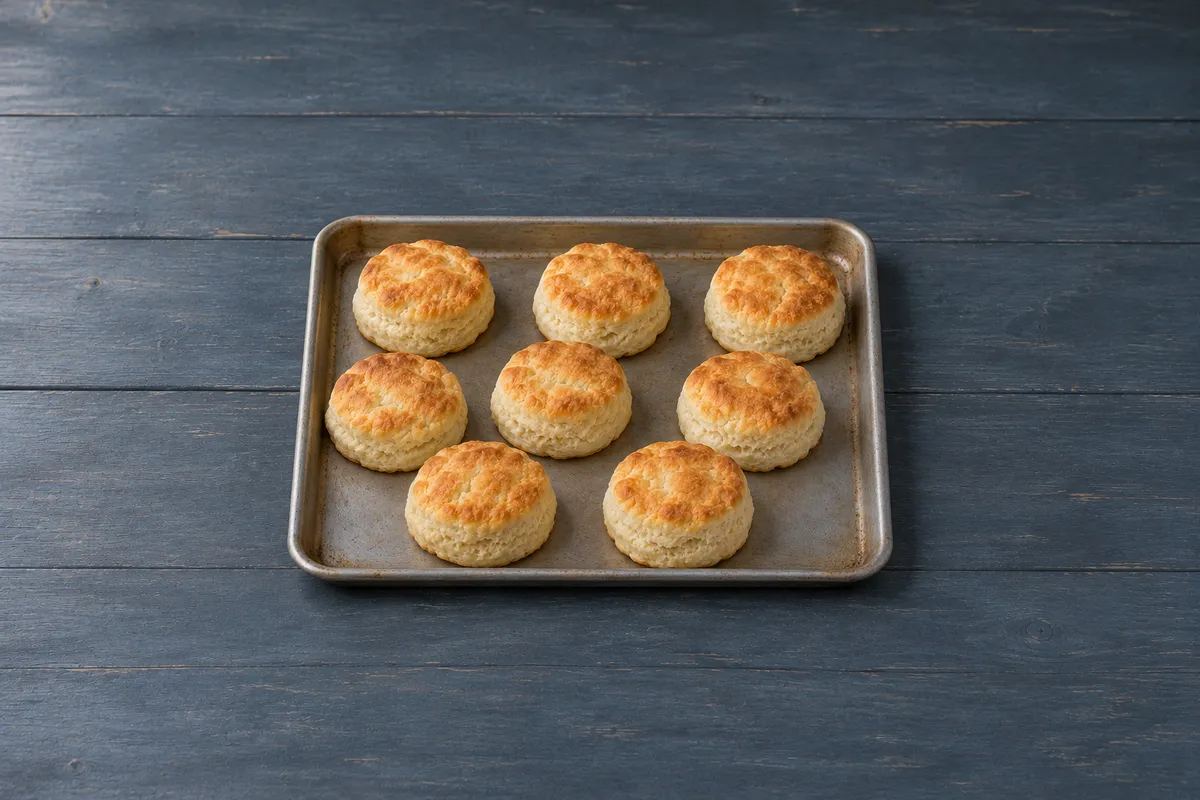
Before changing a teaspoon of leavener, find the rest of its system. Baking soda beside cream of tartar is a different instruction from baking powder on its own. Soda in a molasses batter asks you to consider the syrup and other ingredients too. The white powders may share a shelf, but a recipe hasn’t assigned them the same role.
The useful distinction is between a single ingredient and a preparation that already combines ingredients. Once that is clear, old biscuit and muffin recipes become easier to read, and a tempting spoon-for-spoon substitution looks much less straightforward.

Read the diagram as text
Read the whole system Identify the ingredients before changing them. Baking soda WHAT IT IS: Sodium bicarbonate. IN A RECIPE: Look for acid ingredients elsewhere in the formula. Cream of tartar WHAT IT IS: An acid ingredient. IN A RECIPE: May be paired with a separate amount of baking soda. Baking powder WHAT IT IS: A prepared sodium-bicarbonate and acid mixture. ALSO COMMON: Starch is commonly included. Follow the complete formula. Double-acting describes reaction timing, not twice the strength.
Three names, three different purchases
Baking soda is sodium bicarbonate. It is a base. In a wet mixture, a suitable acid can react with it and release carbon dioxide. Bubbles of that gas help raise a dough or batter that can hold them while it bakes. NC State’s food-science explanation describes that basic acid-and-soda reaction.
Cream of tartar supplies an acid ingredient. Its chemical name is potassium hydrogen tartrate. It isn’t dairy cream, and it isn’t another name for baking soda. When a formula lists both cream of tartar and soda, the separate measures belong to one leavening arrangement. Don’t leave one out because the other sounds sufficient.
Baking powder is a prepared mixture. It contains sodium bicarbonate together with an acid ingredient and commonly starch. The powder brings its own acid component rather than requiring the batter to obtain all of it from another food. That preparation is what the recipe means when it asks for a measure of baking powder.
Food-grade baking soda also needs its full name. Historical references to culinary soda aren’t an invitation to use washing soda or an unidentified household alkali. The modern recipe should identify the baking ingredient you can actually buy.
| The ingredient line says | What to look for elsewhere in the formula |
|---|---|
| Baking powder | The specified amount and product type; don’t automatically add separate soda or cream of tartar |
| Soda and cream of tartar | Both quantities, measured separately and kept together when scaling |
| Soda with molasses, sour milk or another acidic food | The complete formula, including that food’s amount and the other liquids |
This reading check identifies the system. It doesn’t calculate the acidity of a jar of molasses or supply a universal powder replacement.
A biscuit recipe already using prepared powder
Fannie Merritt Farmer’s Baking Powder Biscuit I, in her 1896 Boston Cooking-School Cook Book, lists four teaspoons of baking powder to two cups of flour. The recipe also contains butter, lard, salt, and milk and water in equal parts. Cream of tartar and soda don’t appear as separate additions.
The powder has simplified one part of the work, but the method still asks the cook to distribute the dry ingredients, work in the fats and judge the liquid. Farmer explicitly says flour differences prevent her from giving an exact liquid requirement. Prepared powder doesn’t remove the need to recognize a soft dough.
She also asks for a hot oven and prompt baking. Our modern Baking-Powder Biscuits keeps a commercial powder as its selected route. The modern flour weight and defined measuring spoons make that version usable; they don’t establish which brand or exact formulation sat in a nineteenth-century kitchen.
The distinction matters if you’re reading an adjacent recipe that mixes a powder at home. A historical preparation can explain the ingredients’ roles without becoming an approved replacement in Farmer’s dough.
Two cornmeal recipes make the contrast visible
Our Cornmeal Gems uses three level teaspoons of modern double-acting baking powder. It combines cornmeal and wheat flour with milk, egg and a small amount of butter and sugar. The batter goes into the specified muffin wells and is baked promptly.
Cornmeal Ragged Robins has a different formula and a separate acid-and-soda arrangement: two and a half teaspoons of cream of tartar and one and a quarter teaspoons of baking soda. There is more cornmeal than bread flour by volume, no egg, and the soft dough is dropped onto sheets.
The cream-of-tartar allowance is twice the soda allowance by volume. That’s useful arithmetic for understanding this particular ingredient list. It doesn’t mean that their combined three and three-quarter teaspoons can be replaced with three and three-quarter teaspoons of commercial powder. A measured spoonful of a single chemical and one of a prepared mixture contain different things.
Nor can the gems’ three teaspoons prove that they have less raising power than the Ragged Robins. The recipes differ in grain balance, liquid, fat, egg, shape and portion size as well as leavener. Comparing the teaspoon totals alone discards too much of the formula.
Double-acting describes timing
A soda-and-cream-of-tartar mixture begins reacting when wetted, so preparation before mixing is particularly useful. Have the oven, pan and other ingredients ready. The wet dough shouldn’t wait while you search for a cutter or grease a tray.
Double-acting powder supplies gas release during mixing and further release during baking. It doesn’t mean the powder is twice as strong, that the amount should be doubled or that wet batter can wait indefinitely.
Even counting acid names on a label can mislead. Rumford’s current product page describes its regular powder as double-acting while listing cornstarch, sodium bicarbonate and monocalcium phosphate. Only one acid ingredient is named. The timing description is more useful than a rule that double-acting must always mean two differently named acids. Read the label on the product you’re using, since formulations can change.
When an old book gives an alternative
Sarah Tyson Rorer’s Philadelphia Cook Book offers a revealing biscuit comparison. In the undated printing, with an 1886 copyright, one dough has two alternative routes: two heaping teaspoonfuls of baking powder, or half a teaspoonful of soda and one teaspoonful of cream of tartar.
That is a choice inside a particular recipe. It isn’t an instruction to add all three, and it doesn’t establish a modern exchange rate for every baking powder. The heap itself is an unresolved measure, another reason not to turn the line into a precise conversion chart.
Rorer’s working directions are clearer: prepare the oven, pans and tools before putting in the milk, then work quickly. The practical advice survives without claiming that a modern commercial powder and her separately measured ingredients will produce identical biscuits.
Scale the formula before adjusting the method
If you double the Ragged Robins ingredients, its two and a half teaspoons of cream of tartar becomes five, and its one and a quarter teaspoons of soda becomes two and a half. Both belong to the doubled formula. Doubling just the soda would change the balance rather than make a larger batch of the same dough.
Keep the measurement basis as well. A two-to-one ratio by volume isn’t a two-to-one ratio by weight, and a tablespoon of powder isn’t a tablespoon of pure soda. Follow the quantities and any ingredient-specific weight equivalents supplied by the chosen recipe.
For a larger batch, decide how it will reach the oven. Extra sheets, matching pans or separately mixed batches may be more useful than leaving a bowl of wet dough waiting through an earlier bake. Keep the intended portion size and pan fill; cooking time doesn’t multiply with the ingredient factor.
If the pantry is missing a leavener, choose a complete formula written for the ingredients you have or use a substitution explicitly supported for that recipe. The shortest route to dinner may be another recipe, rather than an improvised teaspoon calculation.
Sources
Fannie Merritt Farmer, The Boston Cooking-School Cook Book, 1896, p. 70, Baking Powder Biscuit I; Sarah Tyson Rorer, Philadelphia Cook Book: A Manual of Home Economies, undated printing, copyright 1886, p. 337, Soda Biscuit. The linked Cornmeal Gems and Cornmeal Ragged Robins identify their separate 1918 sources and modern choices. Modern reaction and product explanations are linked in the text.