

- Vintage
- Food history
- Leftovers
- Cooking methods
Leftovers Before Microwaves: Hash, Patties and a Different Dinner
How nineteenth- and early twentieth-century cookbooks turned cooked meat, rice and bread into dishes with new textures, sauces and shapes.
A cold roast could return to the table chopped into a crusty hash, folded into a thick sauce or tucked inside pastry. The first cooking had already happened. The next decision was what kind of dish to make from it.
Looking at leftovers before microwaves opens up a collection of techniques: browning, binding, layering and filling. Earlier cooks could reheat food, and these books include straightforward warming instructions. Their more interesting possibilities change the form of dinner as well as its temperature.
The examples here come from British, Dutch and American cookbooks of the nineteenth and early twentieth centuries. They show what particular authors taught their readers, rather than a single routine followed in every home. They also begin with usable cooked food. A new sauce or a browned crust cannot rescue food that has been stored unsafely.
Sometimes the remainder was planned
The preface to the 1911 copy of The Cook Book of Left-overs, by Helen Carroll Clarke and Phoebe Deyo Rulon, makes room for deliberate extra cooking. The authors suggest planning a remainder when the first preparation is lengthy or when reheating suits the food. Their stated aim is to save the cook time and labor while serving attractive dishes. Clarke and Rulon, preface, p. v.
That is a useful distinction. An unexpected spoonful at the bottom of a dish and a portion set aside for another meal offer different possibilities. Having enough cooked meat for a filling makes a planned pie more practical than hoping a few scraps will stretch to fit it.
For another view of how a household divided a roast, our sister site The Forgotten Menu’s What Did Victorian Children Eat? follows Beeton’s account of nursery dinners. Sharing a joint between tables is a separate practice from making another meal with the leftovers.
The book’s promises of economy belong to its authors. The recipes still require chopping, sauce making, dishes and another application of heat. They explain how an ingredient might be used again; they do not establish that every new dish cost less in money or effort.
Hash gave cooked meat a browned surface
Clarke and Rulon’s Corned-Beef Hash combines chopped meat and potatoes, moistened with milk or stock. The mixture cooks in a covered frying pan, with a brown, crusty underside as its intended finish. The recipe treats the surface touching the pan as something worth developing. Corned-Beef Hash, p. 16.
Their next entry changes the arrangement. Corned-Beef-and-Beet Hash uses cooked beef, boiled potatoes and cooked beets, chopped separately before mixing. The authors describe warming it while turning it, and also offer the option of forming balls and browning them. Even two adjacent hashes can ask for different handling.
For a later example to cook, our Browned Potato and Meat Hash, adapted from a 1934 USDA recipe starts with cooked beef and boiled potatoes. It follows the source’s single-pan alternative, with modern weights and added moistening liquid. Its earlier cooking is outside the recipe’s short skillet time. It illustrates the technique without claiming to reproduce Clarke and Rulon’s formula.
A thick sauce made small pieces hold together
Sauce could do more than moisten a serving. In the fifth Dutch edition of H. Davidis’s Keukenboek (1873), recipe 24 explicitly starts croquettes with leftover meat. Beef or veal mixed with ham is one suggested combination.
The meat is finely chopped and added to a sauce made with butter, flour, broth or meat juices, and eggs beaten with water. Parsley and softened shallots join it. Cooking continues until the mixture becomes a thick paste. It can then be shaped into small rolls, coated with bread, egg and bread again, and fried. Davidis, Croquettes, pp. 57–58.
The sauce changes the practical role of the meat. A collection of little pieces can become one portion that holds a shape. The outer crumb adds another texture around it. That is a different result from stirring chopped meat into a loose gravy and spooning it onto a plate.
This dated recipe is evidence for one household treatment of leftovers. It does not establish who invented croquettes or that every earlier croquette began with surplus meat. Its historical cooling and frying directions also need present-day handling controls before becoming a modern recipe.
Pastry offered a separate container
Beeton’s Chicken or Fowl Patties, published in The Book of Household Management (1861), begin with the remains of cold roast chicken or fowl. The white meat is minced and combined with ham, cream, veal gravy, lemon and butter rolled in flour. The prepared filling goes into pastry cases. Beeton, recipe 928, p. 445.
The cases have their own preparation. Beeton directs the cook to bake puff pastry with a piece of bread inside, remove the bread through an opening in the top, and fill the hollow afterward. In this recipe, patties means little filled pastry cases, rather than flattened cakes of minced meat.
Our Chicken-and-Ham Picnic Hand Pies, adapted from Beeton use cooked chicken in a different structure: sealed pies filled before baking. Their thicker sauce, modern quantities and chilled picnic service are explained on the recipe page. The historical source provides the cooked-meat filling family; the hand-pie format is a stated adaptation.
Rice and bread could become part of the structure
Clarke and Rulon’s A Scallop of Roast Beef with Rice layers cooked rice, chopped cold roast beef and tomatoes in a baking dish, finishing with buttered crumbs. The rice occupies its own layers instead of appearing as a side serving. The tomatoes and crumb topping give the assembled dish another cooking stage. A Scallop of Roast Beef with Rice, p. 14.
The same page offers Irish Rissoles made with minced meat, soft crumbs and enough milk to shape them. Here the bread goes inside the mixture. Compare that with the croquettes’ outer coating or the scallop’s topping: the same broad ingredient can bind a portion, enclose it or finish its surface.
Those positions matter more than a general instruction to add bread. Crumbs mixed through meat are working toward a different texture from crumbs scattered over a dish. Neither use automatically makes fine soft crumbs interchangeable with coarse dry ones.
Three companion recipes
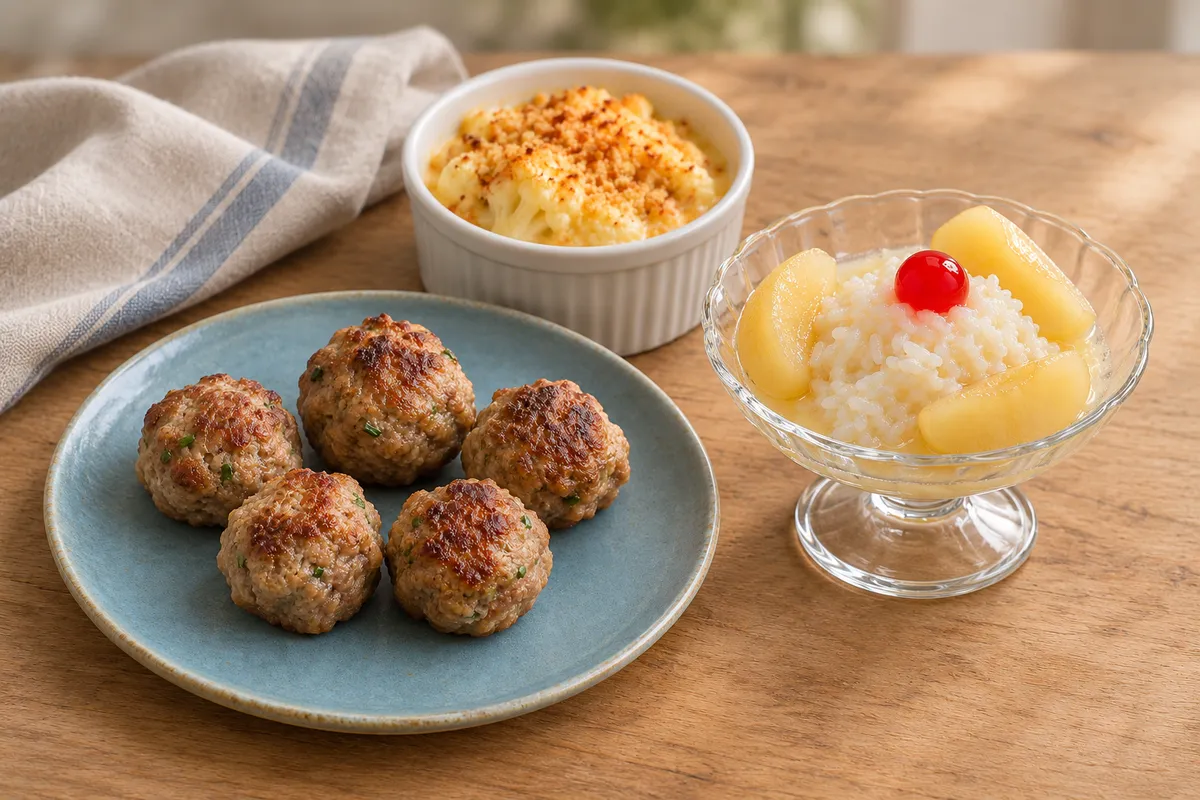
Three new adaptations explore different cooked ingredients:
- Irish rissoles (1911): finely chopped cooked beef with soft crumbs, milk and chives, formed into small portions and browned in a pan.
- Cauliflower-cheese ramekins (1911): cooked florets in a paprika-seasoned cheese sauce, finished in individual oven dishes with buttered crumbs.
- Rice with apples (1911): plain cooked rice warmed with cream and served with tart apple quarters poached in lemon syrup.
All three follow entries in Clarke and Rulon’s book, with their modern choices explained separately. They are untested adaptations rather than verified results from a kitchen trial.
Bring the idea forward with safe leftovers
These books offer ways to choose a new form for cooked food. Start with what you actually have: enough chopped meat for hash, a suitable filling for pastry, or cooked rice for a layered dish. Read the complete modern recipe before committing the ingredients, including the sauce, shaping and cooling stages.
Use current handling guidance. Refrigerate perishable food within two hours, or within one hour above 90°F (32°C). Keep the refrigerator at 40°F (4°C) or below, and use shallow containers so food cools promptly. FoodSafety.gov’s cooling guidance.
For cooked rice, follow the Food Standards Agency’s more specific guidance: cool quickly, ideally within one hour, refrigerate and use within 24 hours, reheating only once.
When reheating leftovers, check that the food reaches 165°F (74°C); a brown pastry lid or crust is not a measurement of the filling’s temperature. FoodSafety.gov’s temperature chart. Reheating is not a repair for unsafe storage: some bacterial toxins survive cooking temperatures. USDA on food left out of refrigeration.
Once the food is suitable to use, the older recipes pose an appealing cooking question: what should this ingredient become next? A crust underneath, a coating around it or a pastry case can give the next meal its own character.
Source note
The historical examples are Beeton’s The Book of Household Management (1861), recipe 928, p. 445; H. Davidis’s Keukenboek, fifth Dutch edition (Haarlem, 1873), recipe 24, pp. 57–58; and Clarke and Rulon’s The Cook Book of Left-overs (Harper & Brothers, copyright 1911), preface p. v and pp. 14, 16. They are descriptions of published methods, not instructions to follow historical storage advice.