
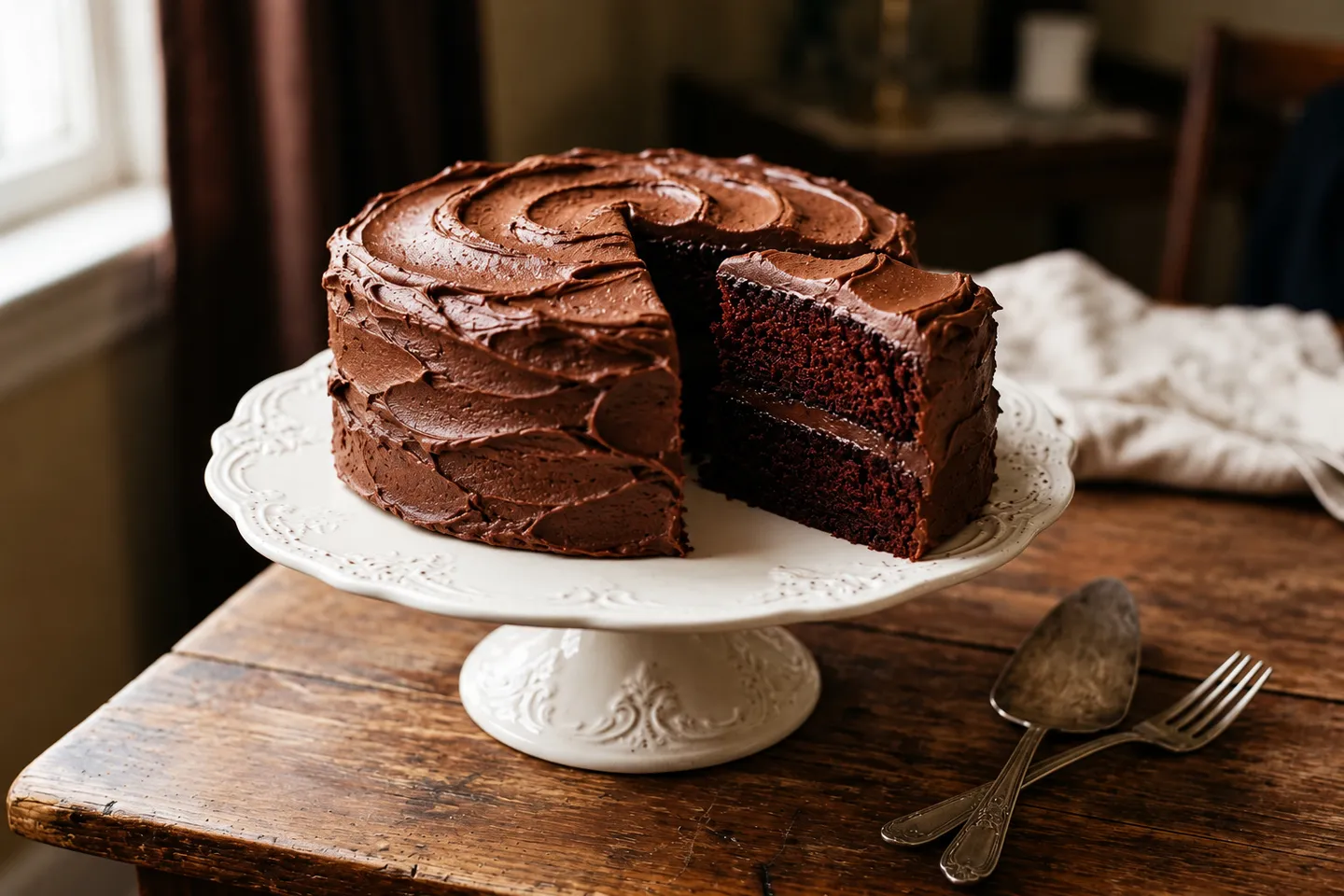
Devil's Food Cake with Chocolate Frosting (1920s)
A two-layer chocolate cake with brown sugar, natural cocoa and buttermilk, finished with chocolate buttercream. Cool both layers completely before frosting.
- Original yieldYield
- 1 9-inch two-layer cake1 9-inch two-layer cake
- PrepPrep time
- CookCook time
- TotalTotal time
Includes 10 minutes cooling in pans and 2 hours cooling on a rack before frosting.
Published Updated
Original recipe: 1 9-inch two-layer cake
The story behind the recipe
Apple jelly isn't the filling most of us expect to find in a devil's food cake. Yet Mary A. Wilson's 1920 version puts it between chocolate-and-cinnamon layers, beaten with a reserved egg white. The name sounds familiar; the cake underneath it has a few surprises.
Cocoa with a little cinnamon
This version keeps Wilson's cocoa-and-cinnamon pairing. Natural unsweetened cocoa gives the layers their chocolate flavor, and cinnamon adds a small spice note. Chocolate buttercream replaces her filling and icing, so the finished cake stays chocolate from its crumb to its outer coat.
Read more about this recipe
Three preparations in the old cake
Wilson treats the cake, filling and icing separately in Mrs. Wilson's Cook Book. Shortening, milk and baking powder belong to her cake mixture. An egg white is held back for the apple-jelly filling, and powdered sugar and cornstarch are moistened with boiling water for the icing.
That apple jelly changes how we picture the original. There would be a fruit filling between the layers, rather than another portion of cocoa frosting. The icing above it is a different preparation again. The recipe name hasn't promised that everything between and around the cake will taste of chocolate.
Our version takes a simpler direction at assembly: one buttercream fills the middle and covers the outside. The batter is also substantially adapted, using butter, brown sugar, whole eggs, buttermilk and baking soda in modern proportions. Wilson supplies the historical chocolate-and-spice idea, not an unchanged formula for the cake below.
Natural cocoa for cake and frosting
Natural unsweetened cocoa is the one to buy for both parts of this recipe. It brings chocolate without the sugar already present in a sweetened drinking powder. The batter pairs it with buttermilk and baking soda; Dutch-process cocoa isn't the specified ingredient.
The cocoa appears twice in the shopping list because some belongs to the cake and some to the frosting. Likewise, the butter for the cake layers is separate from the butter needed for the frosting. Keeping those portions separate leaves you ready for assembly once the baked layers are cool.
Brown sugar and cinnamon give the crumb another direction besides chocolate. Neither needs to become a large, separate flavor layer. The frosting supplies a more direct cocoa finish, and a cut slice shows both preparations together: cake beneath and buttercream between and around it.
The long part happens on the rack
Two nine-inch pans give this version its broad layers. The oven time is only part of the project. Cooling in the pans, turning the cakes onto a rack and letting them cool completely account for much of the elapsed estimate.
Frosting a warm layer asks the buttercream to meet heat when you want it to stay spreadable. Waiting makes assembly less hurried, and it leaves time to prepare the frosting while the layers cool. Keep the finished cake refrigerated as directed: milk in this buttercream is a practical detail, not just a small amount to overlook.
Wilson's apple-jelly filling is worth remembering when looking through old cakes. Familiar names can conceal quite different finishes. This one chooses chocolate buttercream, but keeps the small cinnamon note that first made the source interesting.
Make it your wayOriginal: 12 servings · Makes 1 9-inch two-layer cake
Original recipe: 1 9-inch two-layer cake
Ingredients
For 1 9-inch two-layer cake. Quantities are shown as written.
Source measurement convention: US customary. Explicit unit definitions take precedence; unconfirmed measures must be checked before conversion.
Original quantities for 1 9-inch two-layer cake.
For the Cake
- Softened butter1/2 cup
- Brown sugar2 cups
- Large eggs2
- Buttermilk1/2 cup
- All-purpose flour2 1/2 cups
- Baking soda1 tsp
- Boiling water1/2 cup
- Natural unsweetened cocoa powder1/2 cup
- Ground cinnamon1 tsp
- Vanilla extract1 tsp
- Butter (as needed, for greasing the pans)
- All-purpose flour (as needed, for dusting the pans)
For the Frosting
- Softened butter1/2 cup
- Powdered sugar2 cups
- Natural unsweetened cocoa powder1/4 cup
- Whole milk2 tbsp
Measurement notes
- softened butter, brown sugar, buttermilk, all-purpose flour, boiling water, natural unsweetened cocoa powder, powdered sugar: US cup: 1 = 236.5882 ml (rounded).
- baking soda, ground cinnamon, vanilla extract: US tsp: 1 = 4.9289 ml (rounded).
- whole milk: US tbsp: 1 = 14.7868 ml (rounded).
Measurement notes
Original ingredients
- 1/2 cup softened butterUS cup: 1 = 236.5882 ml (rounded).
- 2 cups brown sugarUS cup: 1 = 236.5882 ml (rounded).
- 2 large eggs
- 1/2 cup buttermilkUS cup: 1 = 236.5882 ml (rounded).
- 2.5 cups all-purpose flourUS cup: 1 = 236.5882 ml (rounded).
- 1 teaspoon baking sodaUS tsp: 1 = 4.9289 ml (rounded).
- 1/2 cup boiling waterUS cup: 1 = 236.5882 ml (rounded).
- 1/2 cup natural unsweetened cocoa powderUS cup: 1 = 236.5882 ml (rounded).
- 1 teaspoon ground cinnamonUS tsp: 1 = 4.9289 ml (rounded).
- 1 teaspoon vanilla extractUS tsp: 1 = 4.9289 ml (rounded).
- Butter (as needed, for greasing the pans)
- All-purpose flour (as needed, for dusting the pans)
- 1/2 cup softened butterUS cup: 1 = 236.5882 ml (rounded).
- 2 cups powdered sugarUS cup: 1 = 236.5882 ml (rounded).
- 1/4 cup natural unsweetened cocoa powderUS cup: 1 = 236.5882 ml (rounded).
- 2 tablespoons whole milkUS tbsp: 1 = 14.7868 ml (rounded).
Equipment
 Two 9-inch round cake pans
 Electric mixer
 Wire cooling rack
Instructions
The Cake Base
Prepare the oven and cake pans
Preheat the oven to 350 degrees F (175 degrees C) and grease and flour two 9-inch round cake pans using the extra butter and flour.
Cream butter and sugar, then add eggs
Cream the 1/2 cup softened butter and brown sugar together until light and fluffy, about three to four minutes. Beat in the eggs one at a time.
Make and cool the cocoa paste
In a small bowl, stir the 1/2 cup natural unsweetened cocoa powder into the boiling water to form a paste. Set it aside to cool before adding it to the batter.
Mix baking soda and buttermilk
Stir the baking soda into the buttermilk.
Alternate flour and buttermilk
Alternate adding the all-purpose flour and the buttermilk mixture to the butter-sugar base, starting and ending with flour.
Add cocoa, cinnamon and vanilla
Stir in the cooled cocoa mixture, the ground cinnamon, and the vanilla extract until just combined.
Divide the batter between pans
Pour the batter evenly into the two prepared cake pans.
Bake the cake layers
Bake for about 40 minutes. A toothpick inserted in the center should come out clean, or with just a few moist crumbs.
Cool the layers completely
Let the cake layers cool in the pans for 10 minutes, then turn them out onto a wire rack to cool completely before frosting (about 2 hours).
The Frosting
Beat the chocolate frosting
To make the frosting, beat the remaining 1/2 cup softened butter, powdered sugar, 1/4 cup natural unsweetened cocoa powder, and 2 tablespoons of whole milk together until smooth and spreadable.
Assemble and frost the cake
Frost the top of one completely cooled layer, place the second layer on top, and frost the top and sides of the entire cake.
Estimated calories 480 kcal
Nutrition portion: 1/12 of recipe · Original yield: 1 9-inch two-layer cake
Source & assumptions
Ingredient-based estimate using CoFID 2021, USDA SR Legacy (2018), the Norwegian Food Composition Table. About 480 kcal per nutrition portion (1/12 of the recipe). Standard nutrition portion: one-twelfth of the original two-layer cake, including all frosting. This slice count is editorial. Excludes unmeasured pan butter and flour. Actual ingredients and preparation affect the estimate.
Recipe notes
When adjusting quantities
This batter is formulated for two 9-inch round pans. Cooking time and temperature do not scale automatically if you change the pan size.
Original recipe notes
These notes describe the original recipe. Quantities mentioned here do not change when you adjust servings.
Use natural unsweetened cocoa for this recipe, rather than Dutch-process cocoa. The specified cocoa and buttermilk are paired with baking soda.
The butter and cocoa appear in both ingredient groups. Measure the cake and frosting portions separately so that the frosting ingredients are still available when the layers have cooled.
Storage
Keep the frosted cake covered in the refrigerator. This frosting contains milk; do not treat it as a shelf-stable frosting.
Read the scaling guide. Times, temperatures and equipment need their own consideration. Open the recipe tool to review and correct individual amounts.
Sources and attribution
Inspired by Mary A. Wilson's Mrs. Wilson's Cook Book (1920), p. 59. The cocoa-and-cinnamon pairing is retained; the cake formula and chocolate buttercream are modern adaptations.
Mary A. Wilson, Mrs. Wilson's Cook Book (1920), p. 59. Cocoa and cinnamon are retained; the modern cake formula and chocolate buttercream replace her batter proportions, apple-jelly filling and separate icing.