
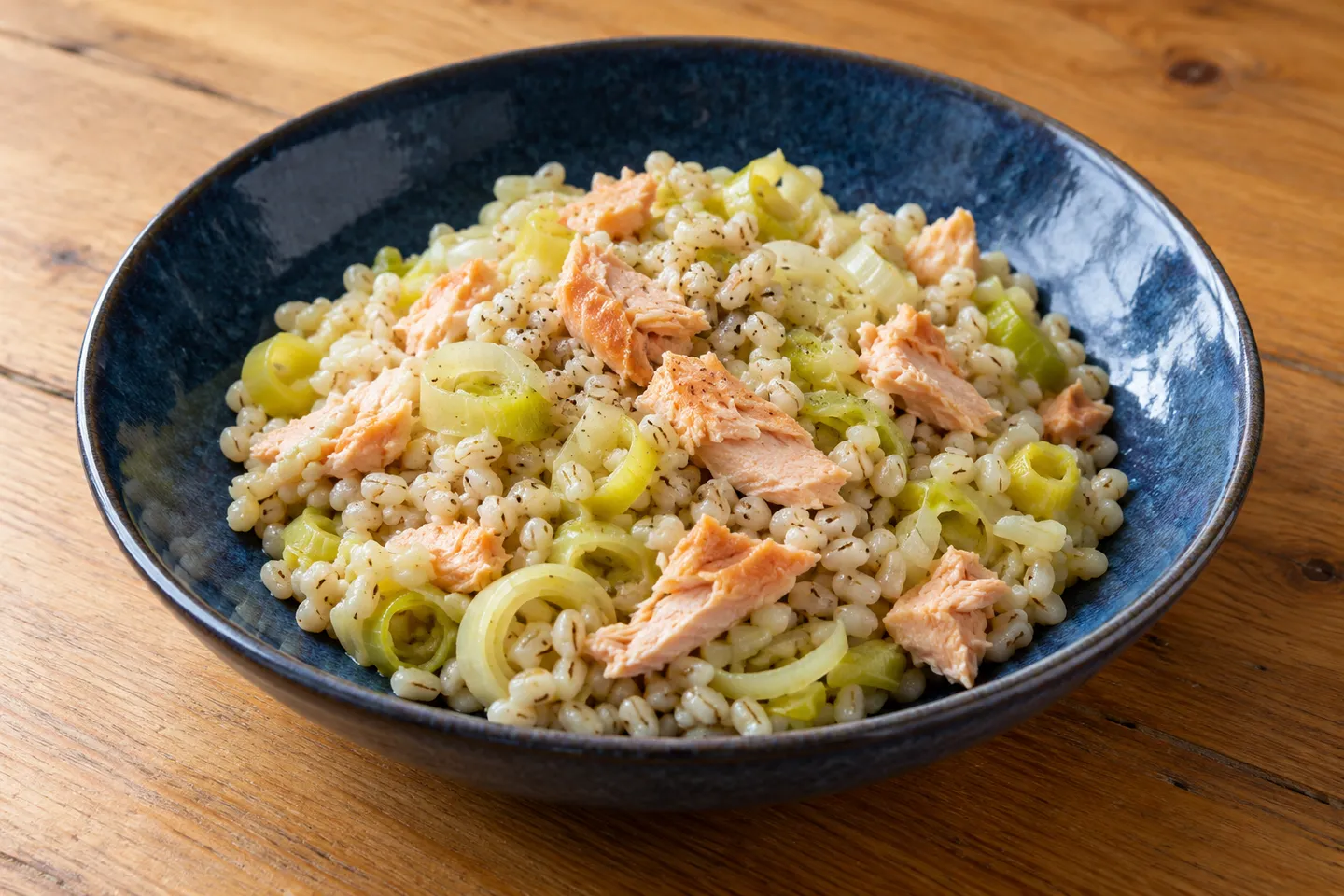
Hot-Smoked Trout with Barley and Leeks
Flakes of fully cooked hot-smoked trout warmed through with pearl barley and buttery leeks, for a modern meal inspired by a northern pantry.
- Original yieldYield
- 4 lunch portions4 lunch portions
- PrepPrep time
- CookCook time
- TotalTotal time
Estimated: 15 minutes preparation and up to 55 minutes cooking, including the final heating. The leeks cook while the barley simmers. Check the barley package; brands vary.
Published
Original recipe: 4 lunch portions
The story behind the recipe
The trout is already smoked and cooked before the pan goes on. It needs warming through, while the barley and leeks need time to become tender. Keeping those tasks separate gives you distinct fish flakes among the grains instead of fish stirred to shreds through an unfinished pot.
A packet to read carefully
Buy fully cooked, ready-to-eat hot-smoked trout. Look for moist flakes, not the thin, translucent slices of cold-smoked fish. Keep the pack refrigerated as directed.
Read more about this recipe
Grain beneath the fish
Pearl barley keeps a little chew after cooking, which suits small flakes of fish. Some of its outer material has been removed in processing. Whole hulled barley and quick-cooking barley follow different schedules, so check the product name before buying.
Cooking the barley in water also leaves the fish's salt level separate from the grain at first. Smoked trout varies between producers, so there is no fixed extra salt in the ingredient list. The barley is cooked and drained before the fish is folded through; it doesn't have to absorb a strongly salted broth while it softens.
The leeks provide a softer texture beside those grains. Cut them across into thin slices and wash away the grit between the layers. Slow covered cooking gives them time to soften in butter and a little water. Browning them heavily would produce a different flavor from the mild, buttery base intended here.
Preserved fish was food for later
Museum Nord's account of Viking-Age fishing places dried fish in the coastal economy of northern Norway. It connects the seasonal catch with food that could be stored and transported. A surplus was valuable partly because it could leave the place where it had been caught.
The seasonal catch could feed people well beyond the shore. Our skillet meal borrows that pantry idea with a different preserved product: moist hot-smoked trout, ready to flake into the grain.
The pairing makes the pantry idea approachable: grain supplies the bulk of the meal, and a smaller amount of strongly flavored fish is divided through it. The leeks stretch between both ingredients, soft enough to coat a spoonful without hiding the barley's chew.
Fold, then check the heat
Large flakes are easier to keep intact than a fine mince. Remove the skin and check for bones before the fish reaches the skillet. Once it is added, fold from the bottom rather than repeatedly beating the mixture with a spoon.
The last covered heating stage matters. Hot grain underneath doesn't prove that cold flakes added from the refrigerator are hot all the way through. Check the mixture in several places and serve as soon as it has reached the stated temperature.
Leave some flakes large enough to recognize. The barley supplies most of the meal, with the fish distributed through four lunch portions.
Explore the historical background and companion recipes in The Viking Winter Pantry: Preserved Fish, Grain and Dairy.
Make it your wayOriginal: 4 servings · Makes 4 lunch portions
Original recipe: 4 lunch portions
Ingredients
For 4 lunch portions. Quantities are shown as written.
Source measurement convention: Metric. Explicit unit definitions take precedence; unconfirmed measures must be checked before conversion.
Original quantities for 4 lunch portions.
- Uncooked pearl barley200 g
- Water1 l
- Leeks, trimmed weight, white and pale green parts300 g
- Unsalted butter25 g
- Water, for the leeks and final heating100 ml
- Ready-to-eat hot-smoked trout, skin and bones removed250 g
- Ground black pepper1/4 tsp
Measurement notes
- ground black pepper: US tsp: 1 = 4.9289 ml (rounded).
Measurement notes
Original ingredients
- 200 g uncooked pearl barley
- 1 liter water
- 300 g leeks, trimmed weight, white and pale green parts
- 25 g unsalted butter
- 100 ml water, for the leeks and final heating
- 250 g ready-to-eat hot-smoked trout, skin and bones removed
- 1/4 US tsp ground black pepperUS tsp: 1 = 4.9289 ml (rounded).
Equipment
 Medium saucepan (2-quart)
 Large skillet with tight-fitting lid (12-inch)
 Fine-mesh strainer
 Food thermometer
Instructions
Simmer and drain the barley
Rinse the pearl barley in a strainer. Bring the 1 liter water to a boil in a medium saucepan, add the barley and simmer gently for 30 to 45 minutes, or according to the package, until tender with a little chew. Add boiling water if needed to keep the grains submerged, then drain thoroughly.
Soften the leeks
Meanwhile, halve the leeks lengthwise, rinse between the layers, drain and slice thinly. Melt the butter in a large covered skillet over medium-low heat. Add the leeks and half the 100 ml water. Cover and cook for 12 to 15 minutes, stirring occasionally, until soft; lower the heat if they begin to brown.
Flake the chilled trout
Remove any remaining skin and bones from the hot-smoked trout and separate it into large flakes. Keep refrigerated until the barley and leeks are ready.
Fold together and heat through
Fold the drained barley into the leeks with the black pepper, remaining water and trout. Cover and heat gently for 5 to 8 minutes, folding once or twice, until steaming throughout and at least 165°F (74°C) in several places. Continue heating if needed; follow any more demanding package reheating instruction. Serve immediately.
Estimated calories 340 kcal
Nutrition portion: 1/4 of recipe · Original yield: 4 lunch portions
Source & assumptions
Ingredient-based estimate using CoFID 2021, identified manufacturer information. Approximately 340 kcal per nutrition portion. Uses Hamiltons hot-smoked trout as a representative label and dry pearl barley input. Includes all butter; barley draining can lower this full-input estimate. Ingredients, brands and preparation affect values.
Recipe notes
When adjusting quantities
Keep enough pan space to stir and heat the fish evenly. Use additional pans for larger batches. Cooking times do not scale; follow the barley package and heat the finished mixture throughout.
Original recipe notes
These notes describe the original recipe. Quantities mentioned here do not change when you adjust servings.
A contemporary recipe inspired by northern pantry ingredients, using pearl barley and commercially prepared hot-smoked trout. Bob's Red Mill describes pearl barley's processing; follow the cooking instructions on the actual package you buy.
Use refrigerated ready-to-eat hot-smoked fish, not raw, cold-smoked or home-dried fish. The final heating target uses the 165°F (74°C) benchmark for cooked-food casseroles and leftovers in FoodSafety.gov's chart. Contains fish, barley and milk from the butter.
Refrigerate leftovers promptly in shallow containers, within 2 hours, or within 1 hour above 90°F (32°C). Follow the fish package's use-by and opened-pack limits, using the shorter limit where applicable.
Read the scaling guide. Times, temperatures and equipment need their own consideration. Open the recipe tool to review and correct individual amounts.
Sources and attribution
Recipe details
- Course or meal
- Dinner
- Cooking method
- Stovetop
- Browse category
- Main Dishes