
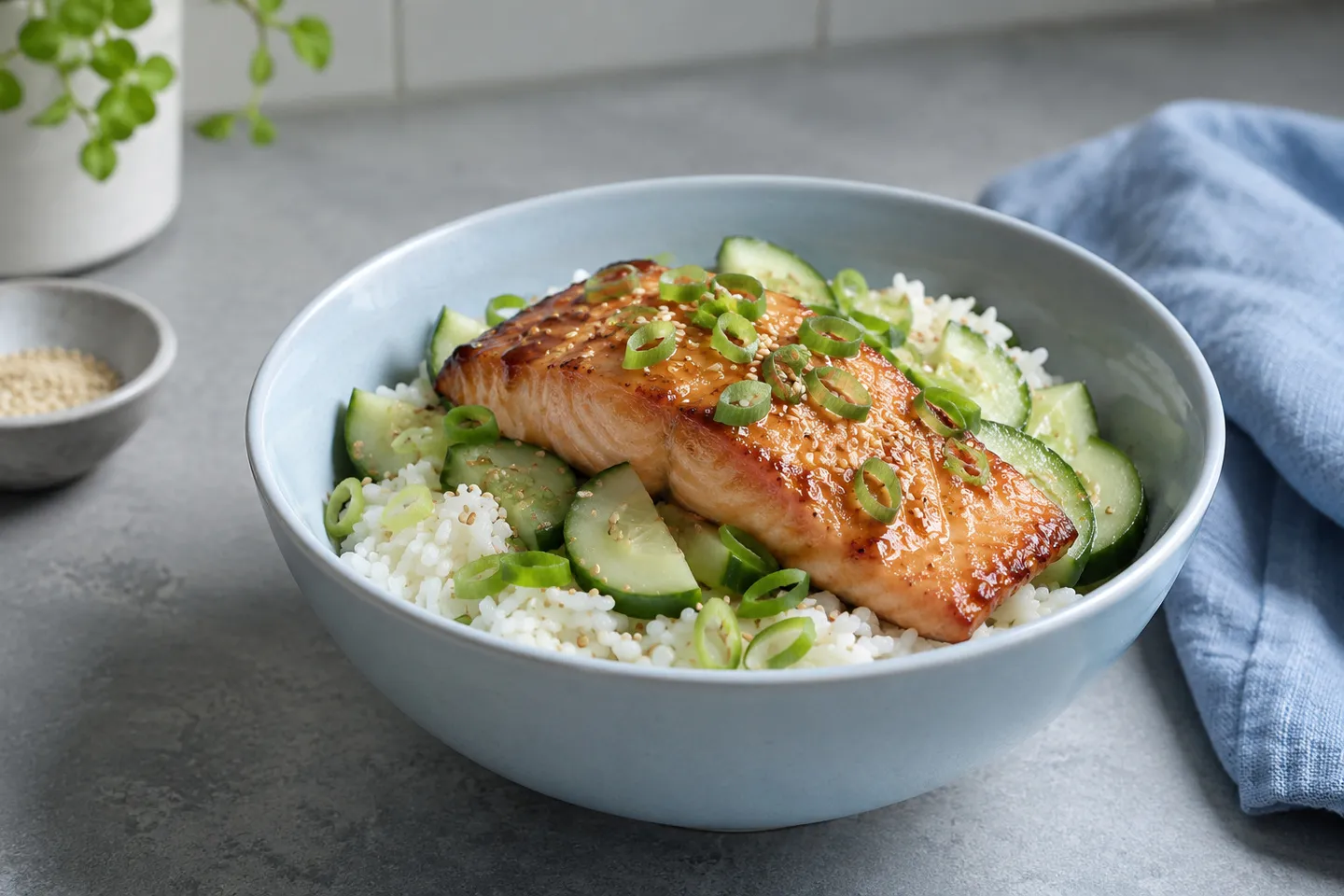
Miso-Glazed Salmon Rice Bowls
Oven-baked salmon with a white-miso glaze, short-grain rice and vinegar-dressed cucumber, finished with scallions and sesame.
- Original yieldYield
- 4 servings4 servings
- PrepPrep time
- CookCook time
- TotalTotal time
Rice cooking and its 10-minute covered rest overlap with baking the salmon; fish thickness and rice instructions can change elapsed time.
Published Updated
Original recipe: 4 servings
The story behind the recipe
Plain rice is a good partner for miso-glazed salmon. It catches the savory coating as the fish flakes apart, while cool vinegar-dressed cucumber gives you a sharper bite between warm mouthfuls. Scallions and sesame finish a bowl with three distinct textures and very little last-minute assembly.
Miso does more than sweeten a glaze
White miso is a Japanese fermented soybean paste with a mild, gently sweet character and plenty of savory flavor. Namiko Hirasawa Chen's guide to miso explains how ingredients and fermentation create different styles. The white paste suits this coating because honey and soy sauce can join it without needing a long list of spices.
Buy plain miso paste and plain rice vinegar. Seasoned sushi vinegar already includes sugar and salt, while instant miso soup mixes bring their own ingredients. Both can look like convenient shortcuts on the shelf, but the measured glaze is built around the unseasoned products.
The vinegar is used in two places. In the glaze it balances the honey and rich fish; around the cucumber it gives a clean, tart finish. Draining the dressed slices keeps their liquid from turning the rice underneath into a puddle.
Read more about this recipe
Let the rice set the pace
Japanese short-grain white rice has enough stickiness for a cohesive bowl. Its grains sit together beneath the salmon, so a fork or spoon can collect a little of both. A long-grain or brown rice would make a different base and require its own water and timing.
The covered rest is part of cooking this rice, not a spare pause to skip when you're hungry. It overlaps with the salmon, which is why the dinner's total time is less than the sum of two entirely separate jobs. Once the rice is resting, there's space to arrange bowls and finish the cucumber.
Fish thickness can vary even when portions weigh the same. Similar-sized pieces help the tray cook evenly, but a browned glaze can't tell you whether the thickest center is ready. The thermometer endpoint in the method settles that question without asking the honey to become darker and darker.
If tonight calls for a pot on the stove instead, five weeknight dinners includes lemon chicken orzo and white bean soup.
Make it your wayOriginal: 4 servings
Original recipe: 4 servings
Ingredients
For 4 servings. Quantities are shown as written.
Source measurement convention: Metric. Explicit unit definitions take precedence; unconfirmed measures must be checked before conversion.
Original quantities for 4 servings.
- Japanese short-grain white rice, dry weight280 g
- Water (for cooking rice)420 ml
- Skinless salmon fillet, cut into four equal portions600 g
- White miso paste40 g
- Reduced-sodium soy sauce15 ml
- Honey20 g
- Rice vinegar, divided30 ml
- Toasted sesame oil5 ml
- Cucumber, thinly sliced200 g
- Fine salt (for cucumber)2 g
- Scallions, thinly sliced40 g
- Toasted sesame seeds5 g
Measurement notes
Measurement notes
Original ingredients
- 280 g Japanese short-grain white rice, dry weight
- 420 ml water (for cooking rice)
- 600 g skinless salmon fillet, cut into four equal portions
- 40 g white miso paste
- 15 ml reduced-sodium soy sauce
- 20 g honey
- 30 ml rice vinegar, divided
- 5 ml toasted sesame oil
- 200 g cucumber, thinly sliced
- 2 g fine salt (for cucumber)
- 40 g scallions, thinly sliced
- 5 g toasted sesame seeds
Equipment
 Rimmed baking sheet
 Small 1.5-liter saucepan
 Food thermometer
Instructions
Start the oven and rice
Preheat the oven to 200°C (400°F). Rinse the Japanese short-grain white rice, drain well, then put it into a 1.5-liter saucepan with the water. Bring to a boil, cover and cook over very low heat for about 15 to 18 minutes until the water is absorbed. Remove from the heat and leave covered for 10 minutes. If the rice package specifies a different water amount or cooking sequence, follow it and record that adjustment.
Mix the glaze
Combine the white miso, reduced-sodium soy sauce, honey, 15 ml of the rice vinegar and the toasted sesame oil.
Glaze and bake the salmon
Put the salmon portions on a parchment-lined rimmed baking sheet, leaving space between them. Spread the glaze over the tops. Bake for about 12 to 18 minutes, until a thermometer in the thickest part reaches 63°C (145°F); thickness decides the actual time.
Dress the cucumber
While the fish bakes, toss the cucumber with the remaining 15 ml rice vinegar and the fine salt. Leave for 5 minutes, then drain any pooled liquid.
Assemble the bowls
Fluff the rested rice and divide among four bowls. Add one salmon portion and a quarter of the cucumber to each. Finish with the scallions and toasted sesame seeds, and serve.
Estimated calories 640 kcal
Nutrition portion: 1/4 of recipe · Original yield: 4 servings
Source & assumptions
Ingredient-based estimate using CoFID 2021, USDA SR Legacy (April 2018), identified manufacturer information. Approximately 640 kcal per nutrition portion. Uses farmed salmon, sweet white miso and unseasoned rice vinegar. Includes all glaze and vinegar energy, although some cucumber dressing is drained. Ingredients, brands and preparation affect values.
Recipe notes
When adjusting quantities
Keep fish portions similarly sized and spaced apart. Larger batches need extra sheet space; rice water/cooking guidance follows the chosen rice and pan, not a multiplied finish time.
Original recipe notes
These notes describe the original recipe. Quantities mentioned here do not change when you adjust servings.
Rice vinegar is the plain unsweetened product, not seasoned sushi vinegar. White miso and soy sauce vary in salt; use the specified reduced-sodium soy sauce as the starting point.
The rice and fish cook concurrently. Prepare the glaze and cucumber while the rice simmers; the covered rice rest belongs in the schedule.
Cool leftovers promptly in shallow containers and refrigerate within 2 hours, or within 1 hour above 32°C (90°F). Use within 3 to 4 days; reheat cooked leftovers to 74°C (165°F). Keep cucumber separately for texture.
Read the scaling guide. Times, temperatures and equipment need their own consideration. Open the recipe tool to review and correct individual amounts.
Recipe details
- Course or meal
- Dinner
- Cuisine
- Other / International
- Cooking method
- Oven
- Occasion
- Weeknight
- Browse category
- Main Dishes