
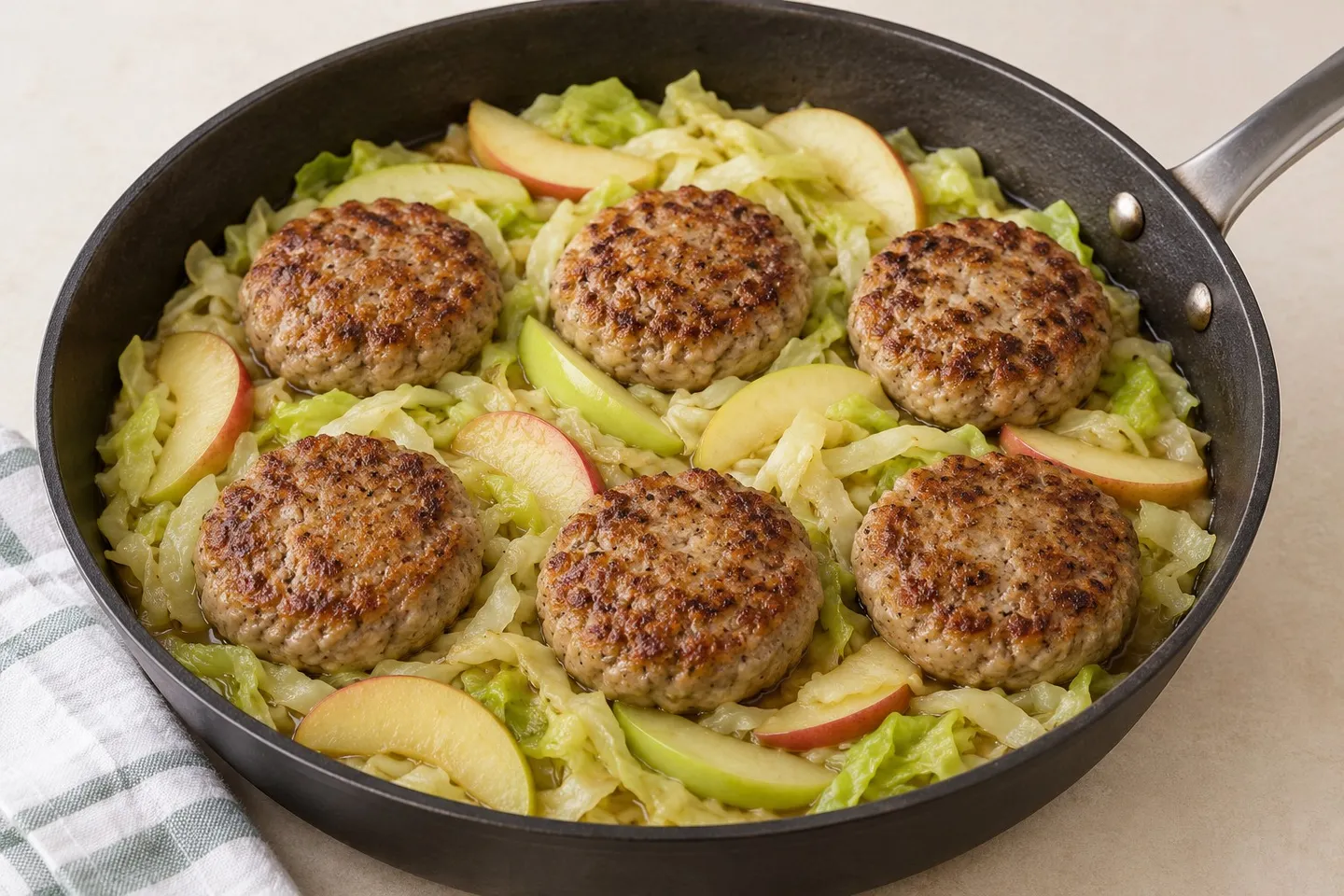
Sausage, Cabbage, and Apple Skillet Casserole (1934)
A sweet and savory Depression skillet dinner layering crisp sausage cakes over shredded green cabbage and tart orchard apples.
- Original yieldYield
- 4 servings4 servings
- PrepPrep time
- CookCook time
- TotalTotal time
Published Updated
Original recipe: 4 servings
The story behind the recipe
Apples lie just beneath the browned sausage in this layered dinner. Below them is cabbage, with another apple-and-cabbage layer nearer the pan. A little cider vinegar cuts across the sweet fruit and savory pork, while covered cooking brings the vegetables together underneath.
A casserole moved to the skillet
The 1934 USDA bulletin Meat Dishes at Low Cost calls it Sausage, Cabbage, and Apples En Casserole. Its cook browns sausage cakes first, then arranges the vegetables in a baking dish. Our version keeps that layered idea in a lidded skillet, where the sausage was browned. It is the covered-pan choice in our five Depression-era dinners.
Read more about this recipe
The top layer is deliberate
The historical directions specify apples as the upper vegetable layer and put the sausage cakes above them. It is a small instruction, but it gives the dish its arrangement. The apples aren't chopped into a general cabbage mixture and the meat doesn't disappear among them.
Thin slices make the fruit easy to lay across the shredded cabbage. Green cabbage supplies much of the meal's volume; tart apple brings a different flavor and texture. Granny Smith or Jonathan are our suggested varieties, rather than names supplied by the brief historical passage.
The contrast is part of the appeal. A browned sausage patty offers a savory bite, then cabbage and apple give the plate something softer and less concentrated. Vinegar provides a sharp note without asking for a separate sauce or condiment at serving.
The frying pan had something to contribute
After browning the sausage, the source has the cook wash its frying pan with vinegar and pour that over the casserole. The pan's browned drippings flavor the vegetables as well as the sausage laid on top.
Our adaptation leaves the rendered fat in the skillet and adds cider vinegar with a little water or unsweetened apple cider. Those modern liquid choices support the stovetop braise. The source specifies a tablespoon of vinegar; we keep that amount and supply weights for the sausage, cabbage and apples, plus seasoning and a serving count.
Using one pan changes the cooking setting, but keeps attention on the same ingredients. The lid goes on after the arranging is finished. Much of the remaining work is quiet covered cooking, with vegetable tenderness and the sausage-center thermometer check determining when dinner is ready.
Room before the cabbage wilts
Raw shredded cabbage takes up more space than its finished layer suggests. The large skillet needs to hold it at the beginning, not only after it has softened. A tight-fitting lid matters too: this is a gentle covered finish, rather than a fast stir-fry with the vegetables moved constantly.
The apple skins stay on in this recipe. They give the slices color and another visible edge within the pale cabbage. The modern measurements make four servings from six patties, so the dish is portioned with vegetables as well as meat; a patty count alone doesn't define a plate.
Hash waits for a crust underneath and meatloaf spends its time in the oven. Here, browned meat rests above fruit and cabbage while the whole pan settles into a sweet, sharp and savory meal.
Make it your wayOriginal: 4 servings
Original recipe: 4 servings
Ingredients
For 4 servings. Quantities are shown as written.
Source measurement convention: Metric. Explicit unit definitions take precedence; unconfirmed measures must be checked before conversion.
Original quantities for 4 servings.
- Pork breakfast sausage (shaped into 6 flat patties)450 g
- Green cabbage (cored and thinly shredded, approx. 1/2 small head)500 g
- Tart apples (approx. 2 large, Granny Smith or Jonathan, cored and thinly sliced)300 g
- Apple cider vinegar15 mlAuthor measures: 1 metric tbsp (1 metric tbsp = 15 ml).
- Water (or unsweetened apple cider)60 ml
- Fine salt1 metric tsp
- Freshly ground black pepper1/4 metric tsp
Measurement notes
- fine salt, freshly ground black pepper: tsp: 1 = 5 ml.
Measurement notes
Original ingredients
- 450 g pork breakfast sausage (shaped into 6 flat patties)
- 500 g green cabbage (cored and thinly shredded, approx. 1/2 small head)
- 300 g tart apples (approx. 2 large, Granny Smith or Jonathan, cored and thinly sliced)
- 15 ml apple cider vinegar (1 tbsp)
- 60 ml water (or unsweetened apple cider)
- 1 tsp fine salttsp: 1 = 5 ml.
- 1/4 tsp freshly ground black peppertsp: 1 = 5 ml.
Equipment
 Large skillet with tight-fitting lid (12-inch)
 Instant-read meat thermometer
Instructions
Brown the sausage patties
Place a large skillet over medium heat. Add the pork breakfast sausage patties and fry for 3 to 4 minutes per side until well browned on both sides (6 to 8 minutes total). Transfer the sausage cakes to a plate, leaving the rendered fat in the pan.
Layer and season half the cabbage
Arrange half of the shredded green cabbage across the bottom of the skillet. Sprinkle with half the fine salt and a pinch of freshly ground black pepper.
Add half the apples
Spread half of the sliced tart apples in an even layer over the cabbage.
Repeat cabbage and apple layers
Repeat with the remaining shredded cabbage, season with the remaining salt and pepper, and top with the rest of the sliced apples.
Arrange the sausage on top
Arrange the browned sausage cakes across the top layer of apples.
Add vinegar and water
Pour the apple cider vinegar and water into the pan around the edges, loosening any browned drippings from the bottom of the skillet.
Cover and simmer gently
Cover the skillet tightly with its lid, reduce heat to low, and simmer gently for 35 to 40 minutes until the cabbage is completely wilted and the apples are tender.
Check the sausage temperature
Insert an instant-read meat thermometer horizontally into the center of a sausage patty to verify it has reached at least 71°C (160°F) before removing from the heat.
Serve hot from the skillet
Serve hot directly from the skillet at the table.
Estimated calories 390 kcal
Nutrition portion: 1/4 of recipe · Original yield: 4 servings
Source & assumptions
Ingredient-based estimate using CoFID 2021, USDA SR Legacy (2018), representative labels for Kotányi ground black pepper. About 390 kcal per nutrition portion (1/4 of the recipe). Uses raw pork breakfast sausage, with all rendered fat retained, and the water option rather than apple cider. Actual ingredients and preparation affect the estimate.
Recipe notes
When adjusting quantities
Scale ingredients proportionally. Ensure the skillet has enough volume to contain the shredded raw cabbage before it wilts down.
Original recipe notes
These notes describe the original recipe. Quantities mentioned here do not change when you adjust servings.
Leave the apple skins intact to add visual color and help the slices maintain their structure during simmering.
Food safety: In accordance with USDA FSIS guidelines for ground pork, ensure the sausage centers reach at least 71°C (160°F).
The 60-minute total time accounts for 15 minutes of shredding and slicing, 6 to 8 minutes of sausage browning, and 35 to 40 minutes of covered simmering.
Read the scaling guide. Times, temperatures and equipment need their own consideration. Open the recipe tool to review and correct individual amounts.

Sources and attribution
Adapted from USDA Bureau of Home Economics, Meat Dishes at Low Cost (1934), p. 9
USDA Bureau of Home Economics, Meat Dishes at Low Cost (1934), p. 9. The skillet, added braising liquid, measured quantities and explicit doneness check adapt its covered casserole, whose main ingredients have no fixed quantities.