

- Baking & desserts
- Ingredient guides
- Rice
Rice Flour in Baking: What Can It Replace?
Learn when a recipe can use rice flour instead of wheat flour, why ordinary and sweet rice flour differ, and how shortbread and pancakes use it.
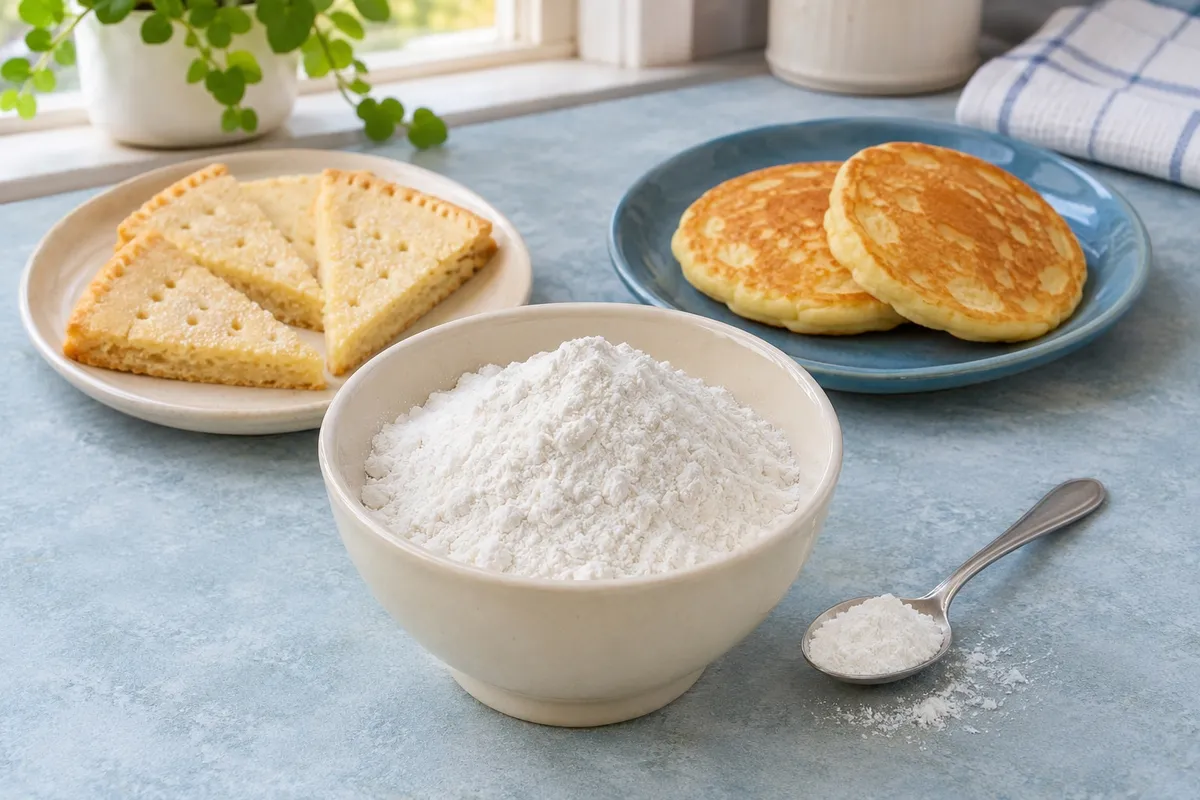
A bag of rice flour can lead to a crisp butter biscuit or a panful of breakfast pancakes. It doesn’t follow that the same bag can replace every cup of wheat flour in your kitchen. The useful question is what the flour needs to do in the particular recipe.
Plain rice flour isn’t a universal one-for-one substitute for all-purpose wheat flour. Choose a formula that specifies rice flour, or a replacement blend whose maker supports that use. Our two examples take different approaches: wheat-and-rice shortbread keeps most of its wheat flour, while the pancakes use white rice flour as their only flour.
If you’re choosing between ground rice, rice flour and intact grains for a pudding, start with our ground-rice shopping guide. This guide moves on to baking and pancake batter, where the other ingredients matter just as much as the name on the flour bag.
Start with the label on the bag
Ordinary white rice flour, brown rice flour and sweet rice flour aren’t three names for an identical ingredient. Brown rice flour includes the bran; white rice flour is milled from polished rice. Their color and flavor differ, and a recipe may specify one rather than offering both.
Sweet rice flour is another distinction. Koda Farms identifies its Mochiko as flour milled from short-grain sweet rice and its ordinary rice flour as a medium-grain product. Sweet rice is also called glutinous rice. That word describes its sticky character, not the presence of wheat gluten; sweet rice flour is not sugar added to ordinary rice flour.
For the companions here, buy plain, finely milled white rice flour, without added starches, gums or raising agents. Sweet rice flour, a self-rising rice product and a formulated gluten-free baking blend are different shopping choices. Keep them for recipes that ask for them.
Grind matters too. A coarse ground-rice ingredient meant for a particular pudding shouldn’t be assumed to behave like fine flour in a biscuit dough. A label and a recipe are more useful than trying to decide by color alone.
Replacing some flour is different from replacing all of it
In Anson Mills’ Charleston Scotch Cake, a shortbread, the flour mixture contains 7.5 ounces wheat flour and 2.5 ounces rice flour. Rice therefore supplies one-quarter of the flour weight. Three-quarters remains wheat.
Our Rice-Flour Shortbread follows that balance, with the source ounce weights converted and lightly rounded to grams. It keeps the specified European-style butter and the round pan. The original calls for Carolina Gold rice flour; using another fine ordinary white rice flour is an ingredient adaptation, not a claim that every mill’s grind behaves identically.
This is a butter biscuit that contains wheat. The rice flour changes part of the flour mixture; it doesn’t make the finished shortbread gluten-free. Removing the remaining wheat would create a different formula that needs its own assessment.
That distinction is useful beyond biscuits. A recipe containing a little rice flour doesn’t establish how much wheat can be removed from an unrelated cake. Nor does a successful all-rice preparation establish a general replacement ratio. Keep the evidence with the formula that supplies it.
Pancakes can start from a rice-flour formula
Alice Medrich’s Basic Pancakes, published by Sunset, explicitly offers white rice flour among its flour choices. Her mixture also includes eggs, milk, butter and baking powder. Rice flour isn’t being asked to make a yeast bread on its own.
Our White Rice Flour Pancakes selects that white-rice branch. It retains the two eggs and the warm milk-and-butter mixture, with a longer estimated home cooking allowance for successive skillet batches. It doesn’t borrow a batter from our Classic Buttermilk Pancakes and silently exchange the flour.
Use the first small pancake to check the heat and consistency. If the outside colors before the center cooks, lower the heat. A thin spatula and a set underside make turning easier than trying to flip a wet, fragile round early.
A replacement blend is a separate product
Some gluten-free baking flours combine rice flour with other flours, starches and a binder. Their replacement instructions apply to the formulated product, rather than to plain rice flour taken from another bag.
King Arthur distinguishes its Measure for Measure blend from individual flours and from products intended for yeast bread. Bob’s Red Mill likewise directs readers to the particular uses and binder requirements of its different blends. Read the exact product instructions: one bag’s cup-for-cup guidance isn’t a property shared by everything called gluten-free flour.
For a wheat-free cake or yeast loaf, a complete recipe designed for that flour or blend is a better starting point than an unsupported universal swap. If a dietary restriction is involved, check every ingredient and preparation surface as well. The shortbread in this package remains unsuitable for someone avoiding wheat.
| What you’re trying to make | Useful starting point | What not to infer |
|---|---|---|
| Butter shortbread with a rice-flour component | A specified wheat-and-rice formula with its pan and thickness | That the remaining wheat can simply be removed |
| Pancakes using ordinary white rice flour | A rice-flour batter with its own eggs, liquid and leavening | That the same proportions work in every cake |
| Baking with a packaged replacement blend | The maker’s instructions for that exact blend and type of bake | That plain rice flour has the same binders or replacement rules |
| A historical rice pudding | The source’s ingredient form and the chosen modern adaptation | That ground rice always meant the modern bag on your shelf |
Keep the amount and the form together
A cup of rice flour and a cup of wheat flour needn’t weigh the same. Our cups-and-grams guide explains why a volume conversion needs an ingredient and form, rather than a single number for flour.
For the pancakes, the 240 g allowance is derived from Medrich’s own equivalence of 120 g for three-quarters of a cup of white rice flour elsewhere in that same recipe. It is not a laboratory measurement or a universal rice-flour cup weight. The shortbread starts from source weights, so it doesn’t require a flour-density estimate.
More batter usually means more rounds through the pan. More shortbread belongs in additional pans at the same depth. Ingredient scaling changes the amount to prepare; it doesn’t multiply the oven temperature or tell you how quickly the center will cook.
Two ways to use the bag
Choose the shortbread for a wheat-and-rice butter dough that is baked, divided while hot and left to cool fully. Choose the pancakes for a white-rice batter that cooks in small portions on the stove. The first keeps wheat in the recipe; the second has a separate formula without it. Those are useful choices to make before anything reaches the mixing bowl.
Sources
- Anson Mills, Charleston Scotch Cake (Shortbread): source formula, flour proportions, butter and pan method.
- Alice Medrich, Basic Pancakes, Sunset: permitted white-rice branch and source cup-weight equivalence.
- Koda Farms, branded rice products: ordinary rice flour and Mochiko ingredient distinctions.
- King Arthur Baking, Which gluten-free flour should I use?: individual flours and purpose-made replacement blends.
- Bob’s Red Mill, What is the best gluten-free flour for baking?: product-specific uses and binder distinctions.