

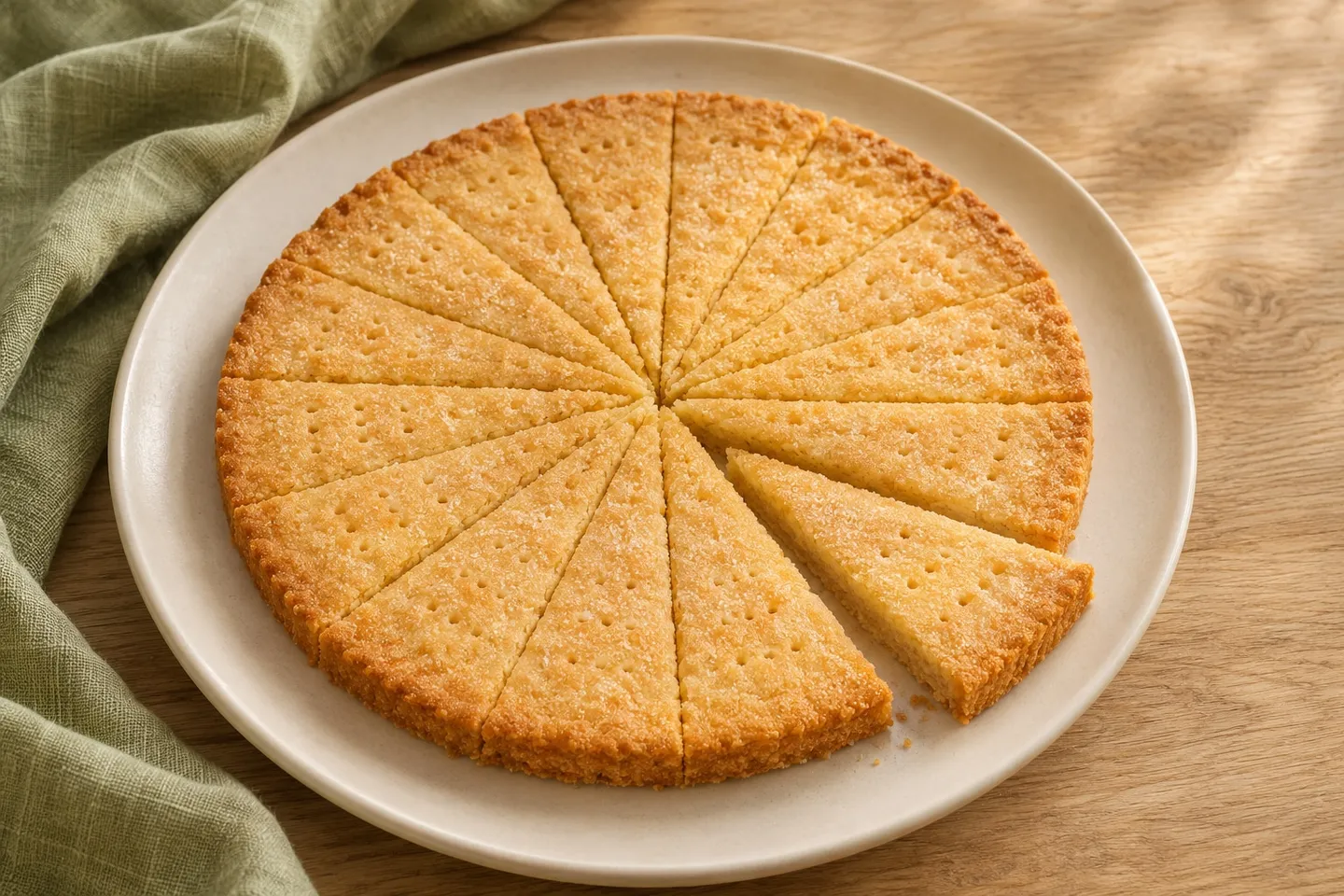
Rice-Flour Shortbread with Wheat Flour
A round butter shortbread made with three parts wheat flour to one part white rice flour, finished with sugar and cut into small wedges.
- Original yieldYield
- 16 small wedges; 2 per serving16 small wedges2 per serving
- PrepPrep time
- CookCook time
- TotalTotal time
Estimated 10 minutes preparation, 60 to 70 minutes baking and at least 40 minutes cooling. Cooling may take longer in a warm kitchen.
Published
Wheat-and-rice shortbread cut into wedges.
Original recipe: 16 small wedges; 2 per serving
The story behind the recipe
Rice flour has a small but deliberate job in this shortbread. It supplies one-quarter of the flour mixture; wheat supplies the rest. Butter, fine sugar and a little salt complete a dough that goes into one round pan and comes out in sixteen narrow wedges.
A biscuit with wheat still in it
Choose this recipe for a wheat-and-rice butter biscuit. It isn't a gluten-free shortbread, and substituting rice flour for the remaining wheat would make a different dough. The three-to-one flour balance is part of the recipe, not a starting point for removing ingredients at random.
Read more about this recipe
Where the proportions come from
Anson Mills publishes the source as Charleston Scotch Cake (Shortbread). Its formula uses seven and a half ounces of wheat flour and two and a half ounces of rice flour. The modern weights here are rounded conversions of those amounts, with the same treatment for the butter and the sugar mixed into the dough.
The rounding is small: 7.5 ounces becomes 213 g, 2.5 ounces becomes 71 g, 3.5 ounces becomes 99 g, and 5 ounces becomes 142 g. A separate spoonful of sugar finishes the top. It belongs outside the dough quantity because it is added after baking, when the shortbread is still hot.
The source specifies Carolina Gold rice flour. Our ingredient line uses fine ordinary white rice flour so the required form is clear when shopping. A different mill's flour remains an adaptation; the name doesn't establish identical grind or baking behavior. Sweet or glutinous rice flour isn't the ingredient selected here.
Butter and sugar are specific choices
Keep the butter cold for the food-processor method. The machine distributes small pieces through the dry mixture before the crumbs are firmly pressed into the pan. This is a different sequence from beating softened butter and sugar into a light cake mixture.
European-style butter is retained from the source rather than quietly replaced with a lower-fat spread. A product labeled as a spread may contain a different balance of water and fat. Use butter, not a spread chosen because the package looks similar.
Superfine sugar means sugar with small crystals, sometimes sold as caster sugar. It is not confectioners' sugar. The source's separate finishing sugar and its dough sugar have the same ingredient name but different places in the method. Keeping those roles visible is useful when adjusting a batch.
The round pan controls the depth
A 9-inch round pan gives this amount of dough a defined area. Pressing the mixture evenly helps avoid a tall center and thin edges. The source uses the pan ungreased; the butter is already in the dough.
The partial bake before scoring is another useful detail. The round first spends twenty minutes in the oven, then receives its wedge marks and small holes. At that stage, score the surface without cutting all the way through. The final cuts are made while the baked shortbread is hot, and lifting waits until it is completely cool.
For more shortbread, additional pans preserve the original depth more predictably than stacking twice the dough in one pan. A half batch needs half the original pan area, not necessarily a pan with half its diameter. The serving controls change ingredients; the written heating stages still need a cook's attention.
What to serve beside it
These are small, plain butter biscuits with a sugar finish. They don't need icing to complete the formula. Tea or coffee leaves room for that simplicity, while a separate bowl of fruit offers contrast without adding moisture to the stored biscuits.
For the ingredient question behind the recipe, the rice-flour baking guide compares this partial replacement with a pancake formula that uses white rice flour as its only flour.
Make it your wayOriginal: 8 servings · Makes 16 small wedges; 2 per serving
Original recipe: 16 small wedges; 2 per serving
Ingredients
For 16 small wedges; 2 per serving. Quantities are shown as written.
Source measurement convention: Metric. Explicit unit definitions take precedence; unconfirmed measures must be checked before conversion.
Original quantities for 16 small wedges; 2 per serving.
- All-purpose flour213 g
- Plain finely milled white rice flour71 g
- Superfine sugar, for the dough99 g
- Fine sea salt1/2 tsp
- Unsalted European-style butter, cold and cut into small pieces142 g
- Superfine sugar, for finishing1 tbsp
Measurement notes
- fine sea salt: US tsp: 1 = 4.9289 ml (rounded).
- superfine sugar, for finishing: US tbsp: 1 = 14.7868 ml (rounded).
Measurement notes
Original ingredients
- 213 g all-purpose flour
- 71 g plain finely milled white rice flour
- 99 g superfine sugar, for the dough
- 1/2 US tsp fine sea saltUS tsp: 1 = 4.9289 ml (rounded).
- 142 g unsalted European-style butter, cold and cut into small pieces
- 1 US tbsp superfine sugar, for finishingUS tbsp: 1 = 14.7868 ml (rounded).
Equipment
 Food processor
 9-inch round cake pan
 Thin spatula
 Knife
 Wire cooling rack
Instructions
Heat the oven and mix dry ingredients
Set oven racks in the lower and upper thirds and heat the oven to 325°F (165°C), conventional heat. Combine the all-purpose flour, white rice flour, dough sugar and salt in the food processor, using short pulses to distribute them.
Process the butter and press into the pan
Add the cold butter pieces. Pulse until the mixture resembles coarse crumbs, then process briefly, about 10 seconds, until the crumbs are fine. Tip into an ungreased 9-inch round cake pan and press into a firm, even layer with the back of a spoon or a spatula.
Partially bake, score and prick
Bake on the lower rack for 20 minutes. Remove the pan briefly and mark sixteen equal wedges in the surface with a knife. Prick each wedge with a wooden skewer or toothpick. Neither the score marks nor the holes should go completely through the dough at this stage.
Finish baking until toasted brown
Return to the lower rack for another 10 minutes. Move to the upper rack and bake for a further 30 to 40 minutes, until the shortbread is evenly toasted brown. Watch the edges toward the end; the full bake is approximately 60 to 70 minutes.
Sugar, cut and cool completely
Put the pan on the wire cooling rack. While the shortbread is hot, scatter over the finishing sugar and carefully cut through the scored lines. Let it cool completely in the pan before lifting the wedges with a thin spatula. Allow at least 40 minutes for cooling, longer if the center is still warm.
Recipe notes
When adjusting quantities
At the original quantity use one 9-inch round pan. Keep the original dough depth when changing the quantity: use proportionately smaller pan area for a half batch, or additional original-sized pans for larger batches. Do not multiply temperature or baking time.
Original recipe notes
These notes describe the original recipe. Quantities mentioned here do not change when you adjust servings.
Contains wheat and milk. This is not gluten-free. Use plain fine white rice flour; sweet rice flour, coarse ground rice and a packaged replacement baking blend are outside this formula.
The gram weights are rounded source-weight conversions. The salt and finishing sugar retain source spoon measures; US spoons are intended. The source uses 325°F; 165°C is the rounded conventional-oven display.
For half the quantity, use approximately half the original pan area and retain the dough depth. For larger quantities use additional pans. Mark a proportionate number of equally sized wedges. Bake and cool according to the food's condition; elapsed time does not multiply with the ingredients.
Read the scaling guide. Times, temperatures and equipment need their own consideration. Open the recipe tool to review and correct individual amounts.
Sources and attribution
Adapted from Anson Mills' Charleston Scotch Cake (Shortbread).
Adapted from Anson Mills' Charleston Scotch Cake. Source weights are converted and rounded to grams; fine ordinary white rice flour replaces the specified Carolina Gold product. Sixteen source wedges are presented as eight two-piece servings. TuneMyRecipe has not recorded a kitchen test of this adaptation.
Adapted from Anson Mills' Charleston Scotch Cake. Source weights are converted and rounded to grams; fine ordinary white rice flour replaces the specified Carolina Gold product. Sixteen source wedges are presented as eight two-piece servings. TuneMyRecipe has not recorded a kitchen test of this adaptation.
Recipe details
- Cuisine
- American
- Cooking method
- Oven
- Browse category
- Baking & Desserts