

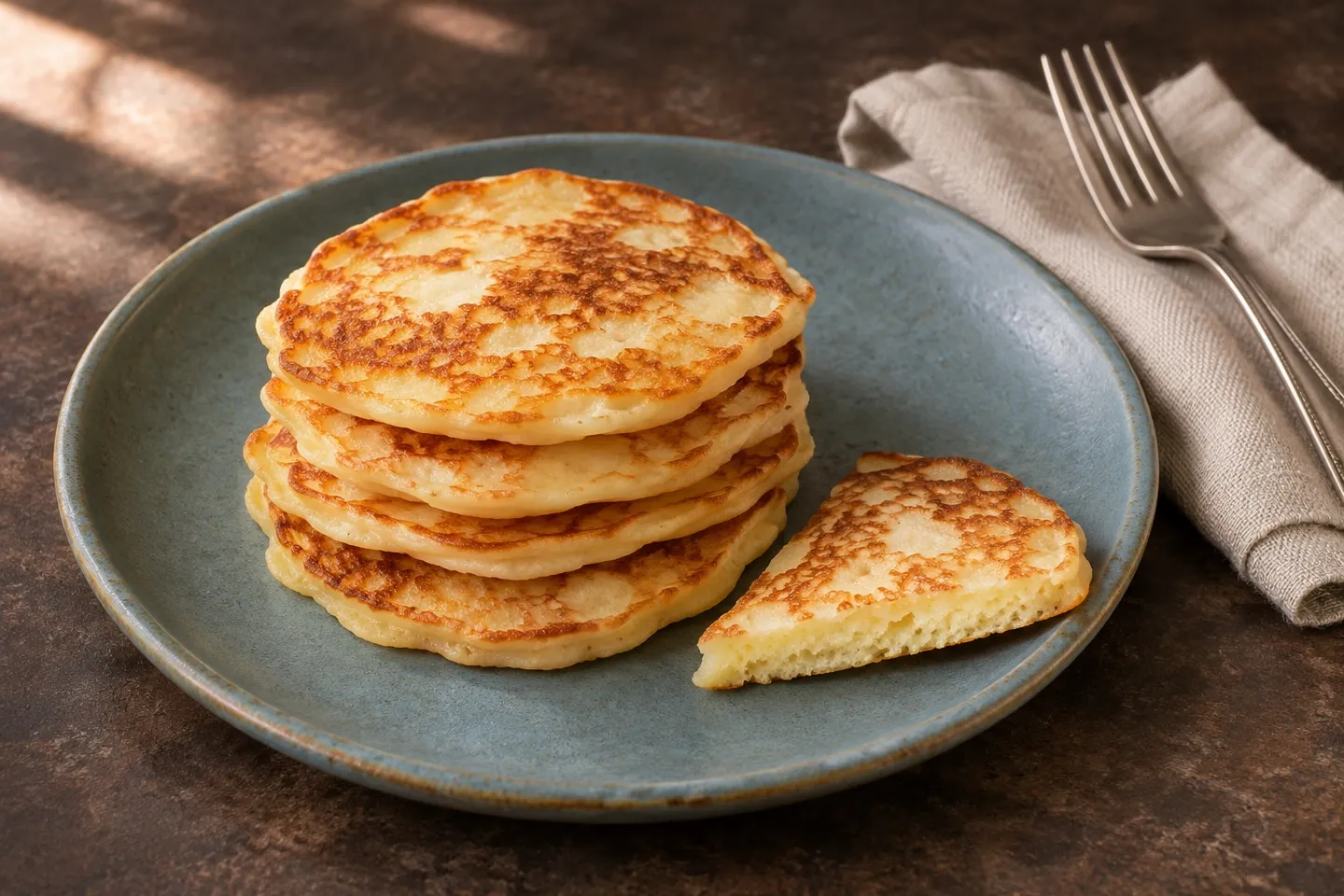
White Rice Flour Pancakes
Small breakfast pancakes using plain white rice flour as the only flour, with eggs, warm milk, butter and baking powder.
- Original yieldYield
- About 14 small pancakesAbout 14 small pancakes
- PrepPrep time
- CookCook time
- TotalTotal time
Estimated 5 minutes mixing and 20 minutes cooking in skillet batches. A larger griddle may shorten the total; use doneness cues for each pancake.
Published
White rice flour pancakes, served plain.
Original recipe: About 14 small pancakes
The story behind the recipe
These pancakes put ordinary white rice flour at the center of breakfast. Eggs, warm milk, melted butter and baking powder turn it into a batter for small rounds cooked in a skillet. There is no wheat flour hidden in the mixture, and no ready-made baking blend to find first.
Start with the right rice flour
Buy plain, finely milled white rice flour. Sweet rice flour, also sold as glutinous rice flour, is a different ingredient. The recipe doesn't call for a self-rising product or a blend containing added gums and starches. A useful shopping decision happens before the batter is mixed.
Read more about this recipe
A source that offers rice flour by name
Alice Medrich's Basic Pancakes, published by Sunset, lists white rice flour as one of its flour options. This version selects that branch and keeps the source's eggs, butter, milk and baking powder. It isn't the site's buttermilk-pancake batter with a flour exchange made afterward.
The source measures its main flour allowance in cups. In a separate conditional variation on the same page, Medrich supplies 120 g for three-quarters of a cup of white rice flour. The 240 g here is derived by doubling that stated relationship for the one-and-a-half-cup allowance. That is a source-specific conversion, not a universal weight for every cup of rice flour.
We have also made the small salt measure level rather than slightly rounded and allowed more time for cooking successive home skillet batches. The original approximate yield is retained as about fourteen small pancakes, presented here as four servings. Actual count varies with the amount poured for each round. The source leaves extra pan butter and any liquid adjustment unmeasured; we provide 14 g butter and up to 30 ml milk as practical allowances, separate from the batter formula.
The rest of the batter matters
The flour choice doesn't remove the eggs or butter. Eggs are part of the selected source formula, while the butter is melted and the milk warmed before mixing. Warm means comfortably warm, not boiling: very hot liquid would begin cooking the eggs instead of joining a smooth batter.
Baking powder supplies the leavening in this version. Baking soda is not an equivalent ingredient to exchange spoon for spoon. There is no buttermilk in the selected mixture, and adding it would change another variable alongside the flour.
Rice flour on its own also differs from a packaged gluten-free replacement blend. Such blends may include several flours, starches and a binder, each chosen for a purpose. This recipe specifies its individual flour and the surrounding ingredients; a blend should follow its own supported recipe instead.
Give the first small pancake a useful job
A small first round lets you judge the hot pan and the batter before filling every available space. It should spread enough to make a pancake rather than remain as a mound. If necessary, a little extra milk loosens the mixture; add it gradually instead of pouring in an unmeasured large splash.
Let the first side set before slipping a thin spatula underneath. A few bubbles and a surface that is losing its wet shine are useful signs to watch. Look underneath too. If the surface browns while the center remains wet, lower the heat and give the inside time to cook.
Keep the rounds small enough to lift cleanly. Additional batter is a reason for another batch, not for making each pancake much thicker. A large stack cooked in one crowded pan makes it harder to turn a round without disturbing its neighbor.
Breakfast choices can stay simple
Serve the pancakes warm. Fruit or syrup can be offered separately so each person can choose the amount. Keeping them separate also lets the plain pancake remain the starting point for breakfast.
The rice-flour baking guide compares this all-rice flour mixture with a shortbread that retains wheat. If you're using intact grains or a coarse ground-rice product, the rice-pudding ingredient guide addresses that different shopping question.
Make it your wayOriginal: 4 servings · Makes About 14 small pancakes
Original recipe: About 14 small pancakes
Ingredients
For About 14 small pancakes. Quantities are shown as written.
Source measurement convention: Metric. Explicit unit definitions take precedence; unconfirmed measures must be checked before conversion.
Original quantities for About 14 small pancakes.
- Plain finely milled white rice flour240 g
- Granulated sugar1 tbsp
- Baking powder2 tsp
- Fine salt1/2 tsp
- Large eggs2
- Unsalted butter, melted and warm57 g
- Unsalted butter, for greasing the pan14 g
- Whole milk, warm1 cup
- Whole milk, optional, for adjusting the batter30 ml
Measurement notes
- granulated sugar: US tbsp: 1 = 14.7868 ml (rounded).
- baking powder, fine salt: US tsp: 1 = 4.9289 ml (rounded).
- whole milk, warm: US cup: 1 = 236.5882 ml (rounded).
Measurement notes
Original ingredients
- 240 g plain finely milled white rice flour
- 1 US tbsp granulated sugarUS tbsp: 1 = 14.7868 ml (rounded).
- 2 US tsp baking powderUS tsp: 1 = 4.9289 ml (rounded).
- 1/2 US tsp fine saltUS tsp: 1 = 4.9289 ml (rounded).
- 2 large eggs
- 57 g unsalted butter, melted and warm
- 14 g unsalted butter, for greasing the pan
- 1 US cup whole milk, warmUS cup: 1 = 236.5882 ml (rounded).
- 30 ml whole milk, optional, for adjusting the batter
Equipment
 Mixing bowl
 Whisk
 Large skillet or griddle
 Thin spatula
 Measuring spoons
Instructions
Whisk dry and wet ingredients separately
Whisk the rice flour, sugar, baking powder and salt together in a mixing bowl. In a separate bowl or jug, beat the eggs, then stir in the warm milk and melted butter. Use the butter measured for the batter, keeping the separate pan butter aside. The milk and melted butter should be warm, not hot enough to cook the eggs.
Combine and check the batter
Add the liquid to the dry ingredients and whisk until smooth. The batter should be pourable. If it sits in a stiff mound, stir in the optional adjusting milk a teaspoon at a time until it spreads from the spoon, using only as much of that allowance as needed. Any extra milk is a consistency adjustment, not a replacement for the measured starting amount.
Heat the pan and try a small pancake
Heat a large skillet or griddle over medium heat, then brush with a little of the pan butter. Cook one small pancake first, using approximately 3 US tablespoons (45 ml) batter and guiding it into a small round about 3 to 4 inches (8 to 10 cm) across. Adjust the heat if the butter or pancake darkens quickly.
Cook, turn and check the center
Cook until the underside is lightly golden, the edges are set and a few bubbles appear, approximately 1 to 2 minutes. Slide a thin spatula underneath, turn once, and cook the other side for about 30 to 60 seconds, or longer if needed for the center to lose its raw batter. Reduce the heat if browning is faster than cooking through.
Cook the remaining batches
Continue in uncrowded batches, using the remaining pan butter sparingly between batches. Keep the pancake size similar and serve promptly. At the original ingredient quantity, expect approximately fourteen small pancakes; the exact count depends on portion size.
Recipe notes
When adjusting quantities
Keep each pancake small and cook extra batter in additional batches. Ingredient scaling does not change the heat or the cooking time for each pancake. For fractional eggs, beat and measure the required portion.
Original recipe notes
These notes describe the original recipe. Quantities mentioned here do not change when you adjust servings.
Contains eggs and milk. No wheat ingredient is added, but no gluten-free dietary label is assigned: ingredient labels, manufacturing and cross-contact still matter. Do not substitute sweet/glutinous rice flour, coarse ground rice or a packaged flour blend for the named ordinary flour.
One cup means an exact US cup, and spoons are US measures. The starting milk allowance is about 237 ml; a 250 ml metric cup would add extra liquid. The 240 g rice flour follows the source-specific derivation described above. Batter butter is rounded from four US tablespoons, approximately 56.7 g, to 57 g. The additional 14 g pan butter and optional 30 ml adjusting milk are author-defined allowances; use only what is needed.
For half a batch use half the ingredients. For quantities requiring a fraction of an egg, beat the egg and measure the needed portion. More batter needs more skillet batches; do not multiply the heat or the per-pancake cooking time. Keep the doneness check in the method when changing servings.
Read the scaling guide. Times, temperatures and equipment need their own consideration. Open the recipe tool to review and correct individual amounts.
Sources and attribution
Adapted from the white-rice-flour option in Alice Medrich's Basic Pancakes, published by Sunset.
Adapted from Alice Medrich's Basic Pancakes in Sunset, selecting ordinary white rice flour. The flour weight is derived from the author's stated cup equivalence; butter is converted to grams, salt is leveled and batch timing is a home-kitchen estimate. TuneMyRecipe has not recorded a kitchen test of this adaptation.
Adapted from Alice Medrich's Basic Pancakes in Sunset, selecting ordinary white rice flour. The flour weight is derived from the author's stated cup equivalence; butter is converted to grams, salt is leveled and batch timing is a home-kitchen estimate. TuneMyRecipe has not recorded a kitchen test of this adaptation.
Recipe details
- Course or meal
- Breakfast
- Cuisine
- American
- Cooking method
- Stovetop
- Browse category
- Breakfast & Brunch