

- Ingredient comparisons
- Oats
- Cooking & measurement
Rolled, Quick or Steel-Cut Oats? Choose the Form Your Recipe Needs
Read oat labels, compare product cooking directions and keep dry oats distinct from cooked oatmeal before choosing oats for a bowl or a meatloaf.
A saucepan of oats gives you room to watch and stir. A meatloaf puts the oats inside the mixture, where you can’t judge their tenderness until dinner is cooked. That difference matters when you’re tempted to use whichever box is already open.
For a recipe that specifies old-fashioned rolled oats, buy those flakes. Steel-cut oats are pieces of the kernel; quick and instant oats have been prepared for faster softening. All can make oatmeal, but the shared breakfast name doesn’t give them the same cooking requirements or make them interchangeable in a loaf.
The useful shopping question is: what has happened to the oat, and what does this recipe expect it to do?
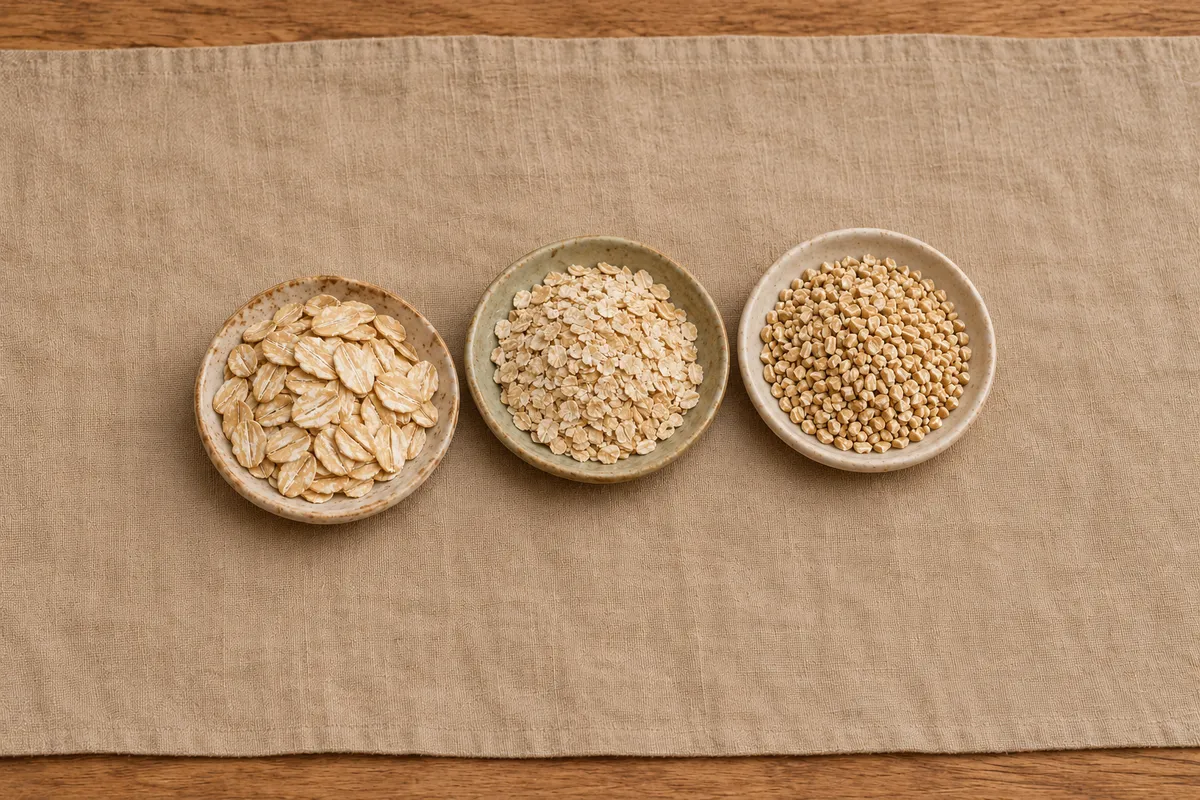
In the photograph, left to right: old-fashioned rolled oats, quick rolled oats and traditional steel-cut oats.
Look at the shape before the cooking time
Oat groats are the kernels from which these products are made. Cutting, rolling and grinding produce different forms. Bob’s Red Mill describes its rolled oats as steamed groats rolled to a chosen thickness, with quick, regular and thick versions made by that method. Its steel-cut oats are cut into larger pieces, while its Scottish oatmeal is stone-ground. Bob’s manufacturing explanation makes the distinction clearer than a breakfast photograph.
| Label | Form to recognize | What to check next |
|---|---|---|
| Old-fashioned or regular rolled oats | Flat flakes | Whether the recipe specifies regular or a thicker flake |
| Quick-cooking rolled oats | Thinner flakes prepared for faster cooking | That these are rolled oats, rather than quick-cooking steel-cut oats |
| Instant oatmeal | Thin, finely chopped rolled oats | Ingredients, packet amount and preparation method |
| Steel-cut oats | Cut kernel pieces rather than flakes | Traditional or quick-cooking product, plus its liquid and timing |
| Scottish oatmeal | A ground meal in Bob’s product range | Grind and directions; don’t assume rolled flakes |
| Oat flour | Oats milled into flour | Whether the recipe actually calls for flour |
Quaker’s comparison of its oat forms describes old-fashioned oats as flat and flaky, quick oats as thin, and instant oats as thinner and more finely chopped. It associates steel-cut oats with a chewier bowl and instant oats with a soft one. Those descriptions help you choose a breakfast texture. They don’t establish a replacement quantity for baking.
“Quick” needs another word beside it
Quick rolled oats and quick steel-cut oats are different products. Read the whole name rather than treating quick as a fifth oat shape.
Consider Quaker’s two steel-cut products. Its Traditional Steel Cut Oats directions call for an uncovered simmer of 25–30 minutes, or until the desired texture. Its Quick 3-Minute Steel Cut Oats page gives about five minutes for the stovetop method. The microwave instructions specify 2½–3 minutes at 50% power, followed by 2–3 minutes to cool, with a separate wattage table.
Even the words on the front of that second product need the cooking instructions behind them. Three minutes isn’t a promise for every appliance or method, and it isn’t the complete time from opening the package to eating.
Quaker’s general preparation guide provides another useful comparison: about five minutes on the stove for its old-fashioned oats and about one minute for its quick rolled oats. The instant-packet hot-water method instead includes a two-minute stand. These are manufacturer instructions for named products and methods, not universal times for every bag of oats.
Before starting a bowl, check the liquid amount, heat or microwave power, stirring and standing time together. A familiar product name is easy to remember; a change in any of those instructions is easier to miss.
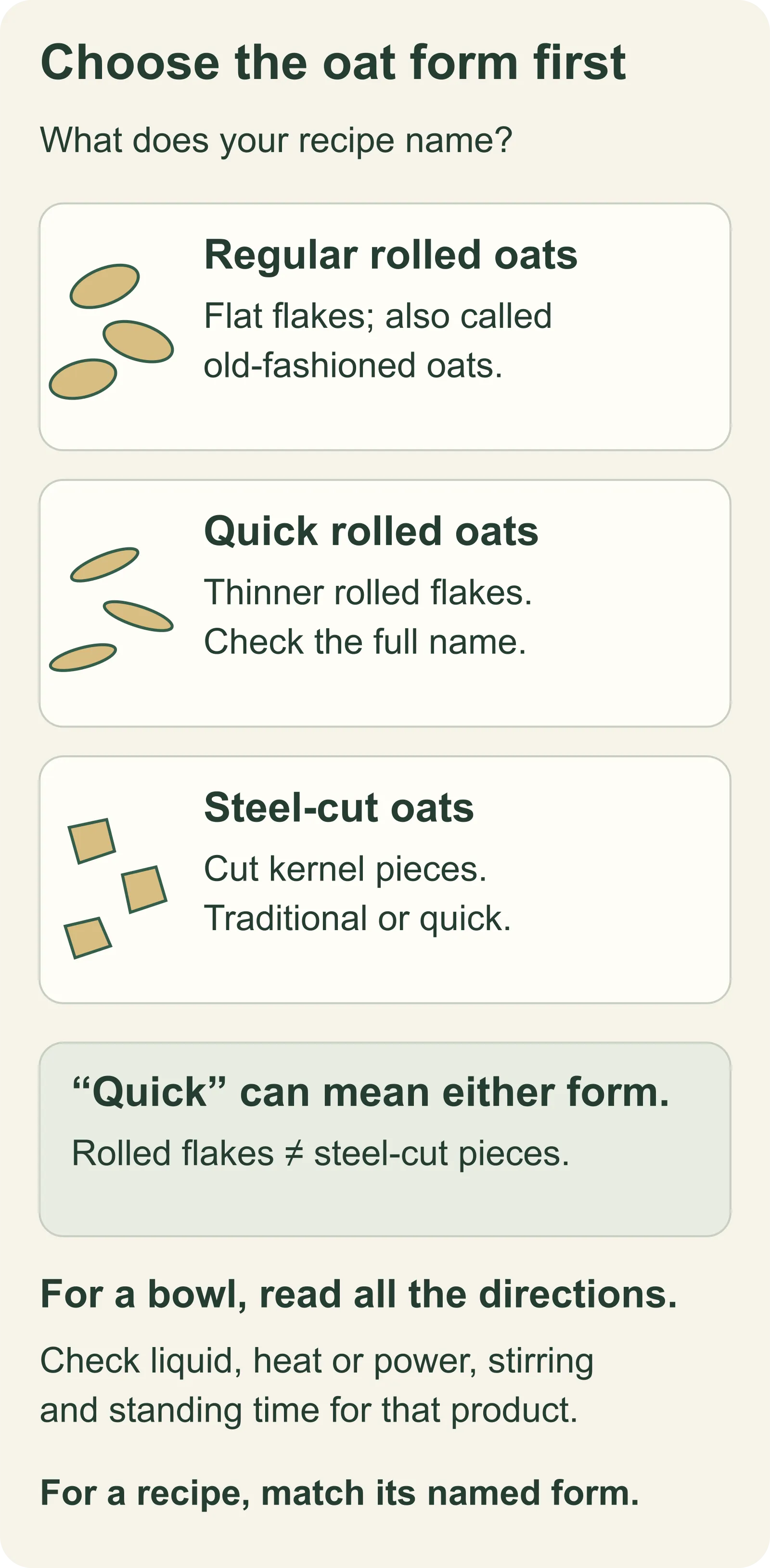
Read the full product name: quick rolled oats and quick steel-cut oats are different forms. Diagram: TuneMyRecipe.
Oatmeal can describe the dish or the ingredient
In an American breakfast recipe, oatmeal often means the cooked bowl. On a package, it can be part of a product name whose contents still need identifying. Scottish oatmeal is a useful warning against reading the word as a synonym for rolled oats: Bob’s Scottish Oatmeal description identifies oats ground between millstones, rather than steamed and rolled flakes.
Regional wording therefore deserves a second look. If a recipe says only oatmeal, look for a grade, a description of the grind, preparation instructions or a photograph of the uncooked ingredient. Does the author stir flakes into boiling liquid, mix a meal with cold liquid, or add dry oats to a meat mixture? The method supplies clues, although it may not settle an unclear ingredient by itself.
Oat flour is a separate shopping choice. Bob’s flour catalog identifies oat flour as milled whole-grain oats. Grinding changes the form: flour doesn’t supply the flakes named in a rolled-oat recipe. Don’t use the presence of oats in both bags as a substitution rule.
Measure the oats at the stage the recipe names
Dry oats and cooked oatmeal aren’t two labels for the same measured quantity. Cooking introduces liquid, and the amount retained depends on the preparation. A cup of finished porridge can’t tell you how much dry grain went into it without that recipe’s quantities and yield.
Read the qualifier beside the number. “45 g old-fashioned rolled oats” asks you to weigh dry flakes before cooking. “Cooked oatmeal” would require a prepared ingredient. Adding a scoop from yesterday’s breakfast to a formula written for dry oats also adds its retained liquid and any milk, salt or other ingredients used in that bowl.
Weight answers how much you have; it doesn’t answer which form you have. Weighing 100 g of steel-cut oats accurately doesn’t turn them into 100 g of rolled flakes. Likewise, a cup-to-gram reference needs to match the named ingredient and its state. Our cups-and-grams guide explains why those qualifiers belong with the conversion.
A creamy bowl and a sliceable loaf
Our Savory Oatmeal with Chili Crisp and Fried Egg begins with 45 g old-fashioned rolled oats and 240 ml broth. The written method gives the oats a gentle 5–7-minute simmer, until tender, thick and creamy. They form the soft base beneath the fried egg and crunchy condiment.
That liquid amount and short simmer belong to the specified rolled oats. For a steel-cut breakfast, choose directions written for the particular steel-cut product before planning when to fry the egg. Following that product’s porridge method would be a different preparation, rather than a tested substitution in this recipe.
The Savory Oatmeal Meatloaf (1934) puts 100 g dry rolled oats into a mixture with ground beef, drained tomatoes, cooked salt pork and onion. There is no separate porridge stage. Follow its written baking method, center-temperature check and rest before slicing; the cooking time printed on a cereal box doesn’t replace those instructions.
The oats are a modern adaptation choice. The recipe’s USDA source used bread crumbs in its measured example, and the site’s story explains that the rolled-oat amount isn’t a one-for-one conversion of the historical crumbs. This loaf offers a different use for the same oat form as the breakfast bowl, without establishing how quick oats, steel-cut oats or flour would perform inside it.
If you’re shopping for both recipes, plain old-fashioned rolled oats cover the shared requirement. If you’re shopping for your own bowl of porridge, choose the cut or flake you want and read that product’s directions. The ingredient name and the cooking plan should agree before the oats reach the pan.
Two older uses of oatmeal
Scotch Leek and Oatmeal Soup: a meal stirred into broth
Rundell’s 1806 Scotch Leek Soup mixes oatmeal smooth with cold water before it enters the simmering leek broth. The modern adaptation chooses fine oatmeal and ready-made lamb stock. This is an attended thickening stage, quite different from adding dry rolled flakes inside a meatloaf or serving a separate breakfast bowl.
Cook: Scotch Leek and Oatmeal Soup (1806)
Coarse Oatmeal Porridge with Milk: a different grain preparation
The 1906 revised Beeton describes coarse, medium and fine oatmeal and generally prefers coarse for porridge. The selected modern version uses coarse oatmeal, an overnight refrigerator soak and milk at serving. Buy the named coarse form rather than assume quick rolled flakes follow that soaking plan; the milk is a disclosed addition to the household formula.
Cook: Coarse Oatmeal Porridge with Milk (1906)
Rundell’s A New System of Domestic Cookery (1806), p. 99, and Mrs. Beeton’s Book of Household Management, revised edition (1906), no. 3149, provide these separate historical examples. Neither assigns a universal modern product to the word oatmeal.
Sources
Quaker’s linked oat comparison supplies its descriptions of old-fashioned, quick, instant and steel-cut forms. The linked preparation guide and individual Traditional and Quick 3-Minute steel-cut product pages supply the specific cooking examples; follow the current package for the product you buy.
Bob’s Red Mill’s linked manufacturing explanation and Scottish Oatmeal product page distinguish rolled, cut and ground forms. Its linked 2022 flour catalog identifies oat flour as milled whole-grain oats; it is used here for that ingredient distinction, not current availability. Recipe quantities and methods above refer to the two linked TuneMyRecipe recipes.