

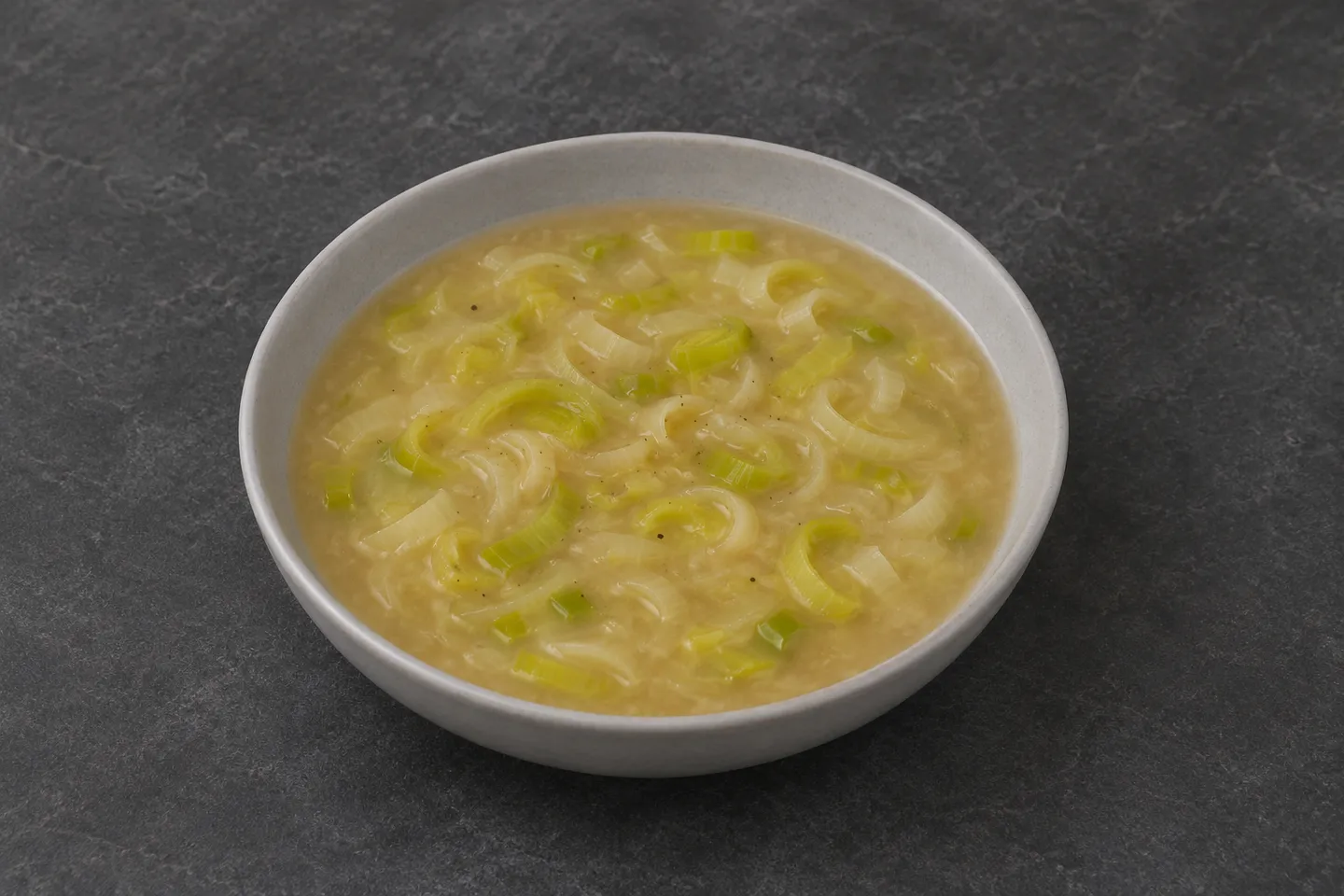
Scotch Leek and Oatmeal Soup (1806)
A gently simmered leek soup thickened with fine oatmeal, using ready-made lamb stock in an adaptation of an 1806 recipe.
- Original yieldYield
- 3 bowls; final volume varies with evaporation3 bowlsfinal volume varies with evaporation
- PrepPrep time
- CookCook time
- TotalTotal time
Estimated: 15 minutes preparation, about 5 minutes heating, 25 to 35 minutes simmering leeks and 10 to 15 minutes after adding oatmeal.
Published
Original recipe: 3 bowls; final volume varies with evaporation
The story behind the recipe
The oatmeal goes into this soup after the leeks have softened. It's mixed with cold water first, then stirred into the hot stock for a gentle final simmer. You still have pieces of leek in the bowl, with a little body in the broth around them rather than a pan of breakfast porridge.
A savory place for oatmeal
The 1806 recipe calls itself Scotch Leek Soup. Its flavor begins with the liquid from boiling a leg of mutton, seasoned with leeks, salt and pepper. Oatmeal follows as a thickener. There's no cream, potato or separate flour mixture in the directions, which makes the grain's presence particularly easy to follow.
Read more about this recipe
Read the stock instruction first
The old book assumes that a leg of mutton has already been boiled. Its cooking liquid is the starting ingredient, rather than an instruction to cook the joint inside this short soup recipe. That distinction matters when planning dinner: a pan of ready broth and a raw leg of meat are very different starting points.
The method below uses ready-made cooked lamb stock, so you can make the soup without preparing a separate meat dish. Read its label for salt, storage and preparation directions. A highly salted stock may need little extra seasoning at the end. Taste the cooked soup before reaching for the salt, particularly as simmering changes how much liquid remains.
Lamb stock is a modern replacement here. It doesn't recover the strength, fat or seasoning of an unidentified pot of mutton-boiling water. What it preserves is a meat-broth base in which leeks cook before the oatmeal is added. There's no need to attach a much older origin story to that straightforward sequence.
Weigh the leeks after trimming
The listed weight is the part of the leek going into the saucepan. Remove roots and tough outer material first, then wash carefully between the layers before slicing. Soil caught inside a leek is easy to miss when only the outside has been rinsed.
Thin slices make it easier to judge tenderness in the soup. The source gives an hour for the leeks; this smaller modern batch uses a shorter checking range. Let the actual vegetables guide the end of that stage. Oatmeal won't soften a tough piece of leek simply because the liquid around it has thickened.
Fine oatmeal is an ingredient, too
Buy plain fine oatmeal for the small thickening amount. The word oatmeal can describe a cooked bowl as well as a dry oat ingredient, but this recipe measures it dry. A scoop of finished porridge would introduce both cooked grain and an unknown amount of liquid.
Rolled flakes, cut kernels and ground oats also differ in form. Our oat guide explains why a familiar breakfast name isn't enough to choose a replacement. This short finishing stage is written for fine oatmeal, without a promise that a larger-cut product will cook on the same schedule.
Turn down the heat and keep stirring
Rundell's direction is unusually practical about the final stage: move the pot to a slow part of the fire and take care that it doesn't burn on the bottom. On a modern stove, use a gentle simmer and stir across the base of the saucepan, where sticking can go unnoticed beneath the liquid.
The difference between tender vegetables and a thickened liquid also appears in Why Soup Gets Thick. Here you can check those changes separately. First taste a leek for tenderness; later judge the oatmeal's cooked texture and the body of the broth. Serve the three bowls while the soup is hot, rather than leaving a thickened pan unattended over heat.
Make it your wayOriginal: 3 servings · Makes 3 bowls; final volume varies with evaporation
Original recipe: 3 bowls; final volume varies with evaporation
Ingredients
For 3 bowls; final volume varies with evaporation. Quantities are shown as written.
Source measurement convention: Metric. Explicit unit definitions take precedence; unconfirmed measures must be checked before conversion.
Original quantities for 3 bowls; final volume varies with evaporation.
- Leeks, trimmed weight, washed thoroughly and sliced300 g
- Ready-made cooked lamb stock750 ml
- Fine oatmeal, dry20 g
- Cold water50 ml
- Salt, to taste
- Ground black pepper, to taste
Measurement notes
Measurement notes
Original ingredients
- 300 g leeks, trimmed weight, washed thoroughly and sliced
- 750 ml ready-made cooked lamb stock
- 20 g fine oatmeal, dry
- 50 ml cold water
- Salt, to taste
- Ground black pepper, to taste
Equipment
 Medium saucepan (2-quart)
 Food thermometer
Instructions
Prepare and simmer the leeks
Trim and thoroughly wash the leeks, opening the layers to remove trapped soil, then weigh the listed prepared amount and slice. Put them in a medium saucepan with the cooked lamb stock. Bring to a boil, then reduce to a gentle simmer, cover and cook for about 25 to 35 minutes, until the leeks are tender.
Stir in the oatmeal slurry
Mix the dry fine oatmeal with the listed cold water until smooth. Stir it into the soup, return to a gentle simmer and cook for about 10 to 15 minutes, stirring often across the bottom so it doesn't stick or scorch. Keep the heat low enough for gentle bubbling, not a hard boil.
Season and check the heat
Taste the cooked soup and add salt and black pepper as needed. If using previously cooked refrigerated stock, make sure the soup has boiled during preparation and check that it reaches at least 165°F (74°C) before serving. Use a clean food thermometer and follow any stricter stock-label instructions.
Serve the soup
Divide into three bowls at the original batch size and serve hot. For a larger quantity, leave stirring room in the pan or use more than one pan; keep the tenderness and temperature checks rather than multiplying the simmering times. Refrigerate leftovers promptly in shallow containers.
Recipe notes
When adjusting quantities
Use the listed trimmed leek weight and mix oatmeal with the listed cold water before adding. Choose a pan with stirring room; stir the bottom frequently after thickening. Times, tenderness and temperature checks do not scale with the ingredients.
Original recipe notes
These notes describe the original recipe. Quantities mentioned here do not change when you adjust servings.
The source leaves the quantity of leeks, mutton-boiling liquid, oatmeal and cold water open. The measured amounts here, three-bowl yield, ready-made lamb stock and shorter leek simmer are modern choices. Cooking the leg of mutton is outside this version. The cold oatmeal mixture and gentle final cooking follow the printed sequence; no medieval or Viking recipe is claimed.
Use fine dry oatmeal rather than prepared porridge, flavored instant oats or an automatic same-weight swap of rolled or steel-cut oats. Stock can contain additional allergens, including celery or wheat, so read its label. No gluten-free or other dietary certification is supplied.
Follow the stock's use-by and storage directions. Prompt refrigeration in shallow containers and boiling soup when reheating follow FDA handling guidance. Refrigerate within 2 hours, or within 1 hour above 90°F (32°C); don't leave the soup cooling for hours in a deep saucepan.
Storage
Use stock within its label's storage instructions. Refrigerate leftover soup promptly in shallow containers, within 2 hours or 1 hour above 90°F (32°C). Bring to a boil when reheating.
Read the scaling guide. Times, temperatures and equipment need their own consideration. Open the recipe tool to review and correct individual amounts.



Sources and attribution
A New System of Domestic Cookery (London: J. Murray and J. Harding, 1806), attributed to Maria Eliza Rundell, Scotch Leek Soup, p. 99; title credits By a Lady.
Adapted from Scotch Leek Soup, p. 99 of *A New System of Domestic Cookery*, 1806, attributed to Maria Eliza Rundell; the title names its author as By a Lady.
Recipe details
- Recipe tradition
- Vintage
- Course or meal
- Soup
- Cooking method
- Stovetop
- Browse category
- Main Dishes