

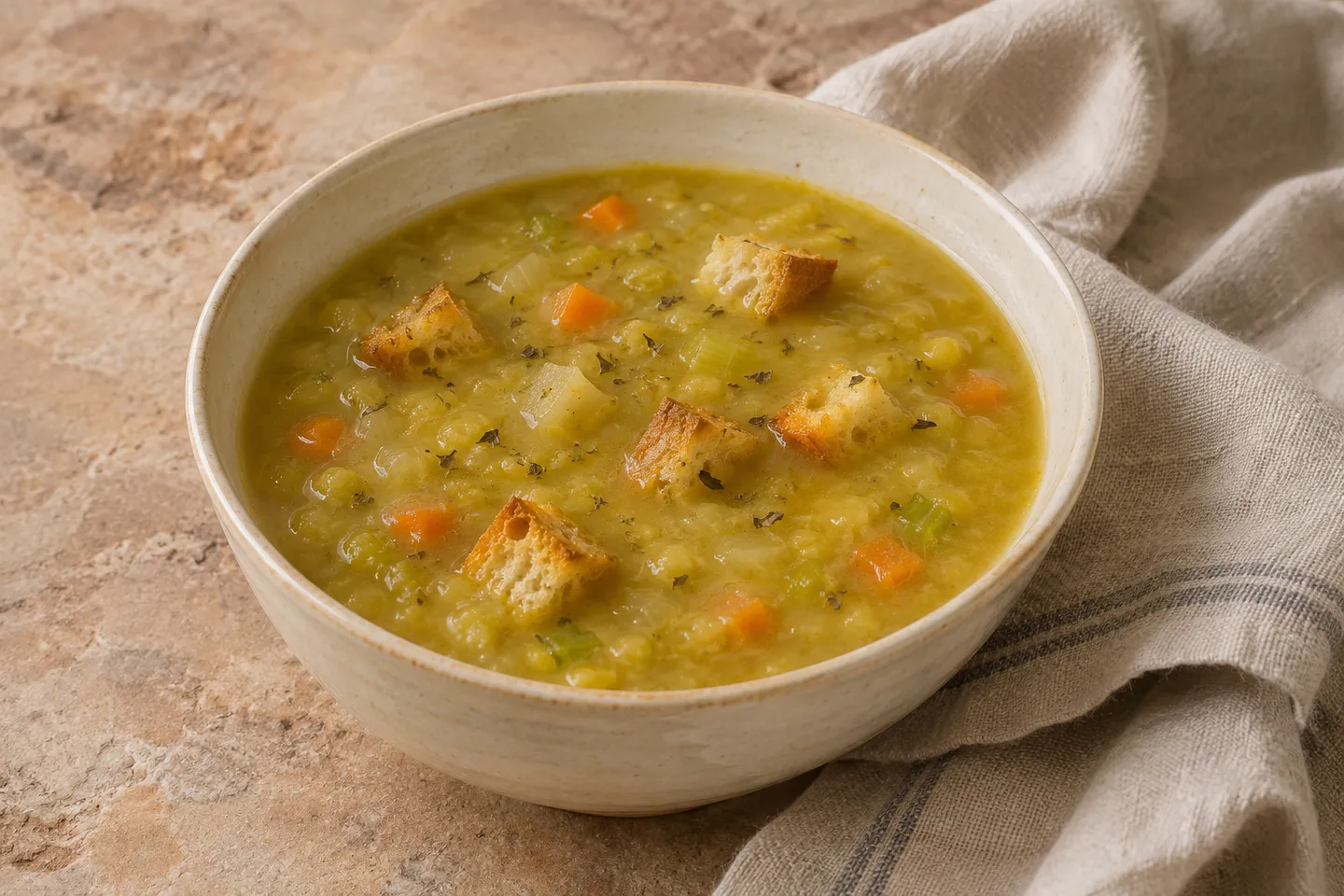
Old Peas Soup with Fried Bread (1806)
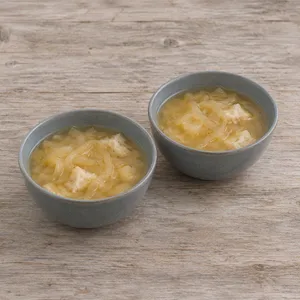
A split-pea soup with ham stock, root vegetables, fried bread and dried mint, adapted from Rundell's 1806 household recipe.
- Original yieldYield
- 4 bowls; final volume depends on evaporation4 bowlsfinal volume depends on evaporation
- PrepPrep time
- CookCook time
- TotalTotal time
Planning estimate: 20 minutes preparation, about 60 minutes for the peas and 30 minutes for the vegetables. Allow longer if the peas remain firm. Fry the bread during the final simmer.
Published
Original recipe: 4 bowls; final volume depends on evaporation
The story behind the recipe
The fried bread goes into the bowl before the soup. Dried mint and pepper join it, and the hot peas follow. That serving order comes from the 1806 recipe: the bread is part of the dish rather than a decoration scattered across the top. Add it just before eating, while some pieces can still keep their edges.
Old peas rather than fresh green peas
In A New System of Domestic Cookery, Old Peas Soup appears directly above Green Peas Soup. The first entry calls for whole or split peas; the second begins with shelled peas. This version uses dried split peas, which cook down into the body of the soup. Frozen green peas would make a different dish.
The book is attributed to Maria Eliza Rundell, although its title names the author as By a Lady. The date here identifies the edition and recipe consulted. It is not a claim that pea soup began in 1806, or that this particular formula was served aboard a named ship.
Read more about this recipe
A household comparison with food at sea
Dried peas belong in our article on long sea voyages because they were among the provisions discussed in naval sources. Rundell's recipe offers a household comparison: a way to cook peas with a savory liquid and finish them with bread. Its fresh vegetables and serving details should not be treated as proof of a sailor's daily meal.
The original starts with liquid left from boiling pork or beef, diluted if it is too salty. It also offers bones or anchovies as ways to give the soup flavor. Here, ready-made cooked low-salt ham stock supplies a convenient starting point. It avoids requiring a separate boiled joint and lets the cook check the stock's ingredients and storage directions before beginning.
Two stages of cooking
Rundell cooks the peas until they can pass through a colander, then stews them again with more liquid and vegetables. That sequence matters: the peas are softened before the roots are added. This adaptation keeps the two stages but uses mashing in the saucepan instead of pushing the peas through a colander. The result need not be completely smooth.
Carrot, turnip, celery and onion all appear among the original choices. Their measured weights here are modern decisions, as are the stock and water quantities and the four-bowl yield. The book does not provide those figures. The development recipe remains untested in a kitchen, so the cooking times are planning estimates and tenderness is the deciding check.
Mint, bread and the last taste
Fry the small bread cubes while the vegetables finish cooking, then divide them among the bowls with the dried mint and pepper. Add salt only after tasting the cooked soup. Even a stock sold as low-salt contributes seasoning, and reducing the liquid concentrates what is already there.
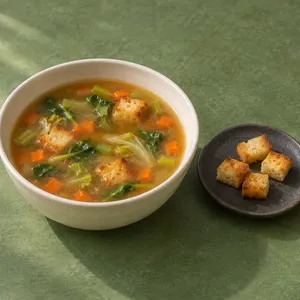
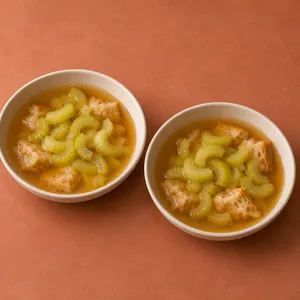
For another household treatment of a provision ingredient, our Scotch leek and oatmeal soup follows a different recipe from the same edition. Neither page claims to reproduce an identified shipboard meal.
Make it your wayOriginal: 4 servings · Makes 4 bowls; final volume depends on evaporation
Original recipe: 4 bowls; final volume depends on evaporation
Ingredients
For 4 bowls; final volume depends on evaporation. Quantities are shown as written.
Source measurement convention: Metric. Explicit unit definitions take precedence; unconfirmed measures must be checked before conversion.
Original quantities for 4 bowls; final volume depends on evaporation.
- Dried split peas, picked over and rinsed180 g
- Ready-made cooked low-salt ham stock750 ml
- Water350 ml
- Carrots, peeled and cut into small dice100 g
- Turnip, peeled and cut into small dice100 g
- Celery, finely diced60 g
- Onion, peeled and finely diced75 g
- Bread, cut into small cubes45 g
- Neutral cooking oil10 ml
- Dried mint1/2 metric tsp
- Ground black pepper, to taste
- Salt, to taste, only if needed
- Additional hot water, as needed to keep the peas covered and adjust the soup
Measurement notes
- dried mint: tsp: 1 = 5 ml.
Measurement notes
Original ingredients
- 180 g dried split peas, picked over and rinsed
- 750 ml ready-made cooked low-salt ham stock
- 350 ml water
- 100 g carrots, peeled and cut into small dice
- 100 g turnip, peeled and cut into small dice
- 60 g celery, finely diced
- 75 g onion, peeled and finely diced
- 45 g bread, cut into small cubes
- 10 ml neutral cooking oil
- 1/2 metric tsp dried minttsp: 1 = 5 ml.
- Ground black pepper, to taste
- Salt, to taste, only if needed
- Additional hot water, as needed to keep the peas covered and adjust the soup
Equipment
 3-liter heavy saucepan
 Small skillet
 Food thermometer
Instructions
Simmer the split peas in cooked ham stock
Check the ham stock label and use ready-made cooked stock within its storage directions. Put the rinsed split peas and stock in the saucepan. Bring to a boil, then reduce to a gentle simmer. Cook with the lid partly covering the pan for about 45 to 60 minutes, stirring regularly, until the peas crush easily. Add additional hot water if necessary to keep them covered; continue cooking if they are still firm.
Mash the peas and simmer the vegetables
Mash the tender peas against the side of the saucepan. Add the measured water allowance, carrots, turnip, celery and onion. Return to a gentle simmer and cook for about 25 to 30 minutes, stirring often, until every vegetable is tender. Adjust with additional hot water if needed for a spoonable soup. Timing is an estimate; continue until the texture is right.
Fry the bread cubes
During the final simmer, heat the oil in the small skillet over medium heat. Add the bread cubes and cook, turning often, until golden on several sides. Lower the heat if they color too quickly and set aside once crisp.
Season and check the soup temperature
Taste the cooked soup and add salt only if needed. If using previously refrigerated cooked stock, make sure the soup has boiled and reaches at least 165°F (74°C), checking with a clean food thermometer. Follow any stricter stock-label directions.
Serve over fried bread and dried mint
Divide the fried bread among four bowls at the original batch size. Divide the dried mint and black pepper among them and ladle over the hot soup just before serving. Refrigerate any remaining soup promptly in shallow containers; keep unused fried bread separate.
Recipe notes
When adjusting quantities
Leave room for bubbling and stirring; use additional pans for larger batches. Tenderness and evaporation determine the cooking time and extra water, which do not multiply automatically. Divide all the bread and mint among the intended bowls.
Original recipe notes
These notes describe the original recipe. Quantities mentioned here do not change when you adjust servings.
This is an untested modern adaptation of a household recipe. It is a companion to the sea-voyage article, not a reconstruction of an authenticated naval menu. No meat-curing or long-term room-temperature preservation method is supplied.
The stock may contain celery, wheat or other allergens; bread also varies. Check the actual products rather than assuming this recipe has a particular dietary certification. No nutrition figures or kitchen-test claims have been assigned.
When reheating leftovers, bring the soup to a boil and check it reaches 165°F (74°C). Follow the stock's shorter storage limit if applicable. The estimates above describe one batch; larger pans and quantities require their own tenderness and temperature checks.
Storage
Refrigerate soup promptly in shallow containers within 2 hours, or 1 hour above 90°F (32°C). Keep at 40°F (4°C) or below for up to 3 to 4 days, following any shorter stock-label limit. Store the fried bread separately. Bring reheated soup to a boil and check it reaches 165°F (74°C).
Read the scaling guide. Times, temperatures and equipment need their own consideration. Open the recipe tool to review and correct individual amounts.
Sources and attribution
A New System of Domestic Cookery (London: J. Murray and J. Harding, 1806), attributed to Maria Eliza Rundell, Old Peas Soup, p. 94; the title credits By a Lady.
Adapted from Old Peas Soup, p. 94 of *A New System of Domestic Cookery*, London, 1806. The weighed formula, ham stock, oil for frying, mashing method and estimated timings are modern adaptation choices. Present-day handling follows FoodSafety.gov's chilling guidance and soup storage chart.
Adapted from Old Peas Soup, p. 94 of *A New System of Domestic Cookery*, London, 1806. The weighed formula, ham stock, oil for frying, mashing method and estimated timings are modern adaptation choices. Present-day handling follows FoodSafety.gov's chilling guidance and soup storage chart.
Recipe details
- Recipe tradition
- Vintage
- Course or meal
- Soup
- Cooking method
- Stovetop
- Browse category
- Main Dishes