

Celery in Browned Vegetable Broth (1771)
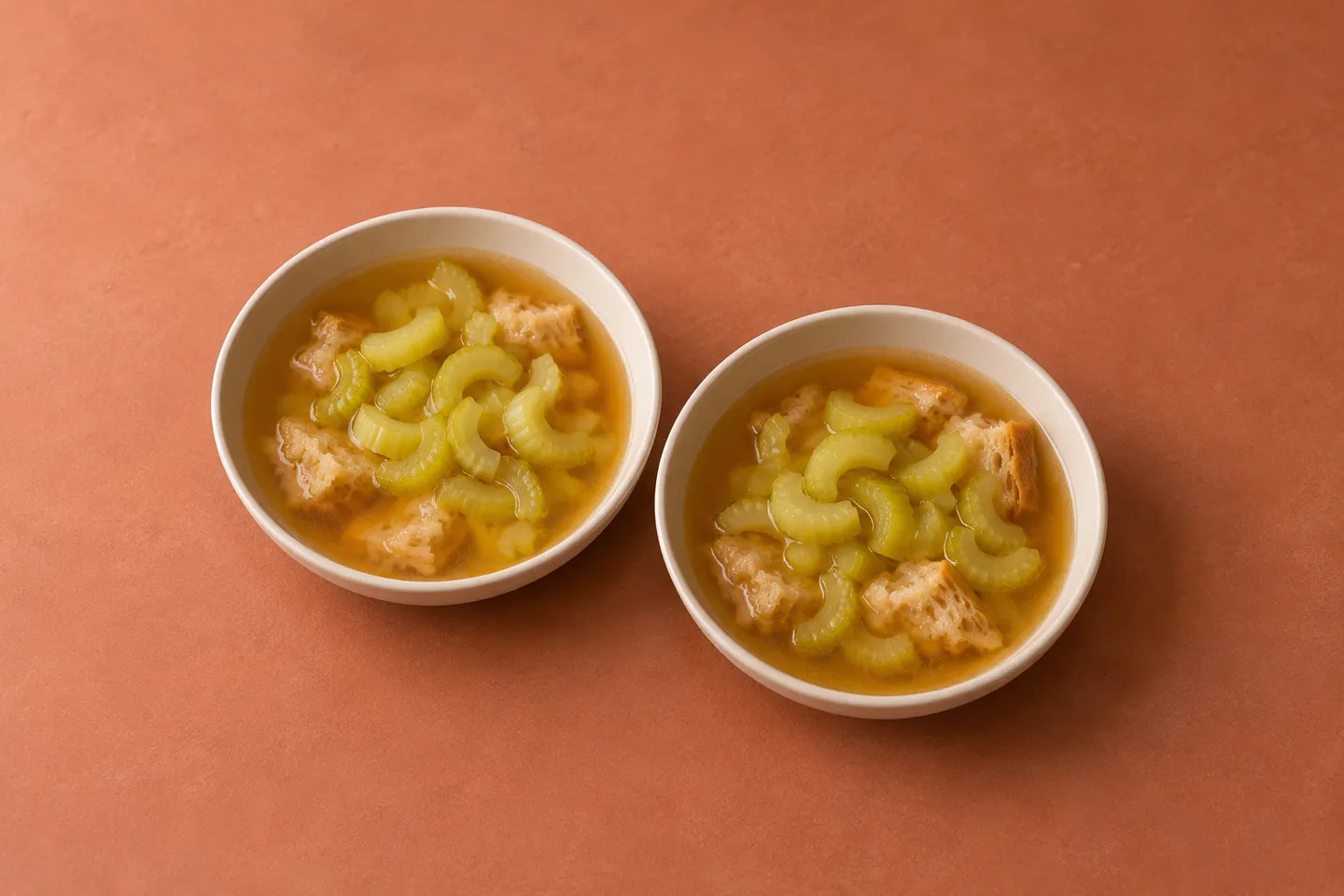
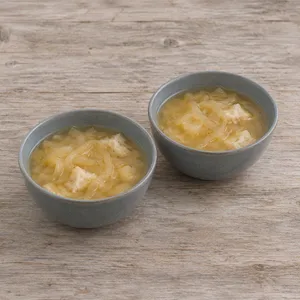
Celery and bread served with a strained broth made from separately browned vegetables, adapted from a 1771 French cookbook.
- Original yieldYield
- 2 bowls; final volume varies with evaporation and bread absorption2 bowlsfinal volume varies with evaporation and bread absorption
- PrepPrep time
- CookCook time
- TotalTotal time
Estimated: 20 minutes preparation, 15 to 20 minutes browning, 30 minutes broth simmering and about 5 minutes finishing. Celery blanching and gentle cooking overlap the broth work.
Published
Original recipe: 2 bowls; final volume varies with evaporation and bread absorption
The story behind the recipe
The celery you eat isn't the vegetable that browns in the broth pan. This soup keeps two preparations separate: one batch for extracting color and flavor, another for arranging in the bowl. Strain the first and serve the second. It's a more deliberate way to make vegetable soup than simmering everything together and deciding afterward what to leave in.
Choose the vegetable for the bowl
The 1771 recipe offers several vegetables as the named garnish, including celery, cabbage, turnips and small onions. Celery is the choice here. The cook is told to leave that selected vegetable out of the separate extraction pan because its own preparation supplies enough of its flavor. The distinction is in the source, rather than a modern decoration added at serving.
Read more about this recipe
Brown before adding the water
Onion, carrot and parsnip are cooked in butter before water is added to make the broth. The original asks for vegetables that are cooked and colored, followed by a half-hour extraction. It compares the resulting broth's taste and color with one containing meat juice, while giving a method that doesn't require meat stock.
For this version, aim for softened vegetables with light browning. Turn them regularly and watch the bottom of the pan. The useful color belongs on the vegetables and cooking surface; blackened pieces would be a different result. Add the garlic and herbs near the end of browning so they don't sit through the entire stage in hot butter.
The saucepan's width matters when making more. A deep pile of chopped vegetables is harder to turn and color evenly than a modest layer. If the increased quantity crowds the pan, split it between pans rather than assuming a longer timer can reproduce the same handling.
Straining is part of the preparation
After simmering, the extraction vegetables are removed. Their cooking liquid is then poured into the separate celery pan, where it combines with the small amount of water and butter already around the garnish. You keep the celery pieces for service, without a bowl full of the softened carrot and parsnip used to make the broth.
That makes this a useful distinction beside the loaves and bean dishes in Nuts, Bread and Beans. A meatless recipe can demand several preparations, and its fat and liquid choices still matter. Here the base is drinking water and the fat is butter. Meatless doesn't mean dairy-free, and the old culinary category maigre isn't a universal dietary certificate.
Bread belongs in the serving bowl
Plain bread is moistened with the finished broth, with celery arranged over it. It isn't browned alongside the extraction vegetables or strained away. Keep that order if you want the bread in the finished soup, and put it in the bowls close to serving rather than letting the whole batch stand over heat.
The source also describes an elaborate presentation with strips of bread attached around a serving dish using egg white. Its bowl-shaped serving option dispenses with that border. That's the route followed here: two bowls, moistened bread, celery and broth. There's no egg-white step to perform or decorative structure to build.
A small batch with two pans
Two servings still need attention to both preparations. The celery is blanched, refreshed and gently cooked while the other vegetables brown and simmer. Once those stages are underway, the last work is straining, seasoning and filling the bowls.
The amount of broth you recover will vary with the pan and evaporation, and the bread absorbs some at serving. Two bowls describe the intended division of the batch, rather than a promise of an exact measured volume. Season after the liquids are combined, when you can taste the broth that will actually be served.
Make it your wayOriginal: 2 servings · Makes 2 bowls; final volume varies with evaporation and bread absorption
Original recipe: 2 bowls; final volume varies with evaporation and bread absorption
Ingredients
For 2 bowls; final volume varies with evaporation and bread absorption. Quantities are shown as written.
Source measurement convention: Metric. Explicit unit definitions take precedence; unconfirmed measures must be checked before conversion.
Original quantities for 2 bowls; final volume varies with evaporation and bread absorption.
- Celery, washed and sliced180 g
- Unsalted butter, divided25 g
- Onion, peeled and finely chopped100 g
- Carrot, trimmed and finely chopped100 g
- Parsnip, trimmed and finely chopped80 g
- Small garlic, chopped1 clove
- Small bay leaf1
- Thyme1 sprig
- Parsley2 sprigs
- Small basil leaf1
- Chopped scallion (level)1 metric tsp
- Clove1
- Water, divided, plus water for blanching and refreshing800 ml
- Plain bread40 g
- Salt, to taste
- Ground black pepper, to taste
Measurement notes
- chopped scallion (level): tsp: 1 = 5 ml.
Measurement notes
Original ingredients
- 180 g celery, washed and sliced
- 25 g unsalted butter, divided
- 100 g onion, peeled and finely chopped
- 100 g carrot, trimmed and finely chopped
- 80 g parsnip, trimmed and finely chopped
- 1 small garlic clove, chopped
- 1 small bay leaf
- 1 thyme sprig
- 2 parsley sprigs
- 1 small basil leaf
- 1 metric tsp chopped scallion (level)tsp: 1 = 5 ml.
- 1 whole clove
- 800 ml water, divided, plus water for blanching and refreshing
- 40 g plain bread
- Salt, to taste
- Ground black pepper, to taste
Equipment
 Medium saucepan (2-quart)
- Small saucepan
 Fine-mesh strainer
Instructions
Blanch and separately cook the celery
Blanch the celery in a saucepan of boiling water for 15 minutes, then drain and refresh briefly under cold drinking water. Put it in a small saucepan with enough of the measured water to provide a shallow cooking liquid, about 100 ml at the original batch size, and part of the butter, about 10 g at that size. Add a little salt, cover and cook gently while preparing the broth. Reserve the rest of the measured water and butter for the extraction pan; the blanching and refreshing water is separate and discarded.
Brown the extraction vegetables
Melt the remaining measured butter in the medium saucepan. Add the onion, carrot and parsnip and cook over moderate heat, turning regularly, until softened and lightly browned, about 15 to 20 minutes. Add the garlic, bay leaf, thyme, parsley, basil and scallion near the end of this stage so they don't scorch. Keep celery out of this pan.
Simmer and strain the broth
Add the remaining measured water, about 700 ml at the original batch size, and the whole clove. Bring to a boil, then simmer gently for 30 minutes. Strain through a fine-mesh strainer into a heatproof container, discarding the extraction vegetables, herb stems and whole spices.
Combine and season with celery
Pour the strained broth into the celery pan with its cooking liquid. Heat through until the celery is tender, then taste and adjust with salt and black pepper. If more cooking is needed, keep the heat gentle and check the celery rather than serving it tough.
Moisten bread and serve
Divide the bread between two bowls at the original batch size. Moisten it with some broth, then distribute the celery and remaining broth over it. Serve immediately. For more servings, use more bowls and keep the same separate-vegetable and straining sequence.
Recipe notes
When adjusting quantities
Keep celery separate from the broth-extraction vegetables and take all cooking water from the listed total. Brown vegetables in uncrowded pans, using more pans if needed. Make additional bowls for a larger batch; browning and simmering times do not multiply.
Original recipe notes
These notes describe the original recipe. Quantities mentioned here do not change when you adjust servings.
The source gives no complete batch measures. All working weights, water amounts, herb quantities and the two-bowl yield are supplied here, with celery selected as the garnish. One clove replaces its three for this small modern batch. The celery's 15-minute blanch and the broth's 30-minute extraction are retained; modern stove guidance and the browning estimate are supplied. Bowl service follows the source's simpler alternative and omits the egg-white bread border.
At the original batch, the 800 ml cooking-water total is divided about 100 ml for celery and 700 ml for broth extraction; all of it is measured before cooking. The butter is similarly divided about 10 g and 15 g. A little variation in those allocations is fine if the listed totals remain unchanged. Blanching and refreshing water is separate, discarded process water. No meat stock is added.
The soup contains milk through butter, celery and any allergens in the bread, commonly wheat. If saving it, set aside broth and celery before adding bread, divide into shallow containers and refrigerate promptly within 2 hours, or 1 hour above 90°F (32°C). Bring soup to a boil when reheating, following FDA food-handling guidance; moisten fresh bread at serving.
Storage
Serve once the bread is moistened. If saving soup, refrigerate broth and celery promptly in shallow containers before adding bread; add fresh bread at serving.
Read the scaling guide. Times, temperatures and equipment need their own consideration. Open the recipe tool to review and correct individual amounts.
Sources and attribution
Menon, attributed, La Cuisinière bourgeoise, nouvelle édition (Paris: P. Guillaume Cavelier, 1771), Potages maigres de plusieurs façons, pp. 17–18.
Adapted from Potages maigres de plusieurs façons, pp. 17–18 of *La Cuisinière bourgeoise*, nouvelle édition, 1771, attributed to Menon; the held title doesn't name an author.
Recipe details
- Recipe tradition
- Vintage
- Course or meal
- Soup
- Cooking method
- Stovetop
- Browse category
- Main Dishes