

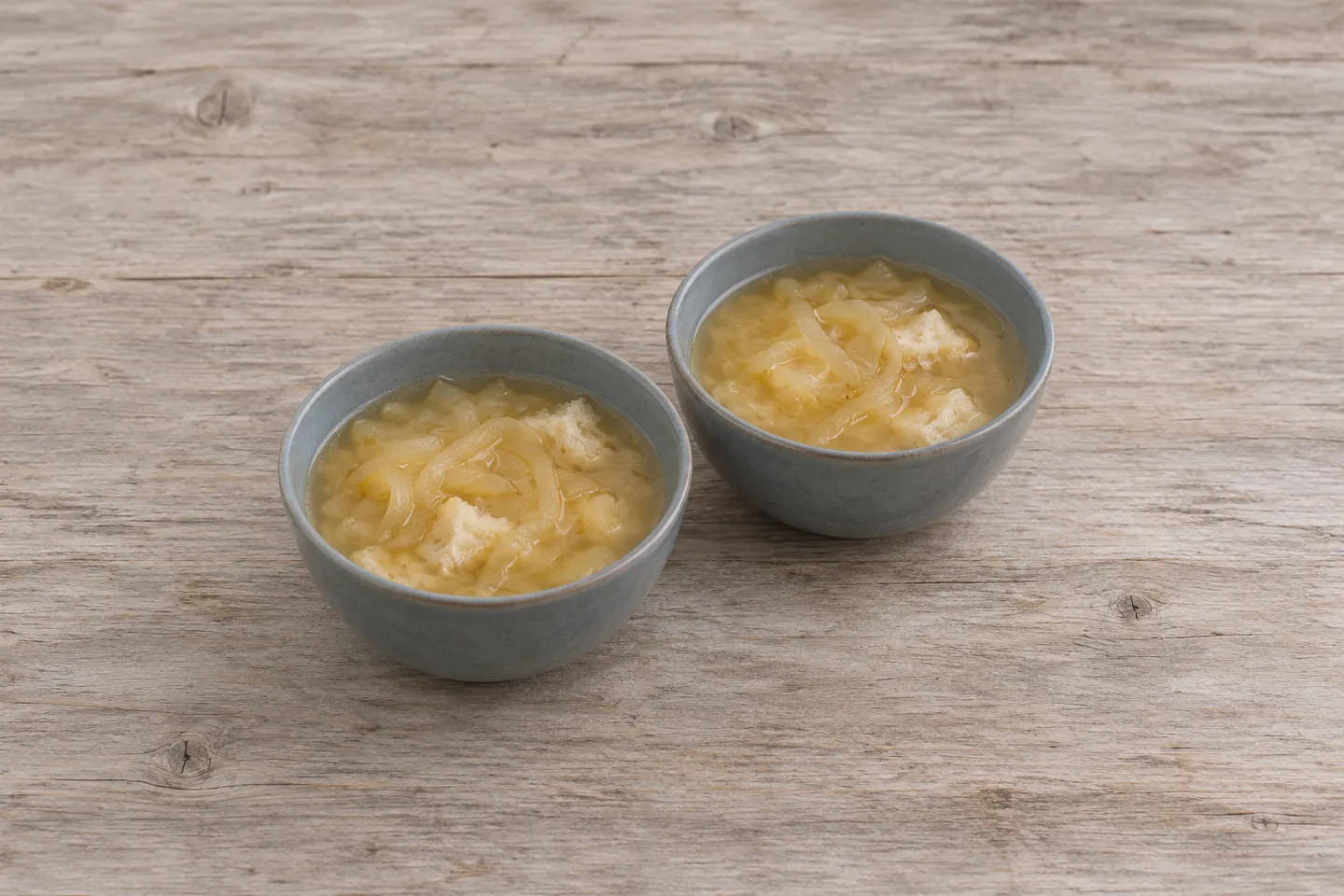
Lightly Browned Onion and Bread Soup (1771)
Lightly golden onions, butter, water and softened bread, adapted from the 1771 La Cuisinière bourgeoise.
- Original yieldYield
- 2 soup portions; final volume varies with evaporation and bread absorption2 soup portionsfinal volume varies with evaporation and bread absorption
- PrepPrep time
- CookCook time
- TotalTotal time
Estimates include 20 to 30 minutes softening and lightly browning onions, then heating, a short simmer and softening the bread.
Published
Original recipe: 2 soup portions; final volume varies with evaporation and bread absorption
The story behind the recipe
Lightly golden onions and softened bread make this a soup to eat with a spoon, without a cheese crust or a pot of meat stock. The onions stay in the pan from the first butter to the final ladleful. Bread cooks in the soup rather than sitting beside it as a dry accompaniment.
Stop at light gold
The 1771 recipe asks for onions cooked until evenly and lightly colored. That is a useful limit. This version doesn't ask you to take a large pile of onions all the way to the deep brown associated with some modern onion soups. Stir and watch the thinner edges, giving the slices time to soften before adding water.
Read more about this recipe
Two branches on one page
La Cuisinière bourgeoise, attributed to Menon, prints this onion soup beside a more elaborate meatless vegetable broth. The onion entry offers two routes. One colors onions in butter and adds water or existing meatless broth. The other uses fewer onions, keeps them uncolored and adds milk. Its bread softens in the serving dish before the remaining liquid is poured in.
The water-based route is followed here. Adding milk at the end would blend two different directions on the source page. The distinction is easy to miss if the recipe is remembered only as onion soup with bread. Both versions contain butter, so the older meatless description doesn't mean that all animal ingredients have disappeared.
Bread belongs in the liquid
For the water version, the source puts bread into the soup to soften. A few slices become part of the spoonful, taking up broth among the onion strips. The amount and kind of bread matter: a dense slice and a light sandwich loaf won't offer the same crumb, even at the same weight.
Plain white bread gives this small modern batch a definite starting point. Keep the stated weight rather than counting arbitrary slices. You don't need to dry the bread into crumbs first. This preparation differs from a sauce made by stirring fine crumbs through infused milk, as the examples in Another Life for Bread show.
A soup that begins with water
Choosing water leaves the onions, butter, pepper and bread to define the bowl. The source permits meatless broth if available, but that is an alternative rather than a hidden requirement. A stock cube would introduce another set of seasonings. Follow this version with water before deciding whether you want a different soup.
The original begins with about a dozen medium onions and leaves most remaining amounts open. Those directions show the sequence without defining a modern two-person batch. The quantities below make that smaller preparation explicit. They don't establish how much soup an eighteenth-century household obtained or how many diners it fed.
Serve after the bread softens
The brief bread stage belongs near serving time. If the pot stands, bread continues to absorb liquid and lose its shape. Ladle while onion strips are still visible among softened pieces, and keep additional dry bread at the table separate from the measured portion in the pot. A bowl made ready now will have a different bread texture from one left waiting.
Make it your wayOriginal: 2 servings · Makes 2 soup portions; final volume varies with evaporation and bread absorption
Original recipe: 2 soup portions; final volume varies with evaporation and bread absorption
Ingredients
For 2 soup portions; final volume varies with evaporation and bread absorption. Quantities are shown as written.
Source measurement convention: Metric. Explicit unit definitions take precedence; unconfirmed measures must be checked before conversion.
Original quantities for 2 soup portions; final volume varies with evaporation and bread absorption.
- Onions, peeled and thinly sliced250 g
- Unsalted butter20 g
- Water600 ml
- Plain white bread, sliced40 g
- Fine salt1/4 tsp
- Coarsely ground black pepper1/8 tsp
Measurement notes
- fine salt, coarsely ground black pepper: US tsp: 1 = 4.9289 ml (rounded).
Measurement notes
Original ingredients
- 250 g onions, peeled and thinly sliced
- 20 g unsalted butter
- 600 ml water
- 40 g plain white bread, sliced
- 1/4 US tsp fine saltUS tsp: 1 = 4.9289 ml (rounded).
- 1/8 US tsp coarsely ground black pepperUS tsp: 1 = 4.9289 ml (rounded).
Equipment
 Medium saucepan (2-quart)
Instructions
Lightly brown the onions
Melt the butter in a medium saucepan over medium-low heat. Add the onions and cook for about 20 to 30 minutes, stirring often, until tender and evenly light golden. Lower the heat if edges darken before the slices soften; don't aim for deep brown.
Simmer with water
Add the listed water, salt and pepper. Bring to a boil, then reduce the heat and simmer gently for about 5 minutes. Stir the bottom to loosen lightly browned onion juices.
Soften the bread
Tear the bread into spoon-sized pieces and add it. Simmer gently for about 2 to 3 minutes, until softened. Stir carefully so some pieces remain recognizable; don't puree.
Serve the onion soup
Ladle into bowls and serve hot. The original batch is deliberately divided into 2 portions. For larger quantities, preserve the light onion color and bread-softening cues rather than multiplying simmering time.
Recipe notes
When adjusting quantities
Keep onions uncrowded while browning. Preserve the listed bread and water together; use more pan space rather than multiplying cooking times.
Original recipe notes
These notes describe the original recipe. Quantities mentioned here do not change when you adjust servings.
This follows the water branch. The onion weight, butter, water, bread, seasonings and two portions are editorial small-batch choices, not an exact reduction of a dozen historical onions. Plain white bread, its cut and cooking estimates are supplied. The separate milk branch isn't combined with this method.
Butter supplies milk and ordinary bread supplies wheat; check actual labels for additional ingredients. The historical meatless category isn't a modern dietary or allergen certification.
Refrigerate leftovers promptly in shallow containers within 2 hours, or 1 hour above 90°F (32°C), and bring soup to a boil when reheating, following FDA food handling. Bread will be softer after holding; no particular shelf life is established.
Storage
Refrigerate leftovers promptly in shallow containers within 2 hours, or 1 hour above 90°F (32°C); bring soup to a boil when reheating.
Read the scaling guide. Times, temperatures and equipment need their own consideration. Open the recipe tool to review and correct individual amounts.
Sources and attribution
Menon, attributed, La Cuisinière bourgeoise, nouvelle édition (Paris, 1771), Potages maigres aux oignons, p. 18.
Adapted from Potages maigres aux oignons, p. 18, in La Cuisinière bourgeoise, nouvelle édition, Paris, 1771, attributed to Menon.
Recipe details
- Recipe tradition
- Vintage
- Course or meal
- Soup
- Cooking method
- Stovetop
- Browse category
- Main Dishes