

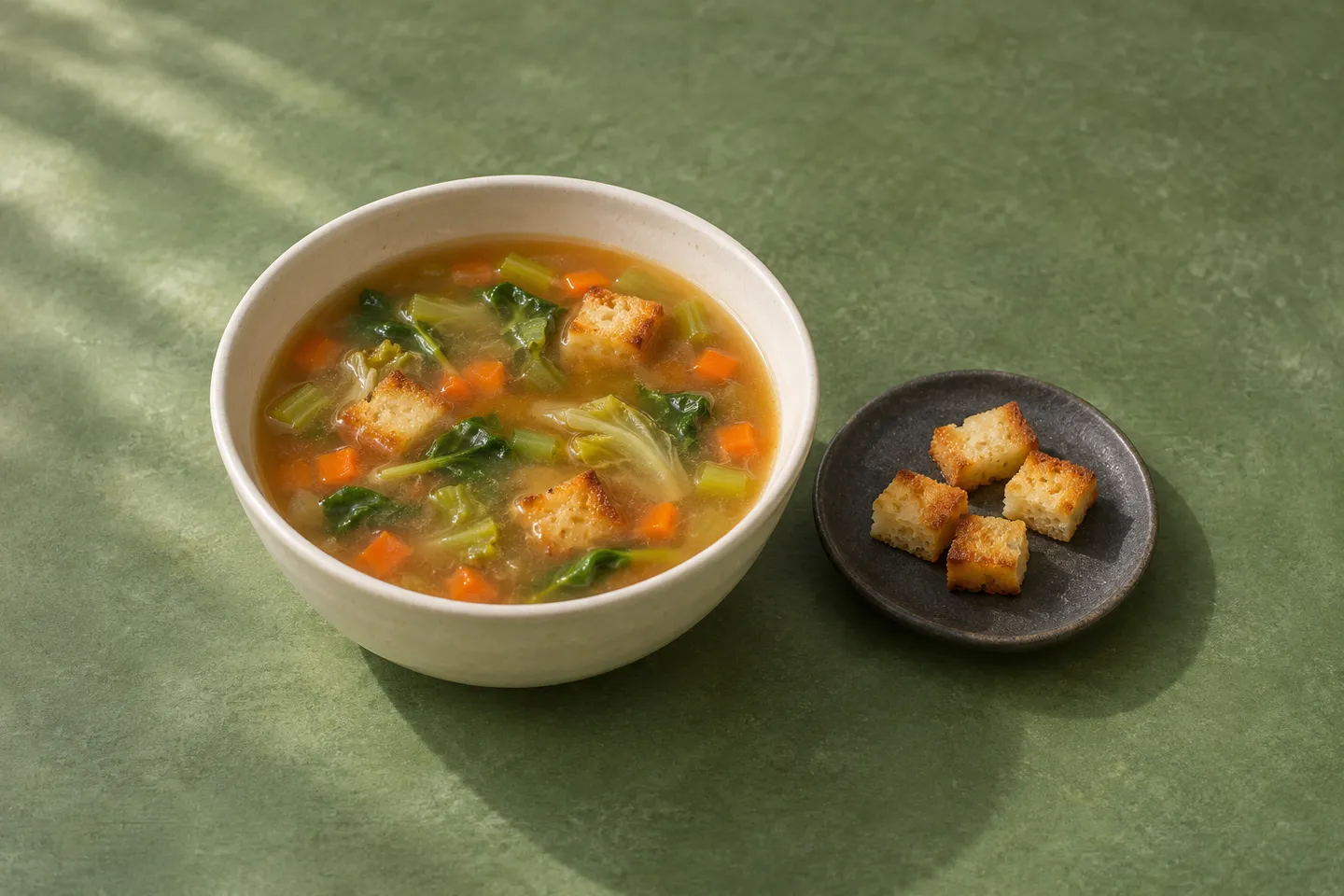
Brown Vegetable and Bread Soup (1848)
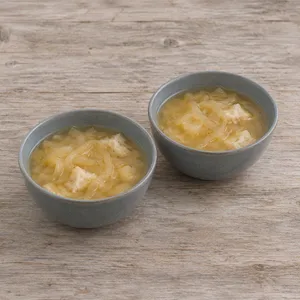
A strained bread infusion, browned flour, vegetables and fried bread, adapted from Tunis G. Campbell's 1848 Brown Soup.
- Original yieldYield
- Approximately 6 starter portions; final volume is unmeasuredApproximately 6 starter portionsfinal volume is unmeasured
- PrepPrep time
- CookCook time
- TotalTotal time
Estimate includes a 90-minute infusion, heating, vegetable frying, browning flour and a 15 to 25 minute final simmer. Fry bread during the final simmer.
Published
Original recipe: Approximately 6 starter portions; final volume is unmeasured
The story behind the recipe
Some fried bread goes into the soup; the rest stays on a separate plate. That small serving instruction finishes a much longer preparation. Before crisp cubes reach the table, bread has already simmered with onion and spices, the liquid has been strained, and vegetables and flour have each had their turn in butter.
Bread in two forms
The first bread is fine dry crumbs, standing in for Campbell's raspings. They cook in water with onion, clove and pepper before the infusion passes through a sieve. The second bread is cut into cubes and fried. One helps make the liquid; the other is an addition you can recognize at serving.
Read more about this recipe
More than a brown color
Tunis G. Campbell includes this recipe in his 1848 Hotel Keepers, Head Waiters, and Housekeepers' Guide. Brown Soup doesn't describe one quick step. Vegetables are fried separately, flour is stirred in butter until brown, and the strained infusion is added before everything finishes together. Color has a place in a sequence of cooking, rather than coming from a bottle of dark stock.
The book's hotel setting doesn't prove this exact soup was served in a named dining room. What survives is a printed prescription. It is specific enough to show how much work could sit behind a short menu name, with several pans and a final judgment about tenderness and consistency.
Start with the long infusion
Campbell gives three quarts or more of water, but leaves the raspings at enough to thicken it. Onion and clove have small count ranges; much else is unmeasured. A ninety-minute covered boil precedes straining. Copying the water alone into a modern ingredient list would leave most of the actual soup undecided.
This version makes those decisions openly. Water has a declared modern basis, while crumb weight, vegetable amounts and butter allowances define a manageable home batch. Don't infer that every solid has been halved from a fully measured historical recipe. The source never provides that complete set of quantities.
Give the vegetables room
Celery and carrot remain visible with endive, lettuce, spinach and parsley. Campbell tells the cook not to cut vegetables too small. Greens soften into the final soup, while firmer pieces still need checking. A browned flour mixture cannot tell you whether the center of a carrot piece is tender.
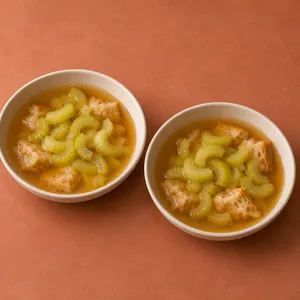
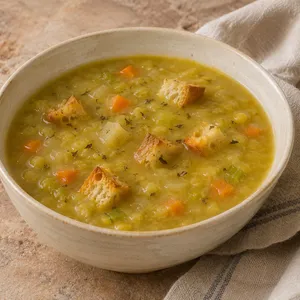
Cook the flour until colored before adding the strained liquid gradually. That differs from whisking flour and cold water together at the end. The examples in Why Soup Gets Thick follow other places where bread, beans or flour change a bowl's body. Here flour meets butter first, after a separate bread infusion has already been prepared.
Keep a little bread dry
The final cubes are fried separately, then divided between soup and plate. The portion in the bowl begins softening immediately. The reserved portion gives diners a choice about when to add it. There is no need to put every cube under broth before anyone sits down.
Approach the soup as a small first course with several preparations to organize. Start the infusion before you need the stove for the final vegetables, and have bread ready to fry near the end. Its unhurried liquid stage belongs in dinner planning, rather than keeping the finished soup waiting with every cube submerged.
Make it your wayOriginal: 6 servings · Makes Approximately 6 starter portions; final volume is unmeasured
Original recipe: Approximately 6 starter portions; final volume is unmeasured
Ingredients
For Approximately 6 starter portions; final volume is unmeasured. Quantities are shown as written.
Source measurement convention: Metric. Explicit unit definitions take precedence; unconfirmed measures must be checked before conversion.
Original quantities for Approximately 6 starter portions; final volume is unmeasured.
Bread infusion
- Water1420 ml
- Onion, peeled and quartered150 g
- Fine dry plain breadcrumbs40 g
- Clove1
- Black peppercorns6
- Fine salt1/2 tsp
Vegetables and thickening
- Celery, trimmed and diced100 g
- Carrot, peeled and diced120 g
- Endive, washed and coarsely cut50 g
- Lettuce, washed and coarsely cut50 g
- Spinach, washed and coarsely cut50 g
- Chopped fresh parsley1 tbsp
- Unsalted butter, for vegetables and flour50 g
- All-purpose flour20 g
Fried bread
- Plain white bread, cut into small cubes90 g
- Unsalted butter15 g
Measurement notes
- fine salt: US tsp: 1 = 4.9289 ml (rounded).
- chopped fresh parsley: US tbsp: 1 = 14.7868 ml (rounded).
Measurement notes
Original ingredients
- 1420 ml water
- 150 g onion, peeled and quartered
- 40 g fine dry plain breadcrumbs
- 1 whole clove
- 6 black peppercorns
- 1/2 US tsp fine saltUS tsp: 1 = 4.9289 ml (rounded).
- 100 g celery, trimmed and diced
- 120 g carrot, peeled and diced
- 50 g endive, washed and coarsely cut
- 50 g lettuce, washed and coarsely cut
- 50 g spinach, washed and coarsely cut
- 1 US tbsp chopped fresh parsleyUS tbsp: 1 = 14.7868 ml (rounded).
- 50 g unsalted butter, for vegetables and flour
- 20 g all-purpose flour
- 90 g plain white bread, cut into small cubes
- 15 g unsalted butter
Equipment
 3-liter heavy saucepan
 Fine-mesh strainer
 12-inch heavy skillet
 Whisk
Instructions
Simmer the bread infusion
Put the water, quartered onion, dry breadcrumbs, clove, peppercorns and salt into a 3-liter or larger heavy saucepan. Bring to a boil, cover and maintain a gentle boil for about 90 minutes. Stir occasionally and lower the heat if it catches; don't let the pot boil dry.
Strain the infusion
Strain into a heatproof bowl through a fine-mesh strainer, discarding spent onion, crumbs and whole spices. Reserve all recovered liquid. Evaporation and straining mean it needn't equal the starting water volume.
Fry the vegetables
Use two-fifths of the vegetable-and-flour butter to fry the celery, carrot, endive, lettuce, spinach and parsley in a skillet over medium heat, stirring, for about 8 to 10 minutes until beginning to soften. Set aside. At the original batch, this butter portion is 20 g from the listed 50 g allowance.
Brown the flour and add liquid
Melt the remaining vegetable-and-flour butter in the emptied soup pan. Stir in the flour and cook over medium-low heat, stirring constantly, until evenly brown without black specks or a burnt smell. Gradually whisk in the strained infusion, beginning with a little to make a smooth mixture, then adding the rest.
Simmer until vegetables are tender
Add the fried vegetables. Simmer gently for about 15 to 25 minutes, stirring the bottom, until carrot and celery are tender and the broth is lightly thickened and pourable. If too thick before the vegetables soften, add a little hot water; no exact final-volume target is assumed.
Fry the bread cubes
Meanwhile, melt the separate fried-bread butter in the skillet. Fry the bread cubes over medium heat, turning, until browned, in uncrowded batches if necessary. Remove when ready so they don't continue browning against the hot pan.
Serve with bread in two places
Ladle into warm bowls. Put some fried bread in each bowl and offer the rest on a separate plate. Divide the original batch into approximately 6 starter portions; preserve small first-course portions and split bread service with changed quantities.
Recipe notes
When adjusting quantities
Allow ample pot and stirring space. Fry bread uncrowded. The 90-minute infusion and vegetable tenderness checks don't multiply with servings.
Original recipe notes
These notes describe the original recipe. Quantities mentioned here do not change when you adjust servings.
Only water has a proportional starting point: half the source's minimum three-quart amount, represented by 1.5 modern US quarts, about 1420 ml. This is a declared convention, not a recovered historical quart. Solid weights, herb and seasoning amounts, butter divisions and six starter portions are editorial choices. Raspings are interpreted as fine dry bread crumbs. The infusion, straining, vegetable frying, browned flour and split bread service remain; pans, estimates and consistency cues are modern.
The vegetable-and-flour butter is divided two-fifths for vegetables and three-fifths for flour. The separate butter is for bread. Preserve these roles at changed quantities and use more cooking space rather than multiplying the infusion or final simmer.
Ordinary bread and flour supply wheat; butter supplies milk. Check actual bread labels. Don't taste raw flour. Refrigerate soup promptly in shallow containers within 2 hours, or 1 hour above 90°F (32°C), keeping unserved bread separate. Bring saved soup to a boil; see FDA safe handling and flour guidance.
Storage
Refrigerate soup promptly in shallow containers within 2 hours, or 1 hour above 90°F (32°C). Keep unserved bread separate; boil soup when reheating.
Read the scaling guide. Times, temperatures and equipment need their own consideration. Open the recipe tool to review and correct individual amounts.
Sources and attribution
Tunis G. Campbell, Hotel Keepers, Head Waiters, and Housekeepers' Guide (Boston, 1848 printing), To make a Brown Soup, pp. 149–150.
Adapted from To make a Brown Soup, pp. 149–150, in Tunis G. Campbell's Hotel Keepers, Head Waiters, and Housekeepers' Guide, 1848 printing.
Recipe details
- Recipe tradition
- Vintage
- Course or meal
- Soup
- Cooking method
- Stovetop
- Browse category
- Main Dishes