

- Vintage
- Food history
- Seafaring
How Food Was Adapted for Long Sea Voyages
How ship's biscuit, salt meat, portable soup and canned provisions were prepared for storage and turned into meals on long sea voyages.
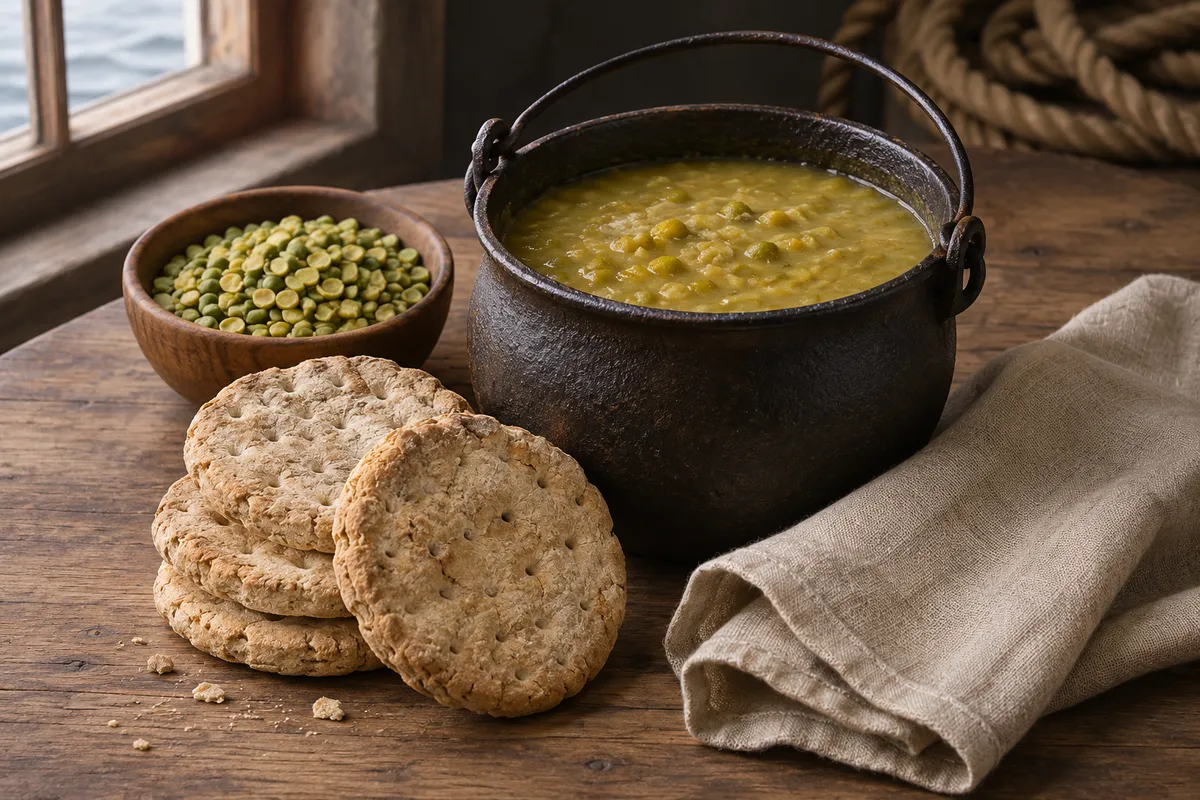
A ship’s biscuit could survive a journey that would ruin an ordinary loaf. Making it pleasant to eat was another job. Sailors broke it, softened it in liquid or worked it into a dish with other provisions. The hardness that helped it travel became something to overcome at dinner.
Long sea voyages changed food twice: first to make it keep, then to make it into a meal. Meat was salted, bread dried and stock concentrated. Aboard ship, cooking could involve softening, simmering, diluting and combining those stored ingredients. British naval provisioning in the eighteenth century and American naval food in the early nineteenth century provide the main examples here, followed by a later Victorian cookery manual.
Bread became a dry provision
Ship’s biscuit was bread made for keeping. In the British naval example described by Royal Museums Greenwich, a stiff dough of flour, water and salt was baked and then dried hard. Its value lay in carrying a staple food through a long passage, although poor storage could still leave biscuit stale, moldy or damaged by insects. Royal Museums Greenwich.
At the table, that durability demanded work. Sailors could break biscuit into pieces or soak it in liquid. A hard ration could become manageable in a bowl of stew. Breaking it first also made it available as an ingredient, rather than something a sailor had to bite through whole. USS Constitution Museum.
The cooking question had shifted. A household baker might aim for a tender loaf ready to slice; provisions for a long passage could leave the softening until the moment of eating.
Salt meat needed work before dinner
Meat arrived in another altered state. The National Maritime Museum Cornwall’s surviving meat cask illustrates the use of barrels and brine for preserved pork. Salting, smoking and pickling could be done ashore before provisions were loaded. These were substantial preparations, not simply extra seasoning added to a fresh joint. National Maritime Museum Cornwall.
The galley then had to deal with the result. In the USS Constitution Museum’s account of dinner aboard the frigate, meat had been boiling for hours to remove some of its preserving salt. Dried peas or rice cooked in large pots on the ship’s iron stove, the camboose. Preserved ingredients became hot food through sustained cooking. A Sailor’s Life for Me.
This helps explain the importance of soups and other wet dishes in accounts of food at sea. A dry biscuit could be softened beside a portion of meat and cooked peas. The meal brought together ingredients whose storage qualities had made them difficult to eat straight from their containers.
A stockpot could be packed as a tablet
Portable soup took a different approach. Instead of preserving a joint, its makers concentrated the results of cooking. Royal Museums Greenwich holds an eighteenth-century dried soup block made from stock reduced to a glue-like substance, dried and packed. Hot water dissolved it again when required.
The stock could become a thicker soup with dried peas, celery or oatmeal. Biscuit could be dipped into the liquid. A small block supplied a starting point for cooking with other provisions, whose texture and substance came into the bowl alongside it. Portable soup block, Royal Museums Greenwich.
The convenience depended on considerable work beforehand. William Kitchiner’s household recipe for portable soup, published in the fourth edition of The Cook’s Oracle in 1822, involves prolonged cooking, removing fat, reducing and drying. It illustrates the preparation behind quick later use, although it is a household recipe rather than a ship’s prescribed procedure.
For a closer look at that concentrated ingredient, our sister site Forgotten Kitchen explains what portable soup was.
The same biscuit could become a sweet dish
Keeping ingredients useful also meant giving them more than one purpose. Biscuit could supply a sweet dish as well as accompany dinner.
In Herman Melville’s description of dunderfunk, discussed by the USS Constitution Museum, pounded hard biscuit is combined with beef fat, molasses and water, then baked in a pan. A hard bread ration becomes the base of something sweet and rich. Some Notes on Navy Biscuit.
Duff, a sailor’s pudding made with suet and flour, was another way to make a distinct dish from provisions. Flour and fat could form a pudding, while broken biscuit found a different use with molasses. The USS Constitution Museum’s meal resources include a modern adaptation of duff alongside its account of sailors’ food.
These examples give a fuller picture than a list of barrels alone. What went into storage helped determine the menu, but preparation still changed texture, sweetness and the form in which food reached the eater.
Fresh supplies still mattered
Preserved provisions were part of a supply system that also sought fresh food. British naval regulations of 1731 set out planned allowances involving biscuit, beef, pork, peas, oatmeal, butter and cheese. A schedule organized what was to be issued, giving the cook a supply pattern to work with. Regulations and Instructions Relating to His Majesty’s Service at Sea, pp. 60–61.
Fresh purchases remained important much later. In an order dated October 10, 1805, Nelson required vouchers for fresh beef, lemons and onions, and called for vegetables for soup when they could be obtained. Preserved stores and the effort to obtain fresh supplies belonged to the same provisioning plan. Nelson’s provisioning order.
Keeping food edible and keeping a crew well nourished were different problems. Scurvy, caused by a lack of vitamin C, remained a serious danger in the age of sail. A successful method of storing meat or bread did not, by itself, supply everything a long voyage required. Royal Museums Greenwich.
Tins changed the choices
During the nineteenth century, canned provisions offered another way to carry prepared food. An 1822 advertisement reproduced by the U.S. National Archives offered meat, concentrated gravies and soups for voyages, with directions for preparing them for the table. The firm’s published captains’ testimonials promoted provisions that had traveled between New York and Liverpool.
The change mattered to the cook. A preserved product could arrive already cooked and boneless, while a concentrated soup still needed dilution. Even within canned provisions, the container held different amounts of work for the galley. U.S. National Archives.
Adoption took time. Royal Museums Greenwich dates official Royal Navy issue of preserved beef in tins to 1847, while noting earlier use of tinned supplies on Arctic expeditions. The appearance of a new method did not replace every older provision at once. Royal Museums Greenwich.
Cooking for the stores on board
The late Victorian manual Cookery for Seamen, first published in 1894, makes the adaptability of sea cooking particularly clear. Royal Museums Greenwich’s discussion of the book describes curries using chicken, fresh or tinned mutton, or salt beef. A familiar kind of dish could accommodate ingredients preserved in different ways.
The same account discusses roasting, baking, boiling, stewing and steaming, alongside care of livestock aboard ship. Sea cooking had a wider range than the enduring image of biscuit and boiled meat suggests. The book’s advice emphasized careful provision, stowage and storage because a cook at sea could not depend on a nearby market. Cookery for Seamen, Royal Museums Greenwich.
That practical problem runs through these examples. Food had to reach the ship in a form that could last, fit the available supply system and still offer possibilities when opened. The last part belonged to the cook: softening the biscuit, turning a stock tablet into soup, or choosing a curry that could use the meat actually on board.
Related recipes to cook at home
Three companion recipes explore different parts of this story:
- Ship’s biscuit: a whole-wheat version following the museum’s classroom reconstruction, softened in soup before eating.
- Old peas soup with fried bread: an adaptation of Rundell’s 1806 household recipe, with ham stock, root vegetables and dried mint. It illustrates cooking with similar provisions without claiming a documented naval formula.
- Sailor’s duff: a raisin pudding following the museum’s modern teaching adaptation, steamed in a covered basin and served with molasses.
Our Scotch leek and oatmeal soup adapts a household recipe from 1806. It offers another way to cook with oatmeal and stock, both relevant to the provisions discussed here, without claiming to reproduce a ship’s meal.
For a later passenger-liner comparison, try plum pudding with sweet sauce, inspired by Titanic’s third-class menu. The 1912 menu names the dish; our recipe uses a separate period cooking source because the menu supplies no formula. This belongs to a different setting from the naval provisioning described above.
Source note
The historical book references are Regulations and Instructions Relating to His Majesty’s Service at Sea (1731), pp. 60–61, and William Kitchiner’s The Cook’s Oracle, fourth edition (1822), recipe 252, pp. 293–295. Nelson’s procurement order is dated October 10, 1805. The later Cookery for Seamen discussion and Melville’s dunderfunk description are cited through the museums linked above.