

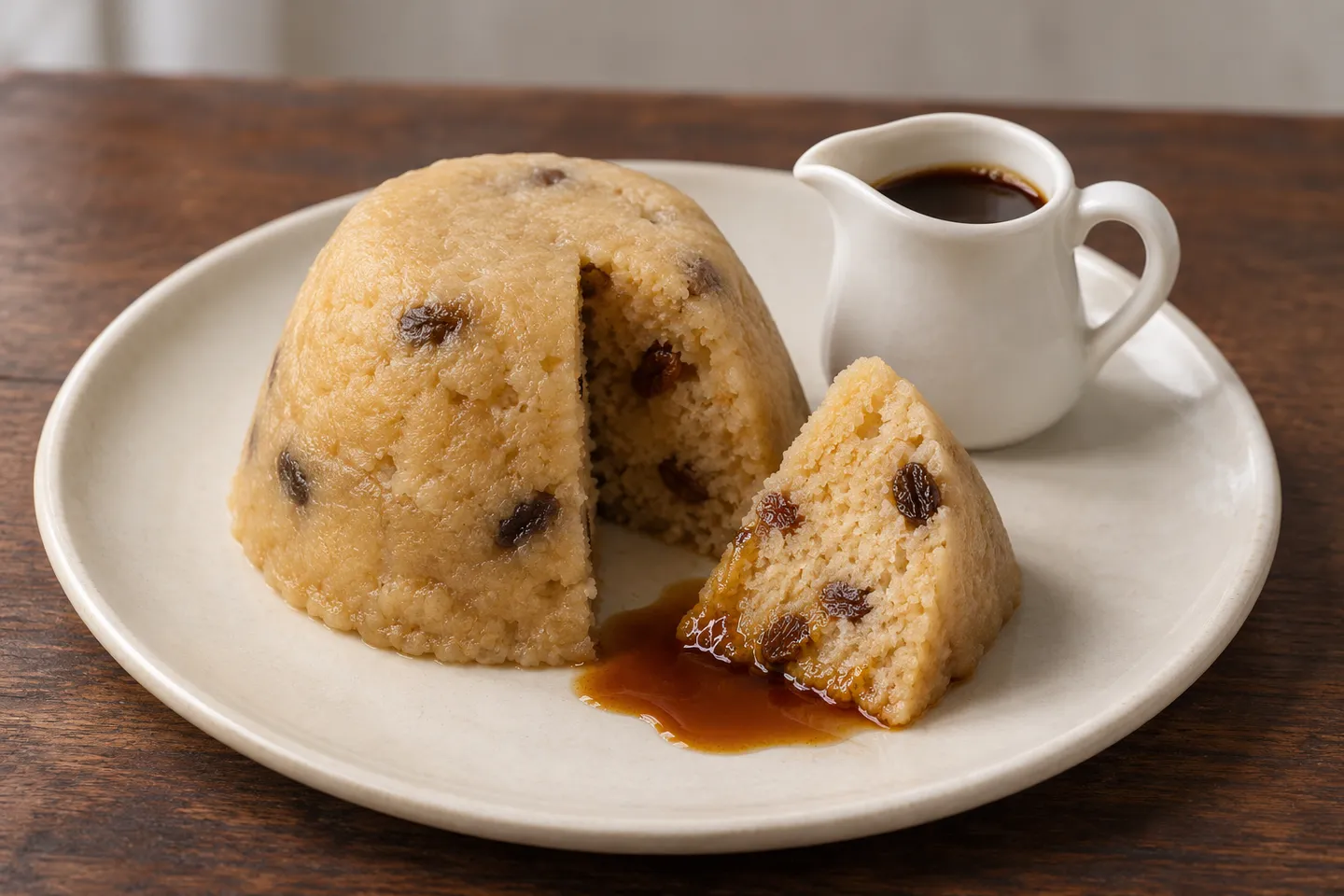
Sailor's Duff (Early Nineteenth-Century Dish, Museum Adaptation)
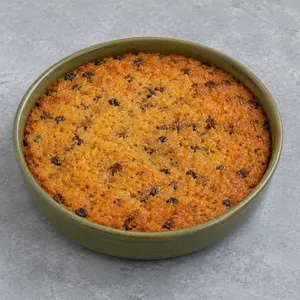
A raisin-filled steamed pudding made with vegetable shortening, adapted from the USS Constitution Museum's modern plum duff teaching recipe.
- Original yieldYield
- 1 small pudding, cut into 12 tasting portions1 small pudding, cut into 12 tasting portions
- PrepPrep time
- CookCook time
- TotalTotal time
Untested planning estimates include 10 minutes standing after the museum's five-hour steaming interval. Allow additional time to bring a large steaming pot to a simmer if it is not ready during preparation.
Published
Original recipe: 1 small pudding, cut into 12 tasting portions
The story behind the recipe
Raisins and molasses give this sailor's pudding its sweet side. The batter cooks in a basin over simmering water, a patient method that needs no oven. Its starting point is the USS Constitution Museum's teaching recipe, which uses vegetable shortening rather than asking a modern cook to prepare suet.
A pudding beside the biscuit
The museum presents duff as one of the treats that could interrupt a diet associated with salt meat and hard bread. The dish offers a useful companion to ship's biscuit: preserved ingredients could become a pudding as well as a ration to soften in stew. This is a small pudding for tasting and sharing, not a reconstruction of a complete naval meal.
Read more about this recipe
Which duff is this?
The museum's recipe sheet credits Sandra Oliver's Saltwater Foodways, published in 1995. It also quotes an 1808 writer complaining about sailors' hard puddings. Those references serve different purposes. An early account documents the dish's historical setting, while a later food-history book supplies the museum's working recipe. The old complaint does not verify the exact proportions in this bowl.
This distinction matters for the fat and raising agents. The museum's general description identifies suet and flour with the older dish; its teaching formula uses melted shortening, baking soda and cream of tartar. This version retains that modern combination. It makes no claim that every ingredient was issued together on Constitution, or that sailors followed this formula during the War of 1812.
Cooking with water and time
The source offers two methods, boiling in a cloth or steaming in a mold. This version chooses the mold method and gives the basin a cover and a stable support in the pot. The five-hour interval belongs to that selected source method; it has not been established by a TuneMyRecipe kitchen test. Check the pot regularly and top up with boiling water so that it cannot boil dry.
A covered basin also keeps the recipe separate from dunderfunk, the baked biscuit dish discussed in the sea-voyage article. Duff here starts with flour, and the raisins are mixed into a thick batter. Molasses goes on at serving. Although the museum names its sheet Plum Duff, the fruit it specifies is raisins, not fresh plums.
Make it your wayOriginal: 12 servings · Makes 1 small pudding, cut into 12 tasting portions
Original recipe: 1 small pudding, cut into 12 tasting portions
Ingredients
For 1 small pudding, cut into 12 tasting portions. Quantities are shown as written.
Source measurement convention: US customary. Explicit unit definitions take precedence; unconfirmed measures must be checked before conversion.
Original quantities for 1 small pudding, cut into 12 tasting portions.
- All-purpose flour2 cups
- Baking soda1/2 tsp
- Cream of tartar1 tsp
- Salt1 pinch
- Vegetable shortening, melted and cooled until warm1/4 cup
- Granulated sugar1/4 cup
- Seedless raisins2/3 cup
- Water2/3 cup
- Vegetable shortening, for greasing the basin1 tsp
- Molasses, for serving1/4 cup
- Water, as needed for steaming and topping up the pot
Measurement notes
- all-purpose flour, vegetable shortening, melted and cooled until warm, granulated sugar, seedless raisins, water, molasses, for serving: US cup: 1 = 236.5882 ml (rounded).
- baking soda, cream of tartar, vegetable shortening, for greasing the basin: US tsp: 1 = 4.9289 ml (rounded).
Measurement notes
Original ingredients
- 2 cups all-purpose flourUS cup: 1 = 236.5882 ml (rounded).
- 1/2 tsp baking sodaUS tsp: 1 = 4.9289 ml (rounded).
- 1 tsp cream of tartarUS tsp: 1 = 4.9289 ml (rounded).
- 1 pinch salt
- 1/4 cup vegetable shortening, melted and cooled until warmUS cup: 1 = 236.5882 ml (rounded).
- 1/4 cup granulated sugarUS cup: 1 = 236.5882 ml (rounded).
- 2/3 cup seedless raisinsUS cup: 1 = 236.5882 ml (rounded).
- 2/3 cup waterUS cup: 1 = 236.5882 ml (rounded).
- 1 tsp vegetable shortening, for greasing the basinUS tsp: 1 = 4.9289 ml (rounded).
- 1/4 cup molasses, for servingUS cup: 1 = 236.5882 ml (rounded).
- Water, as needed for steaming and topping up the pot
Equipment
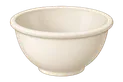 2-liter heatproof pudding basin
 Large deep pot with lid, sized to fit the pudding basin
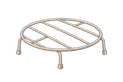 Stable trivet for the steaming pot
 Food thermometer
Instructions
Prepare the basin and steaming pot
Grease the basin with the extra shortening. Put the trivet in the deep pot, add water and bring it to a simmer while preparing the batter.
Mix the raisin pudding batter
Sift the flour, baking soda, cream of tartar and salt together. Mix in the sugar and raisins, followed by the warm melted shortening and measured water, to form a thick batter.
Fill and cover the two-liter basin
Spoon into the 2-liter basin, leaving at least one-third empty for expansion. Do not overfill it. Cover with pleated baking parchment and foil, tied securely below the rim.
Steam gently and maintain the water level
Stand the basin on the trivet. Adjust the hot water to reach halfway up the basin, without entering it. Cover the pot and steam gently for five hours. Check the water regularly and replenish with boiling water as needed; never let the pot boil dry.
Check the pudding center safely
Lift out carefully with heatproof protection. Remove the cover away from your face. The center should be set, with no wet raw batter on a skewer. If necessary, cover again and continue steaming until set.
Stand, unmold and serve with molasses
Let stand for 10 minutes, loosen around the edge and turn onto a plate. At the original quantity, cut into 12 small portions and serve with the molasses.
Recipe notes
When adjusting quantities
Keep this batch in one basin of the stated capacity, no more than two-thirds full. Do not scale the steaming time automatically. Make separate puddings for larger quantities rather than assuming one deeper pudding cooks at the same rate.
Original recipe notes
These notes describe the original recipe. Quantities mentioned here do not change when you adjust servings.
The 2-liter basin, covered steaming arrangement, ten-minute rest and measured serving molasses are adaptation choices. The museum gives the mold method five hours but does not specify its capacity. This basin allows more expansion space than a small bowl; its fill level and final texture still require kitchen testing before a tested-performance claim.
The source says shortening without specifying a product. This version selects vegetable shortening. It does not substitute suet, butter or liquid oil as though their behavior had been tested in this formula.
Storage
Refrigerate leftovers in shallow covered containers within 2 hours, or 1 hour above 90°F (32°C). Keep at 40°F (4°C) or below and use within 3 to 4 days. Reheat leftovers to 165°F (74°C). This is a cooked dessert, not a shelf-stable sea provision.
Read the scaling guide. Times, temperatures and equipment need their own consideration. Open the recipe tool to review and correct individual amounts.
Sources and attribution
Adapted from the USS Constitution Museum's Plum Duff teaching sheet (2011), credited there to Sandra Oliver's Saltwater Foodways (Mystic Seaport Museum, 1995). It is a modern historical adaptation, not a transcribed War of 1812 recipe.
The museum's Plum Duff sheet identifies its modern source and provides twelve servings. The accompanying Dinnertime resource calls the teaching recipe a recent adaptation. The cup measures are retained without unverified flour, fat or raisin weight equivalents. This draft remains untested. Present-day cooling and reheating follow USDA leftover guidance.
The museum's Plum Duff sheet identifies its modern source and provides twelve servings. The accompanying Dinnertime resource calls the teaching recipe a recent adaptation. The cup measures are retained without unverified flour, fat or raisin weight equivalents. This draft remains untested. Present-day cooling and reheating follow USDA leftover guidance.
Recipe details
- Recipe tradition
- Vintage
- Course or meal
- Dessert
- Browse category
- Baking & Desserts