

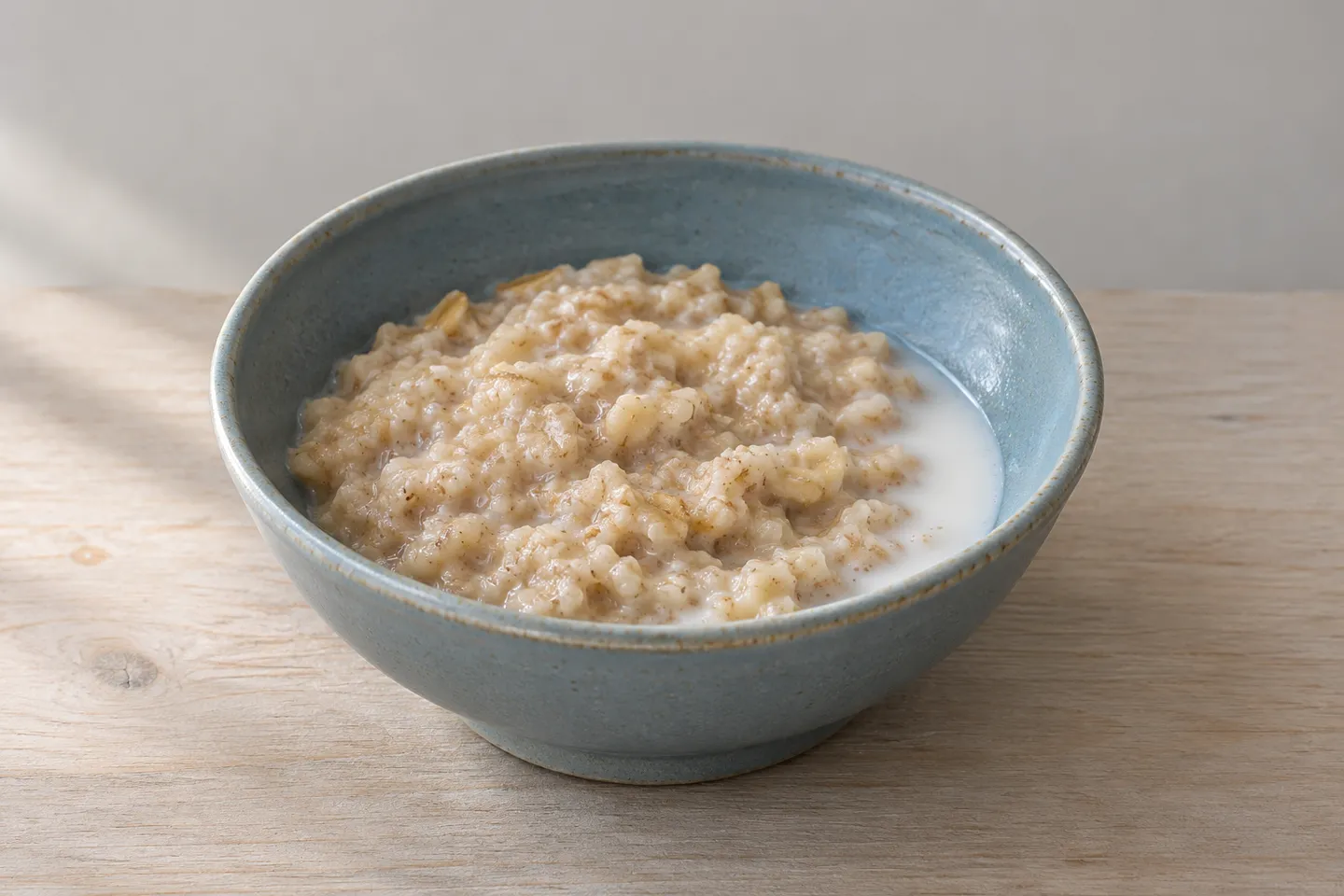
Coarse Oatmeal Porridge with Milk (1906)
Coarse oatmeal soaked overnight in the refrigerator, simmered in its soaking water and served with a measured pour of milk.
- Original yieldYield
- 3 small breakfast bowls3 small breakfast bowls
- PrepPrep time
- CookCook time
- TotalTotal time
Estimated: 10 minutes active preparation across evening and morning, 8 hours refrigerated soaking and about 20–30 minutes cooking. Coarser grain may need longer.
Published
Original recipe: 3 small breakfast bowls
The story behind the recipe
Pour the milk around the porridge after it reaches the bowl. The oats themselves cook in water, so the milk remains a separate, cooler finish around a warm spoonful of grain. This is a small breakfast portion with the coarse texture of cut oatmeal, rather than the flattened flakes of rolled oats.
Start the night before
The 1906 edition of Mrs. Beeton's household book gives several ways to cook porridge. One begins with oatmeal sprinkled into boiling water. Another soaks the grain overnight, then boils the soaking water before returning the oats to it. That second route is the starting point here.
Read more about this recipe
The grain needs its full name
Coarse oatmeal means a cut oat grain for this preparation. Buy plain coarse whole-oat oatmeal or steel-cut oats of a comparable coarse form, rather than instant porridge, sweetened sachets or a bag of rolled flakes. The differences affect the cooking, not just the appearance of the packet. The oat-form comparison explains why the names need to stay with the ingredient.
The source permits coarse, medium or fine oatmeal and says coarse is generally preferred. This version makes a definite choice so that the amount and method refer to one form. A particular mill's coarse cut may still take longer to soften than another's. Tenderness is a more useful stopping point than an insistence that every bag must finish at the same minute.
Use the weight for the oats. A volume of cut grain packs differently from a volume of flakes, and a cup count would obscure the four-ounce starting quantity. Water is measured separately. During cooking, a little more may be needed if evaporation leaves the grain short of liquid before it has softened.
A household recipe with several opinions
The book doesn't present its methods as equally good. It prefers the overnight soak to sprinkling oatmeal into boiling water, then praises a water-jacketed saucepan for a longer preparation that needs less frequent stirring. Those alternatives tell us something about the attention porridge could demand at the stove.
Here, the direct saucepan remains attended, and the selected overnight method keeps the soaking liquid. Straining in the morning separates grain from water for the next operation; it isn't an instruction to throw the water away and begin again. The recipe's other branches, including a previous-day cook lasting hours, aren't folded into this shorter morning method.
This is the revised 1906 Ward, Lock edition, not Isabella Beeton writing a new recipe in that year. Its preface credits C. Herman Senn and other cooks with work on the expanded book. The printed date identifies the household witness used for this version.
Milk beside an ordinary breakfast
The Titanic's third-class menu for April 14, 1912 names porridge and milk. That makes a nearby household recipe a useful comparison, but the menu doesn't identify this grain, method or portion. These three bowls aren't a recovered ship's formula.
Keeping that distinction leaves room to enjoy the breakfast itself. The milk is measured for the whole batch and divided at service, so everyone receives a similar allowance. There's no sugar or butter in this version. If you're choosing from the wider menu, the Titanic article considers several meals and separates menu evidence from modern cooking.
Make it your wayOriginal: 3 servings · Makes 3 small breakfast bowls
Original recipe: 3 small breakfast bowls
Ingredients
For 3 small breakfast bowls. Quantities are shown as written.
Source measurement convention: US customary. Explicit unit definitions take precedence; unconfirmed measures must be checked before conversion.
Original quantities for 3 small breakfast bowls.
- Coarse whole-oat oatmeal, not rolled or instant oats4 ozAuthor measures: 113 g.
- Cold water3 1/2 cupsAuthor measures: 828 ml.
- Fine salt1/4 tsp
- Whole milk, divided for serving1 cupAuthor measures: 237 ml.
- Additional boiling water, only as needed during cooking
Measurement notes
- cold water, whole milk, divided for serving: US cup: 1 = 236.5882 ml (rounded).
- fine salt: US tsp: 1 = 4.9289 ml (rounded).
Measurement notes
Original ingredients
- 4 oz (113 g) coarse whole-oat oatmeal, not rolled or instant oats
- 3 1/2 US cups (828 ml) cold waterUS cup: 1 = 236.5882 ml (rounded).
- 1/4 tsp fine saltUS tsp: 1 = 4.9289 ml (rounded).
- 1 US cup (237 ml) whole milk, divided for servingUS cup: 1 = 236.5882 ml (rounded).
- Additional boiling water, only as needed during cooking
Equipment
- Airtight glass container
 Medium saucepan (2-quart)
 Fine-mesh strainer
Instructions
Refrigerate the overnight soak
Put the oatmeal and cold water into a clean covered container. At the original batch, use at least 1.5 liters capacity; choose proportionately more room for a larger amount, leaving space above the mixture. Refrigerate at 40°F (4°C) or below for about 8 hours overnight.
Boil the soaking liquid and return the oats
Set the fine-mesh strainer over the saucepan and strain the soaking liquid into it, retaining all the oats in the strainer. Bring the liquid to a boil, stir in the reserved oats and salt, then reduce to a gentle simmer.
Simmer until tender
Cook for about 20–30 minutes, stirring frequently and scraping the bottom, until the oats are tender and the porridge is spoonable. If it becomes too dry before the grain is tender, add boiling water a little at a time and continue cooking; coarse cuts may need longer.
Divide the porridge and milk
Divide the cooked porridge among three bowls at the original quantity, or the selected number of portions after scaling. Divide the milk evenly among the bowls and serve immediately.
Recipe notes
When adjusting quantities
Keep the grain's form and scale oats, starting water, salt and serving milk together. Choose a larger soaking container and saucepan for more porridge. Add boiling water only as needed for tenderness; soaking and cooking times don't multiply with the ingredient amounts.
Original recipe notes
These notes describe the original recipe. Quantities mentioned here do not change when you adjust servings.
Adapted from the source's overnight-soak branch. This version uses 113 g oats and a slightly lower modern starting water allowance of 828 ml in place of the source's approximately 852 ml under an Imperial-pint convention. Refrigerated soaking, the fixed salt measure, three small portions and milk at service are modern specifications.
Milk is added at service rather than cooked into the oats. Contains milk; check the oat package for relevant allergen and cross-contact information. The finished weight varies with cooking and any added water.
Storage
Keep the overnight soak refrigerated at 40°F (4°C) or below. Serve the cooked porridge promptly. Refrigerate leftovers in shallow containers within 2 hours, or 1 hour above 90°F (32°C); reheat to 165°F (74°C), stirring and adding a little water if needed.
Read the scaling guide. Times, temperatures and equipment need their own consideration. Open the recipe tool to review and correct individual amounts.

Sources and attribution
Mrs. Beeton's Book of Household Management, new edition (London: Ward, Lock, 1906), no. 3149, Oatmeal Porridge, p. 1341.
Mrs. Beeton's Book of Household Management, new edition, London: Ward, Lock, 1906, no. 3149, Oatmeal Porridge, p. 1341. The digitized edition contains the household recipe; the passenger menu is separate evidence.