

- Cooking techniques
- Sauces
- Ingredients
- Measurement
Three Ways to Build a Sauce: Flour, Bread and Herbs
Choose between a smooth flour-and-milk sauce, softly textured bread sauce and sharp mint sauce, with the measurements that matter for each.
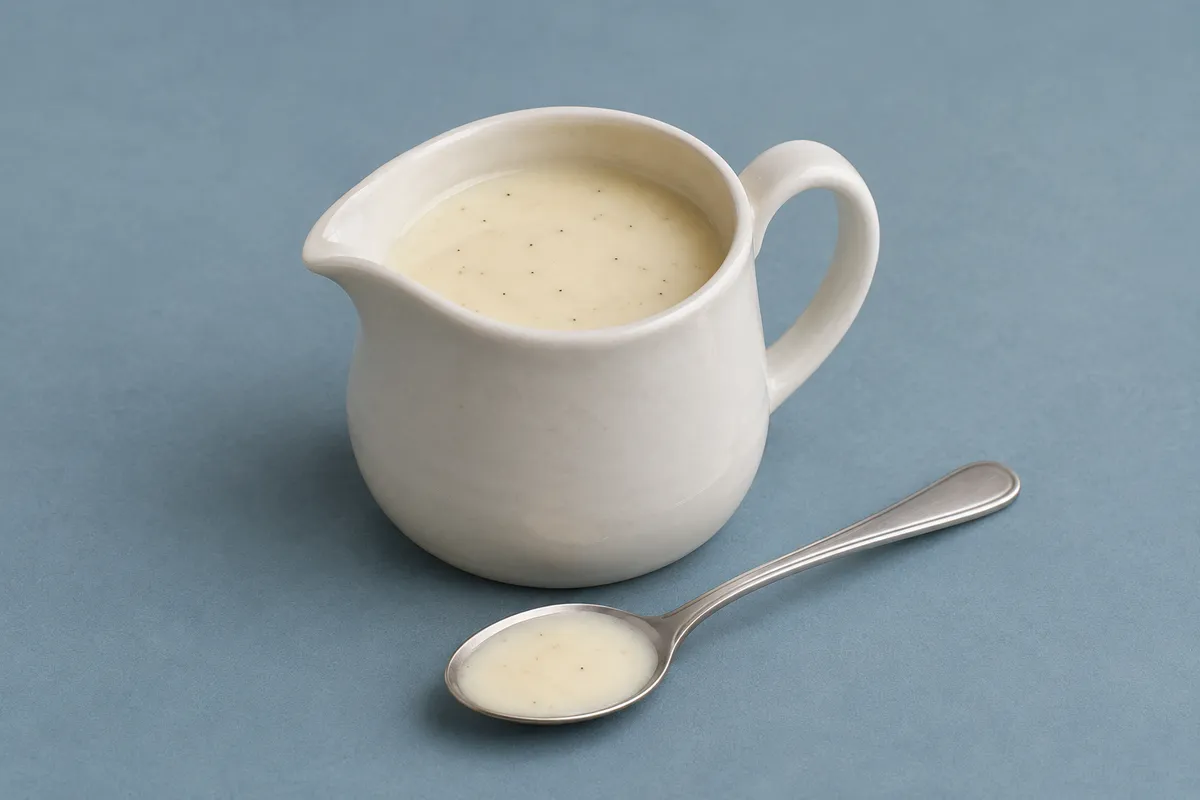
A white sauce should flow around the food. Bread sauce should bring a soft crumb texture of its own. Mint sauce can stay thin, with chopped leaves suspended in sharp, sweetened vinegar. All three belong beside a meal, but only two are meant to thicken.
That gives you a useful starting question before you reach for a saucepan: what do you want the sauce to add? A smooth coating, a spoonable accompaniment and a bright seasoning ask for different ingredients and different kinds of attention. Flour, bread and herbs aren’t three interchangeable ways to fill the same sauceboat.

Read the diagram as text
Three sauces, three paths Follow each recipe’s own method. White Sauce I BASE: Disperse flour in butter. COOK: Add milk and cook the sauce. TEXTURE: Smooth coating. Bread Sauce STEEP + STRAIN: Steep whole flavorings in milk; strain them out. COOK: Add fine soft crumbs and cook. TEXTURE: Soft crumb texture. Mint Sauce COMBINE: Finely chopped mint, sugar and vinegar. CHILL: Cover; infuse in the refrigerator for 2–3 hours. Stir. TEXTURE: Thin sauce with herb pieces. Separate recipe paths. No universal thickener replacement ratio.
Decide what should remain on the spoon
Fannie Merritt Farmer’s White Sauce I, published in 1896, builds its body from flour, butter and milk. The flour is dispersed in melted butter before the milk enters. The intended sauce is blended and smooth; visible crumbs or pieces of onion aren’t part of its character.
Our Onion-and-Clove Bread Sauce takes a different route. Whole flavorings steep in the milk and are strained out. Fine soft breadcrumbs then stay in the sauce. Their texture is the point, so whisking toward the appearance of a flour sauce would be aiming at the wrong finish.
Isabella Beeton’s 1861 mint sauce uses finely chopped fresh leaves, sugar and vinegar. She tells the cook to dissolve the sugar and allow time for the vinegar to take on the mint’s flavor. There is no flour, bread or cooking stage in that recipe. Its loose liquid is useful for distributing a little sharp seasoning over a serving.
| Choose this kind of sauce | What supplies its character | What to watch |
|---|---|---|
| Flour-and-milk white sauce | Cooked flour gives body to the milk | Even blending as liquid is added, followed by cooking |
| Bread sauce | Soft crumbs remain in flavored milk | Prepared crumb weight and the final spoonable texture |
| Mint sauce | Chopped mint flavors sweetened vinegar | Leaf preparation, dissolved sugar and the balance specified by the recipe |
These are choices about the finished food. They don’t establish a replacement ratio between flour, crumbs and chopped herbs.
Follow the flour quantity, even when the method points elsewhere
Farmer’s White Sauce I contains two tablespoons each of butter and flour to one cup of milk. Its entire method is a direction to make it like Thin White Sauce, the preceding recipe. That cross-reference is easy to misread while copying ingredients.
Thin White Sauce uses only one and a half tablespoons of flour. The method belongs to both entries; the smaller flour quantity doesn’t. Borrowing that line as well would quietly change the sauce you were trying to make.
The shared directions explain the sequence: melt the butter until bubbling, blend in the flour and seasoning, then introduce the milk and work the mixture smooth. Farmer offers gradual additions, about a third at a time, and also permits adding the milk at once when using a wire whisk. Even the scalding of the milk is an allowed choice in her account, rather than an indispensable separate ritual.
The underlying thickening happens after flour meets liquid and heat. As the Institute of Food Science and Technology explains, starch in flour absorbs water and swells during heating, thickening the liquid. Mixing flour into fat first helps you distribute it before that cooking stage. Butter alone isn’t the thickener, and a smooth mixture still needs to be cooked according to its recipe.
This distinction is useful beyond white sauce. Our guide to soup thickness includes a flour slurry stirred into strained broth. That flour meets cold water first, rather than melted butter. The two methods both use flour, but their order of mixing differs. Follow the operation the recipe actually gives.
Let the bread sauce keep its bread
The bread sauce starts with 600 ml milk and 100 g fine soft white breadcrumbs. The bread is weighed after its crusts have been removed. That prepared weight is more useful than a slice count, which changes with the loaf and the thickness of the slice.
Keep the word soft with the measurement. A bag of dried crumbs or panko isn’t another packaging choice for the same ingredient. The breadcrumb comparison explains those forms in more detail; for this sauce, buy or prepare the soft crumbs the card specifies.
The milk has already spent time with onion, cloves, peppercorns, garlic and herbs before the bread arrives. Removing those whole ingredients leaves their flavor without their shape. Adding the crumbs afterward gives a different sort of texture, dispersed through the liquid rather than floating as separate slices.
Our modern version follows Rosemary Shrager’s bread sauce, with a prepared onion weight and a measured allowance of extra milk. The reserved 30 ml isn’t part of the initial infusion. It is available if the finished sauce needs loosening. Add only what is needed, rather than pouring it in automatically and wondering why the sauce has become thin.
Give mint sauce time instead of heat
Beeton’s mint sauce is a small preparation with a different schedule. Her recipe calls for four dessertspoonfuls of chopped mint, two of sugar and a quarter pint of vinegar. The mint is washed free of grit, picked from its stalks and minced finely. The sugar is stirred until dissolved.
She suggests making it two or three hours before the meal so that the vinegar takes on the mint’s flavor. Our modern version keeps that useful lead time with the sauce refrigerated throughout the infusion. Heating the mixture to imitate white sauce would introduce an operation her recipe doesn’t ask for.
The measurements need their own care. A modern 10 ml dessertspoon convention makes the mint and sugar allowances 40 ml and 20 ml. Those are volumes of two different ingredients, not 40 g and 20 g. The leaves should already be finely chopped when their volume is measured.
Likewise, choosing the Imperial pint gives about 142 ml for a quarter pint, rounded to 140 ml of 5% white wine vinegar for this adaptation. The vinegar and measure are stated modern choices. They don’t make an American half-cup, a historical dessertspoon and a household cutlery spoon interchangeable. Use the modern card’s quantities when cooking, and keep the original wording for understanding the source.
Measure the batch before promising portions
One cup of milk going into white sauce isn’t a measured cup of finished sauce coming out. Flour and butter join it, while heating can remove liquid. Bread sauce has an additional straining stage, and mint sauce contains chopped leaves as well as vinegar. In each case, an input volume and a finished yield answer different questions.
If a meal needs a particular amount, measure the finished batch. For a larger preparation, multiply the ingredients together and choose a vessel with room to mix; don’t multiply an infusion or simmer time by the same number. Keep a texture adjustment separate so you can tell how much was actually added.
White Sauce I and Mint Sauce provide two historical approaches to set beside the bread sauce. Use each complete recipe for quantities and directions. Choose the sauce by the finish you want, then let its own method get you there.
Sources
Fannie Merritt Farmer, The Boston Cooking-School Cook Book, Boston: Little, Brown, and Company, 1896, p. 237, White Sauce I and Thin White Sauce. Isabella Beeton, The Book of Household Management, London: S.O.Beeton, 1861, no. 469, p. 225, Mint Sauce. The bread-sauce reference and starch explanation are linked beside the relevant discussion.