
Chocolate Mousse Icebox Cake (1920s)
Thin chocolate wafers layered with chocolate mousse in a loaf pan. No oven is needed, but the cake needs at least 12 hours in the fridge before slicing.
- Original yieldYield
- 1 loaf-sized cake1 loaf-sized cake
- PrepPrep time
- CookCook time
Allow for cooling to room temperature, then at least 12 hours chilling. Prep and cooking times are estimates; cooling time varies.
Published Updated
Original recipe: 1 loaf-sized cake
The story behind the recipe
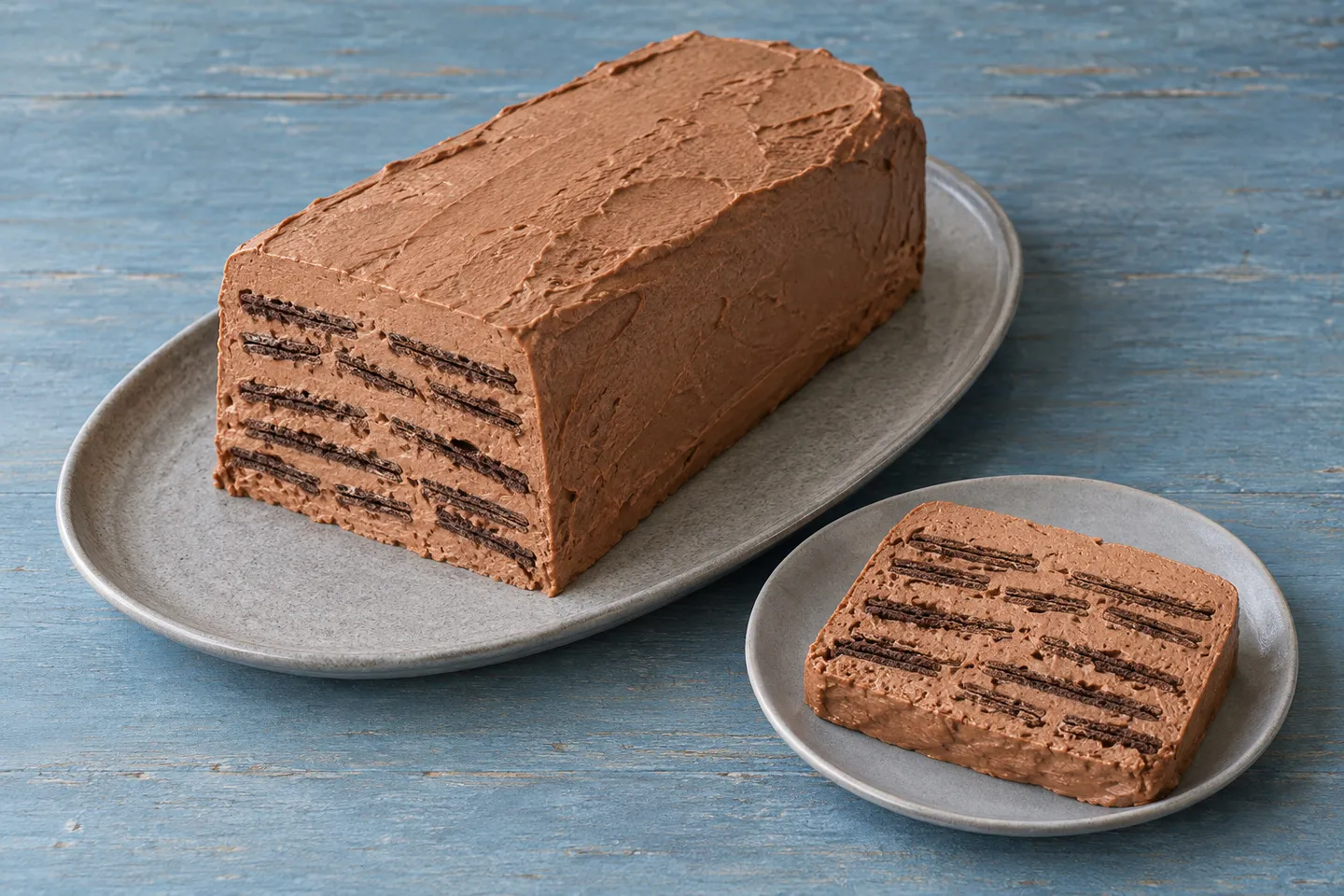
An icebox cake borrows its layers from cookies. Here, thin chocolate wafers alternate with mousse inside a lined mold; the finished dessert is turned out and sliced rather than baked and frosted. Chocolate runs through both parts, so the cut surface has no separate white cream stripe. Make it ahead: the layers need at least twelve hours in the refrigerator before slicing.
Bradley called it pudding
Alice Bradley's 1927 Electric Refrigerator Menus and Recipes includes Chocolate Ice Box Pudding. She layers ladyfingers with a chocolate-and-egg mixture in a brick mold and leaves it in the refrigerator before turning it onto a platter. Her whipped cream goes on afterward, as decoration.
Read more about this recipe
A loaf shaped by cold
The source is quite particular about where the mold belongs: in the refrigerator, not in its colder chilling unit. This is a chilled pudding, not a frozen one. That distinction matters in a book where other dishes deliberately use the freezing compartment.
Our loaf pan or round mold gives the same sort of whole-dessert presentation. The vessel sets the shape before the filling has chilled, and its paper lining helps with the final release. It is a different way to build a cake from stacking baked layers on a plate.
Among Bradley's refrigerator dishes, this one shows cold helping a dessert hold the form already given to it. The orange fruit cups stay slushy, and the lemon sherbet is beaten between freezer stages. This cake waits in its mold for a chilled, sliceable finish.
Cream in the chocolate, wafers between
We fold heavy cream and vanilla into the filling instead of using whipped cream solely as Bradley's decoration. Thin dark chocolate wafers replace ladyfingers. We use twice the chocolate and water, with unsweetened chocolate and a separately measured half cup of sugar in place of her sweet chocolate and two tablespoons of powdered sugar. The minimum chill is twelve hours, compared with her twenty-four.
Wafer thickness is worth noticing when shopping. A thin biscuit gives a different layer from a thick sandwich cookie, especially when repeated through a loaf. If using the suggested sandwich-cookie option, remove its filling; that extra pale cream isn't part of the recipe's layers.
The mousse has its own preparation before the mold comes out. Chocolate is melted with sugar and water, then eggs and whipped cream give the filling its lighter character. Pasteurized eggs are required: the whites are folded in uncooked and the yolks are not fully cooked by this method.
The cake waits overnight
No oven is needed, but there is still a warm chocolate mixture to prepare and cool. Allow for that cooling as well as the overnight refrigeration.
Leave the cake in its mold until it is ready to be turned out, and keep it refrigerated as directed. Cutting a slice reveals the dark wafer layers inside the chocolate mousse.
Make it your wayOriginal: 12 servings · Makes 1 loaf-sized cake
Original recipe: 1 loaf-sized cake
Ingredients
For 1 loaf-sized cake. Quantities are shown as written.
Source measurement convention: US customary. Explicit unit definitions take precedence; unconfirmed measures must be checked before conversion.
Original quantities for 1 loaf-sized cake.
- Unsweetened baking chocolate4 ozAuthor measures: 113 g.
- Sugar1/2 cup
- Water1/4 cup
- Pasteurized eggs4
- Heavy cream1 cup
- Vanilla extract1 tsp
- Thin dark chocolate wafers (like Oreo Thins with the cream scraped off, or homemade)30
Measurement notes
- sugar, water, heavy cream: US cup: 1 = 236.5882 ml (rounded).
- vanilla extract: US tsp: 1 = 4.9289 ml (rounded).
Measurement notes
Original ingredients
- 4 ounces (113 g) unsweetened baking chocolate
- 1/2 cup sugarUS cup: 1 = 236.5882 ml (rounded).
- 1/4 cup waterUS cup: 1 = 236.5882 ml (rounded).
- 4 pasteurized eggs
- 1 cup heavy creamUS cup: 1 = 236.5882 ml (rounded).
- 1 tsp vanilla extractUS tsp: 1 = 4.9289 ml (rounded).
- 30 thin dark chocolate wafers (like Oreo Thins with the cream scraped off, or homemade)
Equipment
 8x4-inch loaf pan or 6-cup round mold
 Double boiler (or saucepan and heatproof bowl)
 Electric mixer or whisk
 Wax paper
Instructions
The Mousse Filling
Melt chocolate with sugar and water
Melt the unsweetened baking chocolate in a double boiler (or a bowl over simmering water if you don't have one). Add the sugar and water, stir until smooth. Let the mixture cool until warm.
Add pasteurized yolks and cool
Separate the pasteurized eggs. Beat the yolks lightly and stir them into the warm chocolate until the mixture thickens slightly. Take it off the heat and let it cool to room temperature.
Fold in beaten egg whites
Beat the egg whites until they hold stiff peaks and fold them into the cooled chocolate.
Whip and fold in cream
Whip the heavy cream with the vanilla extract until thick, then fold it into the chocolate mixture.
Assembly
Layer wafers and mousse
Line an 8x4-inch loaf pan or 6-cup round mold with wax paper to help release the cake. Layer thin dark chocolate wafers on the bottom, cover with filling, and repeat until the wafers and filling are used. End with filling on top.
Cover and chill the cake
Cover and refrigerate for at least 12 hours before turning out and slicing.
Unmold and slice
When you're ready to serve, flip it out onto a plate, peel off the paper, and slice.
Estimated calories 250 kcal
Nutrition portion: 1/12 of recipe · Original yield: 1 loaf-sized cake
Source & assumptions
Ingredient-based estimate using CoFID 2021, USDA SR Legacy (April 2018). Approximately 250 kcal per nutrition portion. Standard nutrition portion: one-twelfth of the loaf cake. Uses 30 standard 6 g plain chocolate wafers; homemade wafers or cream-scraped sandwich cookies can differ. Ingredients, brands and preparation affect values.
Recipe notes
When adjusting quantities
Keep the original mold size and make separate cakes for a larger batch. Changing the mold changes the layer depth; the chilling time does not scale with ingredient quantities.
Original recipe notes
These notes describe the original recipe. Quantities mentioned here do not change when you adjust servings.
Use pasteurized eggs, as listed: the whites are folded in uncooked, and the method does not fully cook the yolks. Keep the finished cake refrigerated.
Choose thin, crisp chocolate wafers. Thick sandwich cookies will give different layers; remove the cream filling if using the suggested sandwich-cookie option.
Storage
Keep covered in the refrigerator at 40 degrees F (4 degrees C) or below until serving. Return it promptly to the refrigerator after slicing.
Make ahead
Assemble the day before serving and refrigerate for at least 12 hours, following the chilling step. Leave it in the mold until ready to unmold.
Read the scaling guide. Times, temperatures and equipment need their own consideration. Open the recipe tool to review and correct individual amounts.

Sources and attribution
Adapted from Alice Bradley, Electric Refrigerator Menus and Recipes (General Electric, copyright 1927; fourth edition, September 1928), Chocolate Ice Box Pudding, No. 98, p. 115.
Egg handling reference: FDA guidance for recipes with raw or undercooked eggs
Alice Bradley, Electric Refrigerator Menus and Recipes (General Electric, copyright 1927; fourth edition, September 1928), Chocolate Ice Box Pudding, No. 98, p. 115.