
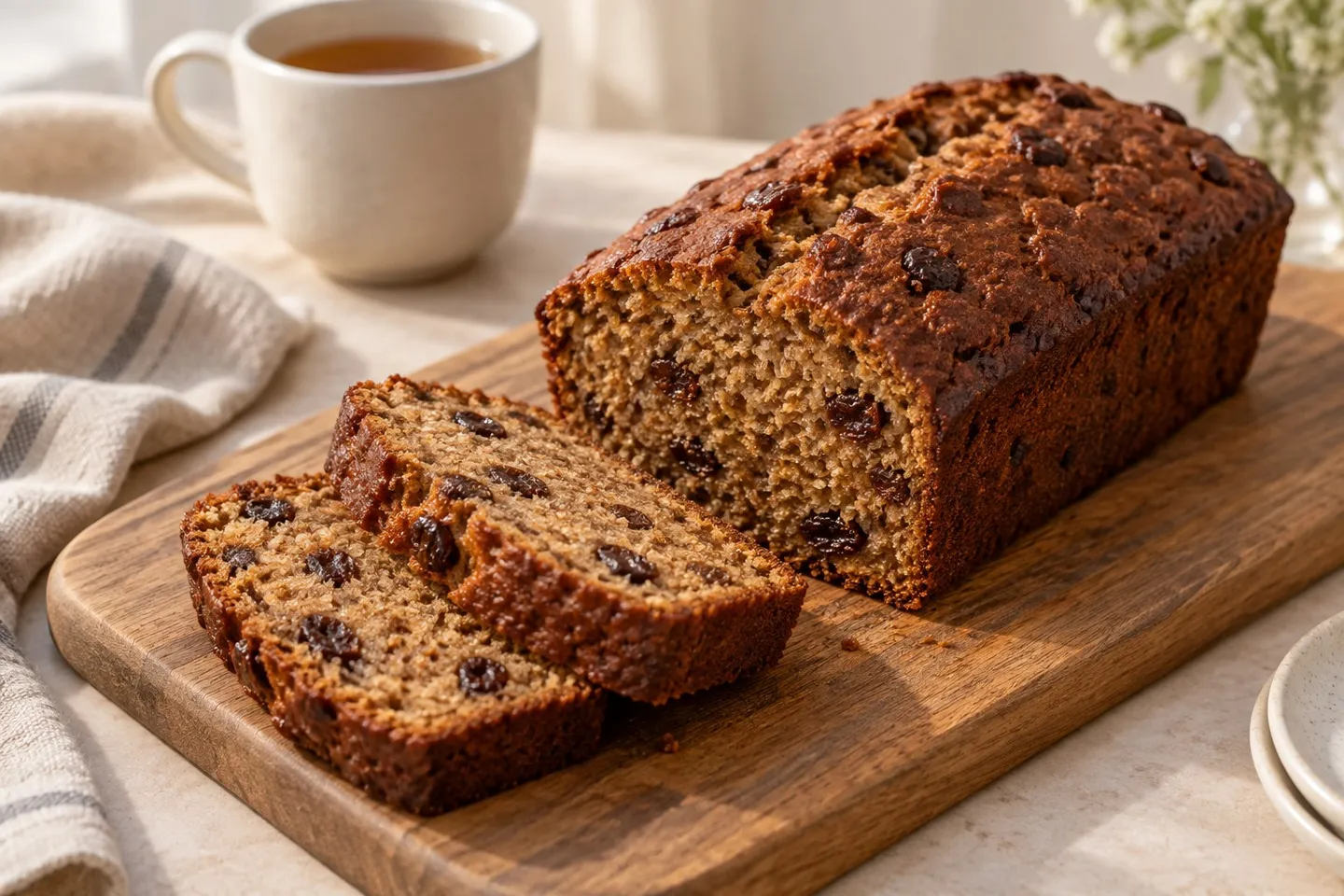
Wartime Eggless Fruit and Spice Cake (1941)
A moist British wartime tea loaf made with rolled oats, raisins, and warm mixed spice, leavened with bicarbonate of soda and vinegar without eggs.
- Original yieldYield
- 10 slices (one 8x4-inch loaf)10 slices (one 8x4-inch loaf)
- PrepPrep time
- CookCook time
Allow about 125 to 130 minutes for preparation, the 60-minute batter rest, and baking, before cooling. Cool in the pan for 15 minutes, then allow the loaf to cool completely before slicing; the full elapsed time varies.
Published Updated
Original recipe: 10 slices (one 8x4-inch loaf)
The story behind the recipe
The cake batter stands for an hour before the vinegar goes in. That is the unexpected pause in Ambrose Heath's 1941 Eggless Cake, a fruit-and-spice loaf that asks for a little patience without asking for eggs.
A plain loaf with plenty in it
Brown sugar, raisins and mixed spice give this version its tea-cake character. Fine rolled oats sit alongside the flour, and there is no filling or frosting to prepare. A slice brings the fruit and spice together in the crumb, rather than in decoration added later.
Read more about this recipe
Heath offered an oatmeal choice
In Kitchen Front Recipes and Hints, Heath allows flour alone or a mixture replacing part of it with fine oatmeal. He also offers different dried fruits and ginger as an alternative to mixed spice. His Eggless Cake is a formula with choices inside it, not a single combination whose every ingredient must be available.
Our version follows the flour-and-oat idea using fine rolled oats. They aren't identical to Heath's fine oatmeal, so choose the fine rolled oats specified for this version. Raisins or sultanas and a cinnamon, nutmeg and clove spice blend narrow the other choices to those listed below.
The wartime setting is relevant, especially to a cake that doesn't need fresh eggs. It doesn't have to supply the whole reason to bake it, though. Dried fruit, brown sugar and warm spice are an appealing combination on their own, with enough going on to leave the top plain.
The late addition of vinegar
Heath's mixture rests before its vinegar is added. Keeping that sequence is a more specific connection to the source than simply giving any eggless fruit loaf a wartime date. Our batter likewise goes through its hour of standing, then receives the vinegar just before baking.
The pause changes how to plan the cake. Active mixing is brief, but there is a long stretch before the pan enters the oven, followed by baking and cooling. It is better suited to an unhurried afternoon than a last-minute request for something warm to slice immediately.
A modern pan and a changed balance
The loaf below isn't a proportional reduction of Heath's formula. Flour and oats total a little over half his allowance, while fat, sugar and dried fruit stay close to his full amounts. Dark brown sugar, a smaller milk allowance and fine rolled oats set a different balance; water and vegetable shortening are listed alternatives.
The baking arrangement changes too. Heath's covered, lined tin and longer bake give way to an uncovered loaf pan with its own temperature and estimated duration. Follow the current pan and doneness directions, rather than combining the modern mixture with the historical baking schedule.
Cooking on the Kitchen Front places the loaf beside other dishes from Heath's book. They use quite different approaches to an ingredient constraint: crumbs in a sausage filling, oil in pastry, or potatoes in dough. Here, the interesting choice is a cake with fruit and spice, given time to stand before its final addition.
Let it cool fully for slicing, as the recipe directs. There is no icing stage waiting afterward; the loaf can finish as it began, with the dried fruit and spice taking most of the attention.
Make it your wayOriginal: 10 servings · Makes 10 slices (one 8x4-inch loaf)
Original recipe: 10 slices (one 8x4-inch loaf)
Ingredients
For 10 slices (one 8x4-inch loaf). Quantities are shown as written.
Source measurement convention: Metric. Explicit unit definitions take precedence; unconfirmed measures must be checked before conversion.
Original quantities for 10 slices (one 8x4-inch loaf).
- All-purpose flour200 gAuthor measures: about 1 1/2 metric cups (250 ml per cup).
- Fine rolled oats60 gAuthor measures: about 2/3 metric cup (250 ml per cup).
- Dark brown sugar (packed)85 gAuthor measures: about 1/3 metric cup (250 ml per cup).
- Margarine (or vegetable shortening, softened)115 gAuthor measures: about 1/2 metric cup (250 ml per cup).
- Raisins (or sultanas)120 gAuthor measures: about 3/4 metric cup (250 ml per cup).
- Baking soda (bicarbonate of soda)1 metric tsp
- White vinegar5 mlAuthor measures: 1 metric tsp (1 metric tsp = 5 ml).
- Whole milk (or water)240 mlAuthor measures: about 1 metric cup (250 ml per cup).
- Ground mixed spice (cinnamon, nutmeg, cloves)1 metric tsp
- Fine salt1/2 metric tsp
- Neutral cooking oil (for greasing)1 metric tsp
Measurement notes
- baking soda (bicarbonate of soda), ground mixed spice (cinnamon, nutmeg, cloves), fine salt, neutral cooking oil (for greasing): tsp: 1 = 5 ml.
Measurement notes
Original ingredients
- 200 g all-purpose flour (approx. 1 1/2 cups)
- 60 g fine rolled oats (approx. 2/3 cup)
- 85 g dark brown sugar (approx. 1/3 cup packed)
- 115 g margarine (or vegetable shortening, softened, approx. 1/2 cup)
- 120 g raisins (or sultanas, approx. 3/4 cup)
- 1 tsp baking soda (bicarbonate of soda)tsp: 1 = 5 ml.
- 5 ml white vinegar (1 tsp)
- 240 ml whole milk (or water, approx. 1 cup)
- 1 tsp ground mixed spice (cinnamon, nutmeg, cloves)tsp: 1 = 5 ml.
- 1/2 tsp fine salttsp: 1 = 5 ml.
- 1 tsp neutral cooking oil (for greasing)tsp: 1 = 5 ml.
Equipment
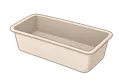 8x4-inch (20x10 cm) loaf pan
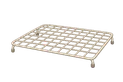 Wire cooling rack
Instructions
Grease and line the loaf pan
Grease an 8x4-inch (20x10 cm) loaf pan with the neutral cooking oil and line with parchment paper.
Cream margarine and sugar
In a large mixing bowl, cream the softened margarine and dark brown sugar together with a wooden spoon or hand mixer until smooth.
Whisk the dry ingredients
In a separate bowl, whisk together the all-purpose flour, fine rolled oats, ground mixed spice, and fine salt.
Dissolve baking soda in milk or water
Dissolve the baking soda in the whole milk or the listed water alternative.
Combine wet and dry mixtures
Add the flour mixture and the milk mixture alternately to the creamed margarine, stirring well to combine.
Fold in raisins
Fold in the raisins until evenly distributed throughout the batter.
Rest the batter and preheat the oven
Cover the bowl and let the mixture stand for 60 minutes before adding the vinegar. During the final part of the rest, preheat your oven to 175°C (350°F).
Stir in vinegar after resting
After resting, stir in the white vinegar, mixing thoroughly as the batter begins to aerate.
Fill the loaf pan immediately
Pour the batter immediately into the prepared loaf pan and smooth the top with a spatula.
Bake and check the center
Bake for 50 to 55 minutes until the loaf is deep golden brown and a wooden skewer inserted in the center comes out clean.
Cool before slicing
Cool in the pan on a wire rack for 15 minutes, then turn out and slice when completely cooled.
Estimated calories 260 kcal
Nutrition portion: 1/10 of recipe · Original yield: 10 slices (one 8x4-inch loaf)
Source & assumptions
Ingredient-based estimate using CoFID 2021, USDA SR Legacy (2018). About 260 kcal per nutrition portion (1/10 of the recipe). Uses hard margarine, raisins and whole milk. Includes the measured oil for the pan. The shortening, sultana and water alternatives are excluded. Actual ingredients and preparation affect the estimate.
Recipe notes
When adjusting quantities
Scale ingredients proportionally. Bake in a parchment-lined loaf pan at moderate heat to ensure the dense fruit crumb cooks through.
Original recipe notes
These notes describe the original recipe. Quantities mentioned here do not change when you adjust servings.
The 125 to 130 minutes covers preparation, the batter rest, and baking only. Cool in the pan for 15 minutes, then allow the loaf to cool completely before slicing.
Read the scaling guide. Times, temperatures and equipment need their own consideration. Open the recipe tool to review and correct individual amounts.
Sources and attribution
Ambrose Heath, Kitchen Front Recipes and Hints (1941), pp. 44-45
Ambrose Heath, Kitchen Front Recipes and Hints (1941), Eggless Cake, pp. 44–45. Modern oat form, quantities, pan and baking treatment are adapted; the pre-vinegar standing stage is retained.
Recipe details
- Recipe tradition
- Vintage
- Course or meal
- Baking
- Cuisine
- British
- Source decade
- 1940s
- Occasion
- Wartime cooking
- Browse category
- Baking & Desserts