
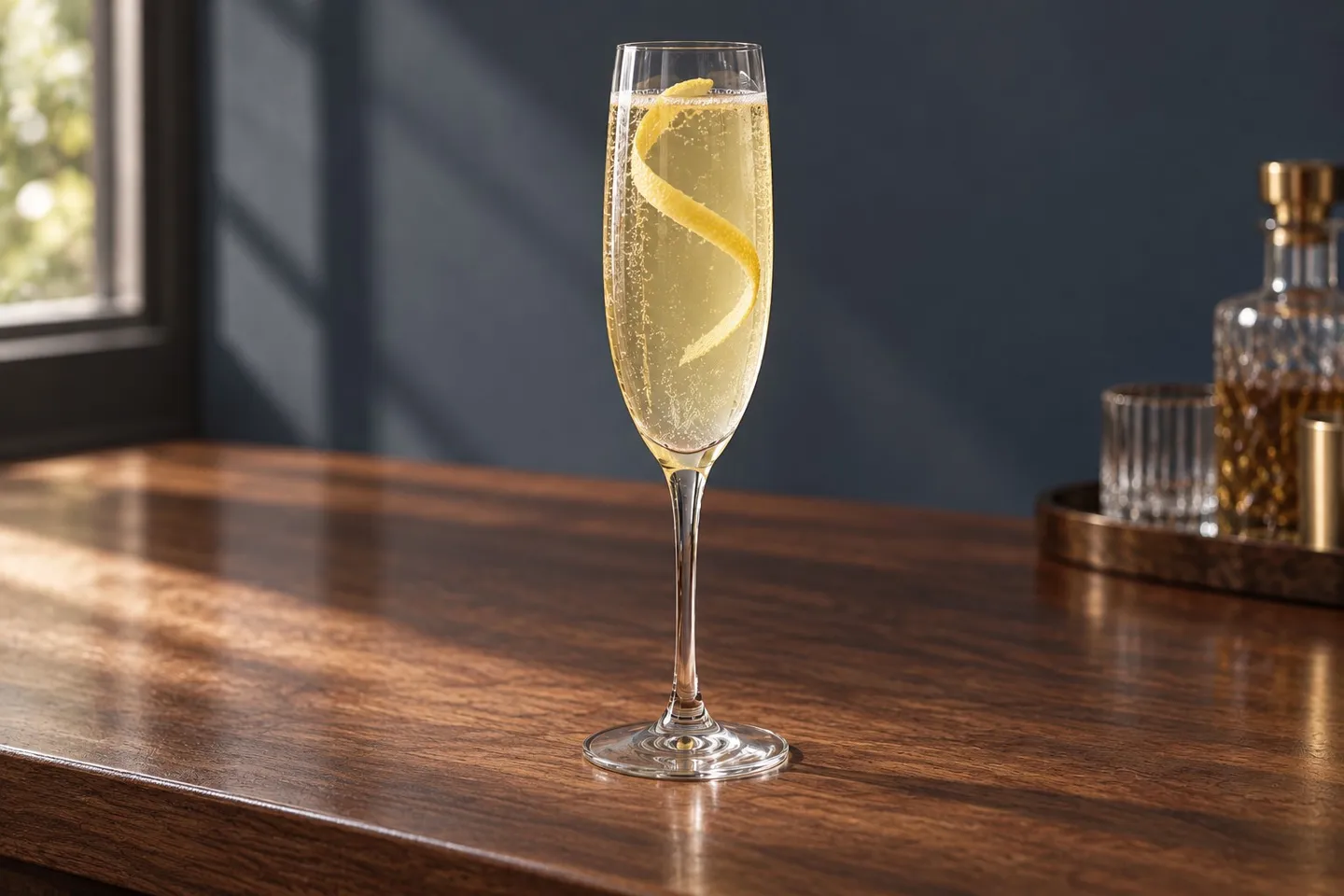
French 75 (1930)
The celebrated Champagne cocktail combining London dry gin, fresh lemon juice, and sugar syrup, topped with cold sparkling Champagne.
- Original yieldYield
- 1 cocktail1 cocktail
- PrepPrep time
- TotalTotal time
Published Updated
Original recipe: 1 cocktail
The story behind the recipe
A French 75 gives a gin sour a sparkling finish. Lemon and syrup are shaken with gin, then cold Champagne joins them in the glass. A lemon spiral adds citrus scent above the bubbles.
The wine is worth choosing
We choose London dry gin and dry Champagne; the Savoy entry leaves both styles unspecified. The recipe also allows a brut sparkling wine, including the Cava suggestion in the notes. Choose the bottle for the flavor you want beside gin and lemon.
A sweeter wine adds sweetness on top of the syrup already measured into the base. It won't disappear simply because there are bubbles. If you have a sweet bottle to open, keep that difference in mind instead of expecting the dry recipe unchanged.
Cold wine also helps the final serving stay cold without retained ice. Chill it beforehand; the few minutes of mixing assume the ingredients are ready.
Read more about this recipe
One name, different old formulas
The Champagne-topped reference here is Harry Craddock's The Savoy Cocktail Book (1930), page 73. It gives gin, lemon, powdered sugar and Champagne in a tall glass with cracked ice.
An earlier “75” in Harry McElhone's 1923 book is a very different drink: gin, Calvados, grenadine and absinthe, named with reference to the French field gun. There is no Champagne in that formula.
Those two entries are an enjoyable surprise in the Jazz Age bar-book article. A familiar name can bring an expectation to the glass that the old ingredient list doesn't share.
Our modern recipe follows the sparkling Savoy combination, with its changed measures and presentation explained below. The gin-and-lemon base is the part prepared in the shaker; Champagne is the finishing pour.
The sour before the bubbles
London dry gin brings botanical flavor, lemon supplies acidity and syrup joins the two with measured sweetness. The fixed amounts give you a starting point independent of the size of a spoon or the juice in one particular fruit.
The gin-to-lemon ratio here is 3:1, compared with the source's 2:1. That makes the gin more prominent before the wine enters. The simple syrup also replaces powdered sugar, making the sweetness easier to measure in the short mixing stage.
The ice chills and dilutes that base. It's strained out before the sparkling addition, leaving the flute free of mixing shards and cracked ice.
Enough room for the last pour
A flute needs space above the citrus base for the wine. Add it gently so the rising fizz doesn't push the drink over the rim.
The long lemon spiral is a modern garnish. Its scent is another citrus element, separate from the lemon juice mixed through the liquid. One spiral is plenty beside the bubbles.
For a small gathering, the still ingredients can be measured together for comfortable shaker batches. Each glass still receives its own Champagne at serving. There is no advantage in shaking sparkling wine with the sour or letting a row of finished drinks wait while the final glasses are prepared.
A toast needn't mean Champagne on its own. Here the bottle meets fresh lemon and gin, with the same attention given to the last gentle pour as to the earlier sharp shake.
For more of the bar-book background, read about cocktails in 1920s London and Paris on our sister site, Forgotten Drink.
Make it your wayOriginal: 1 serving · Makes 1 cocktail
Original recipe: 1 cocktail
Ingredients
For 1 cocktail. Quantities are shown as written.
Source measurement convention: Metric. Explicit unit definitions take precedence; unconfirmed measures must be checked before conversion.
Original quantities for 1 cocktail.
- London dry gin45 ml
- Fresh lemon juice (strained)15 ml
- Simple syrup (1:1)10 ml
- Dry Champagne (or brut sparkling wine, chilled)60 ml
- Long lemon spiral (for garnish)1
Measurement notes
Measurement notes
Original ingredients
- 45 ml London dry gin
- 15 ml fresh lemon juice (strained)
- 10 ml simple syrup (1:1)
- 60 ml dry Champagne (or brut sparkling wine, chilled)
- 1 long lemon spiral (for garnish)
Equipment
 Cocktail shaker
 Hawthorne strainer
 Champagne flute or coupe
Instructions
Combine gin, lemon and syrup
In a cocktail shaker, combine the London dry gin, fresh lemon juice, and simple syrup.
Add cracked ice
Fill the shaker with cracked ice.
Shake to chill
Shake sharply for 10 to 12 seconds until thoroughly chilled.
Strain into a Champagne flute
Strain the cold citrus-gin mixture through a Hawthorne strainer into a tall Champagne flute.
Top with Champagne
Top gently with the dry Champagne, letting the carbonation fizz and blend with the gin base.
Add the lemon spiral
Garnish with the long lemon spiral dropped inside the glass to serve.
Estimated calories 170 kcal
Nutrition portion: whole recipe · Original yield: 1 cocktail
Source & assumptions
Ingredient-based estimate using CoFID 2021, identified manufacturer information. Approximately 170 kcal per nutrition portion. Uses 40% ABV London dry gin, 12% ABV PIAFF Brut Champagne and equal-weight sugar-and-water syrup. Lemon garnish is excluded. Ingredients, brands and preparation affect values.
Recipe notes
When adjusting quantities
Do not shake the Champagne; shake the gin base and top with cold sparkling wine in the glass.
Original recipe notes
These notes describe the original recipe. Quantities mentioned here do not change when you adjust servings.
Harry Craddock, The Savoy Cocktail Book (1930), p. 73. Our 3:1 gin-to-lemon ratio, simple syrup, fixed wine top-up, shaken and strained base, flute and lemon spiral are modern changes from its powdered-sugar and cracked-ice tall-glass serving.
Use dry Champagne or a brut sparkling wine such as Cava. Sweet wine changes the drink.
Make 1:1 syrup with equal weights of sugar and water and cool before use. Never shake the Champagne; add it to each glass after straining the base.
Read the scaling guide. Times, temperatures and equipment need their own consideration. Open the recipe tool to review and correct individual amounts.
Sources and attribution
Harry Craddock, The Savoy Cocktail Book (1930), p. 73
Recipe details
- Recipe tradition
- Vintage
- Course or meal
- Drink
- Cuisine
- Other / International
- Source decade
- 1930s
- Browse category
- Drinks & Cocktails