
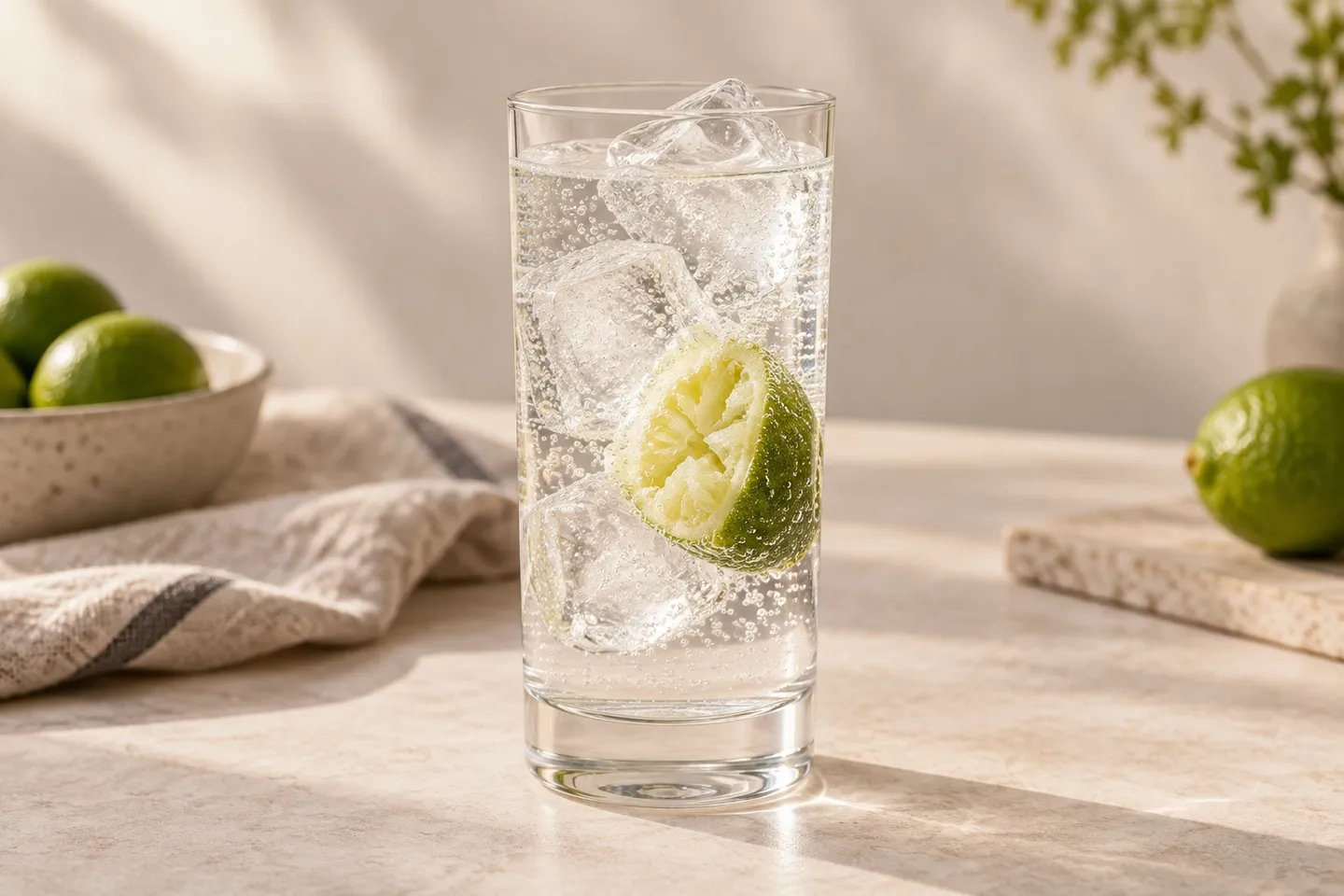
Gin Rickey (1900)
A dry, bracing highball of gin, lime juice, and soda water served over block ice.
- Original yieldYield
- 1 drink1 drink
- PrepPrep time
- TotalTotal time
Published Updated
Original recipe: 1 drink
The story behind the recipe
A Gin Rickey has no sugar to take the edge off the lime. Gin, fresh juice and soda make a long, tart drink, served over large pieces of ice.
A lime drink with a dry finish
The measured lime juice runs through the glass. It isn't just a garnish scent at the rim. Soda lengthens that sharp citrus without adding syrup, leaving the gin noticeable behind it.
London Dry gin is the choice here. Its botanical flavor stays exposed in a mixture this simple, so use a bottle you enjoy in a plainly mixed drink. A strongly flavored gin and a restrained one will lead to different glasses even at the same measures.
The lime half gives the presentation a little roughness: fruit that has already supplied its juice can still sit among the ice. There's no elaborate spiral to cut or berry skewer to assemble.
Read more about this recipe
Johnson's pieces of ice
Harry Johnson's 1900 Bartenders' Manual gives the Rickey one or two pieces of ice. Nearby drinks on the same page use fine shaved ice. That small detail resists a neat history in which one form of ice suddenly replaced the other across a whole bar.
Different drinks already asked for different cold arrangements. A Rickey could be built around a few pieces, while shaved ice packed another glass much more closely. In the historic ice article, Johnson's serving sits beside three earlier Thomas recipes to show the range.
The source calls for the juice of a good-sized lime or two small ones, Tom or Holland gin, and a carbonated top-up in a medium fizz glass. It finishes with a spoon. Our measured London Dry highball keeps the gin-lime-soda idea, with its specific changes noted below.
Rickey or something sweeter?
A dry highball is a useful description when offering this cocktail. It helps someone choose without needing to know a historical bar name. Lime is sharp, soda is unsweetened, and the spirit remains part of every sip.
Old Tom gin is an option in the notes, but it changes the profile. Keep that choice separate from reaching for tonic water: tonic supplies its own sweetness and bitterness and would make another drink.
Fresh lime is worth squeezing for the recipe. Measure the juice once the seeds are out, then use the spent half as directed. A small lime doesn't become a standardized juice measure just because it's neatly shaped.
Cold ingredients simplify the last pour
The Rickey is built in its serving glass, leaving the shaker free for another cocktail. That makes it a helpful choice on a menu beside a foamed drink or a citrus sour with several straining steps.
Chill the soda beforehand. A cold mixer helps the ice last, and a brief stir is enough to join it to the lime and gin. Prolonged stirring and a jug of finished Rickeys left standing would sacrifice the lively part of the pour.
Large clear pieces are the modern presentation, leaving room between them for the liquid and lime. You can see the drink change as the ice melts. Its first tart sip gradually becomes a little longer and lighter.
For a gathering, work out the total ingredient amounts in advance, but build each glass separately. The person choosing a Rickey is asking for something straightforward; fresh lime and cold soda deserve more attention than adding another decoration.
Make it your wayOriginal: 1 serving · Makes 1 drink
Original recipe: 1 drink
Ingredients
For 1 drink. Quantities are shown as written.
Source measurement convention: Metric. Explicit unit definitions take precedence; unconfirmed measures must be checked before conversion.
Original quantities for 1 drink.
- London Dry gin60 ml
- Fresh lime juice20 ml
- Spent lime half (for garnish)1
- Cold soda water100 ml
Measurement notes
Measurement notes
Original ingredients
- 60 ml London Dry gin
- 20 ml fresh lime juice
- 1 spent lime half (for garnish)
- 100 ml cold soda water
Equipment
 Highball glass
 Citrus squeezer
 Bar spoon
Instructions
Add ice to the highball glass
Place the large lumps of clear ice directly into a tall highball glass.
Pour in gin and lime juice
Pour the London Dry gin and fresh lime juice over the ice.
Add the spent lime half
Drop the spent lime half into the glass.
Top with soda and stir
Top with the cold soda water and stir briefly with a bar spoon to combine the ingredients.
Estimated calories 150 kcal
Nutrition portion: whole recipe · Original yield: 1 drink
Source & assumptions
Ingredient-based estimate using CoFID 2021, USDA SR Legacy (2018), representative labels for 58 and CO London Dry Gin (43% ABV). About 150 kcal per nutrition portion (whole recipe). Uses representative London dry gin at 43% ABV. Excludes the spent-lime garnish. Actual ingredients and preparation affect the estimate.
Recipe notes
When adjusting quantities
Scale ingredients proportionally. Build each drink directly in its serving glass.
Original recipe notes
These notes describe the original recipe. Quantities mentioned here do not change when you adjust servings.
Harry Johnson, Bartenders' Manual (1900), p. 241. London Dry gin, fixed liquid amounts, highball glass, clear ice and the retained lime shell are modern choices. Johnson specifies Tom or Holland gin, variable lime quantities and one or two ice pieces.
This recipe has no added sugar. Old Tom gin is an alternative if you prefer a different botanical and sweetness profile.
Use cold soda, stir briefly after adding it and serve promptly to keep the bubbles.
Read the scaling guide. Times, temperatures and equipment need their own consideration. Open the recipe tool to review and correct individual amounts.
Sources and attribution
Harry Johnson, Bartenders' Manual (New York, 1900), p. 241
Recipe details
- Recipe tradition
- Vintage
- Course or meal
- Drink
- Cuisine
- Other / International
- Source decade
- 1900s
- Browse category
- Drinks & Cocktails