
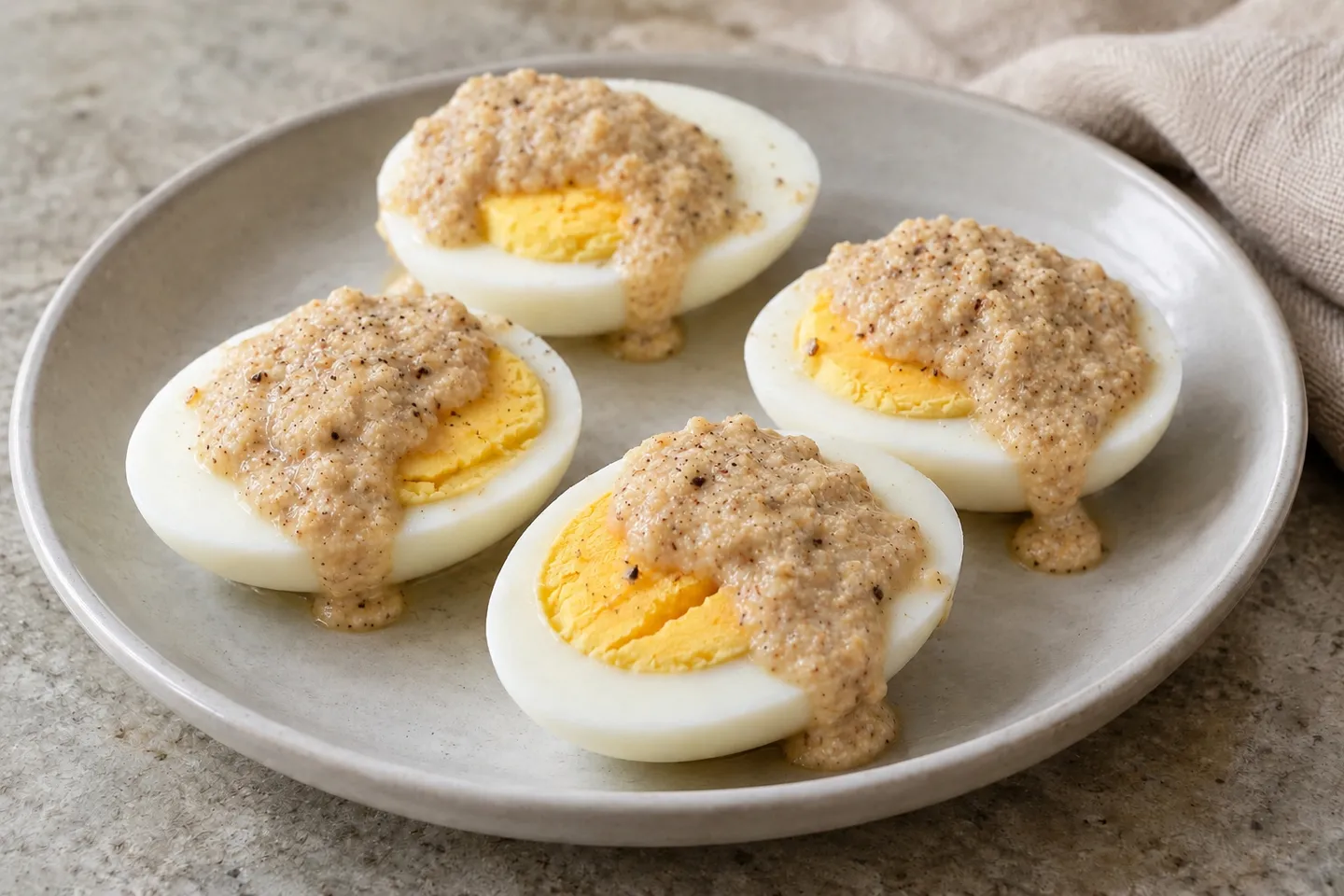
Roman Eggs with Pine Nut Sauce
Hard-boiled egg halves topped with ground pine nuts, honey, vinegar, fish sauce, and a little celery seed.
- Original yieldYield
- 4 appetizer servings (8 egg halves)4 appetizer servings (8 egg halves)
- PrepPrep time
- CookCook time
- TotalTotal time
Includes heating the egg water, the covered stand, and 5 minutes of cooling; soak the nuts and make the sauce while the eggs cook.
Published Updated
Original recipe: 4 appetizer servings (8 egg halves)
The story behind the recipe
Firm-cooked egg halves are topped with a thick pine-nut dressing flavored with honey, vinegar and fish sauce. We use pepper and celery seed too, with the seed standing in for the source's lovage.
A sauce with some texture
The soaked pine nuts are ground into a thick paste, then loosened until it can be spooned over the eggs. A little fine nut texture is expected. Honey supplies sweetness, vinegar a sharp edge, and fish sauce salt and savory flavor, all against the relatively mild egg beneath.
Read more about this recipe
Soft eggs in the old heading
The source is In ovis apalis, Book VII's final egg-sauce passage in De Re Coquinaria, the collection usually called Apicius. The heading refers to soft eggs; Joseph Dommers Vehling's 1936 translation calls them poached. Pepper, lovage, soaked nuts, honey, vinegar, and fish sauce follow in a few brief directions. Our Apicius feature follows the collection's other sauces, including the grape finish on chicken with leeks and fresh herbs.
The nuts are already soaked when the cook is told to bring the sauce together. The text gives more attention to that dressing than to cooking the eggs themselves. It offers a combination without saying how much of each ingredient to use.
Our recipe uses firm-cooked egg halves and pine nuts, though the Latin passage doesn't specify the type of nut. Celery seed stands in for lovage, and the amounts and thinning water are modern choices. Those differences leave a simple appetizer whose historical interest is in the nut, honey, vinegar, and fish-sauce combination.
Shopping for the sauce
Buy plain raw pine nuts rather than salted snack nuts. The sauce already has a measured savory seasoning, and any salt added to the nuts would arrive with it. A small processor suits this quantity; a mortar and pestle gives another way to grind it. Large nut fragments would make the sauce awkward to spoon over a small egg half.
Lovage and celery seed aren't identical. The seed gives a modest celery note here, while the notes offer a measured fresh-lovage alternative for cooks who have the herb. Fish sauce also varies by brand. Start with the listed quantity instead of assuming that the balance needs another splash before it's been combined with the honey and vinegar.
The honey isn't just a finish drizzled over the plate. It belongs inside the sauce, where vinegar and fish sauce accompany it. A sweet-and-sour dressing over eggs may be unfamiliar, but each of its components remains easy to find and measure.
A small beginning
Two halves make a starter. Keep the eggs and sauce separate until serving, so the plate can be assembled without rushing the grinding or egg cooling. Bread or a leafy salad can accompany it if this is lunch rather than the opening of a larger meal.
Four eggs and one sauce make a small cooking project. Spoon the dressing over the cut surfaces just before serving, leaving the yolks and the fine nut texture visible.
Make it your wayOriginal: 4 servings · Makes 4 appetizer servings (8 egg halves)
Original recipe: 4 appetizer servings (8 egg halves)
Ingredients
For 4 appetizer servings (8 egg halves). Quantities are shown as written.
Source measurement convention: Metric. Explicit unit definitions take precedence; unconfirmed measures must be checked before conversion.
Original quantities for 4 appetizer servings (8 egg halves).
- Large eggs, chilled4
- Raw pine nuts40 g
- Wildflower honey15 ml
- White wine vinegar15 ml
- Southeast Asian fish sauce5 ml
- Celery seed, finely ground0.5 g
- Ground black pepper1 g
- Warm water (for thinning the sauce)15 ml
Measurement notes
Measurement notes
Original ingredients
- 4 large eggs, chilled
- 40 g raw pine nuts
- 15 ml wildflower honey
- 15 ml white wine vinegar
- 5 ml Southeast Asian fish sauce
- 0.5 g celery seed, finely ground
- 1 g ground black pepper
- 15 ml warm water (for thinning the sauce)
Equipment
 Food processor
Instructions
Cook the eggs
Place the eggs in a saucepan and cover with cold water by 2 cm. Bring to a full boil, then remove from the heat and cover. Let stand for 10 to 12 minutes, until the yolks and whites are firm; egg size, starting temperature, and altitude can affect the time.
Soak and drain the pine nuts
While the water heats, cover the raw pine nuts with freshly boiled water and leave for 10 minutes. Drain well.
Chill, peel and halve the eggs
Transfer the cooked eggs to ice water for 5 minutes. Peel and halve lengthwise. If an egg is not fully set, continue cooking it before serving.
Grind the pine nuts
Process the drained nuts in a small food processor until finely ground, scraping down as needed. A mortar and pestle also works if you prefer to grind the sauce by hand.
Mix the pine nut sauce
Add the honey, white wine vinegar, fish sauce, ground celery seed, and black pepper. Process to a thick paste. Stir in the warm water a little at a time, using only enough to make a spoonable sauce; some fine nut texture is expected.
Top the egg halves and serve
Arrange the 8 egg halves on a plate and spoon the sauce over them. Serve promptly, or chill the eggs and sauce separately until serving.
Estimated calories 150 kcal
Nutrition portion: 1/4 of recipe · Original yield: 4 appetizer servings (8 egg halves)
Source & assumptions
Ingredient-based estimate using CoFID 2021, USDA SR Legacy (2018), representative labels for Kotányi ground black pepper. About 150 kcal per nutrition portion (1/4 of the recipe). Includes all pine-nut sauce and the four eggs, with shells excluded. Counts the raw nuts before their short soak; no claim of measured soaking losses. Actual ingredients and preparation affect the estimate.
Recipe notes
Original recipe notes
These notes describe the original recipe. Quantities mentioned here do not change when you adjust servings.
Herb choice: Celery seed gives the sauce a celery note, but does not duplicate lovage. If you have fresh culinary lovage, use 2 g finely chopped leaves in place of the celery seed. This is an alternative modern amount, not an ancient equivalent.
Serving: Two halves per person make a starter. Bread, olives, or a leafy salad are present-day accompaniment suggestions. Larger yields may need more than one batch in a small processor.
Storage: Refrigerate eggs and sauce promptly at 40°F (4°C) or below; do not leave them out longer than 2 hours, or 1 hour above 90°F (32°C). Use the assembled dish within 3 days. Make the sauce up to a day ahead, keep it chilled, and stir before serving.
Read the scaling guide. Times, temperatures and equipment need their own consideration. Open the recipe tool to review and correct individual amounts.

Sources and attribution
Apicius, Book VII's final egg-sauce passage, commonly VII.19.3: complete Latin egg passage and Vehling 1936, recipe 328.
For the drinking side of the Roman table, explore what Romans drank besides wine on our sister site, Forgotten Drink.
Recipe details
- Recipe tradition
- Vintage
- Cuisine
- Ancient Roman
- Historical period
- Roman
- Browse category
- Snacks & Dips