
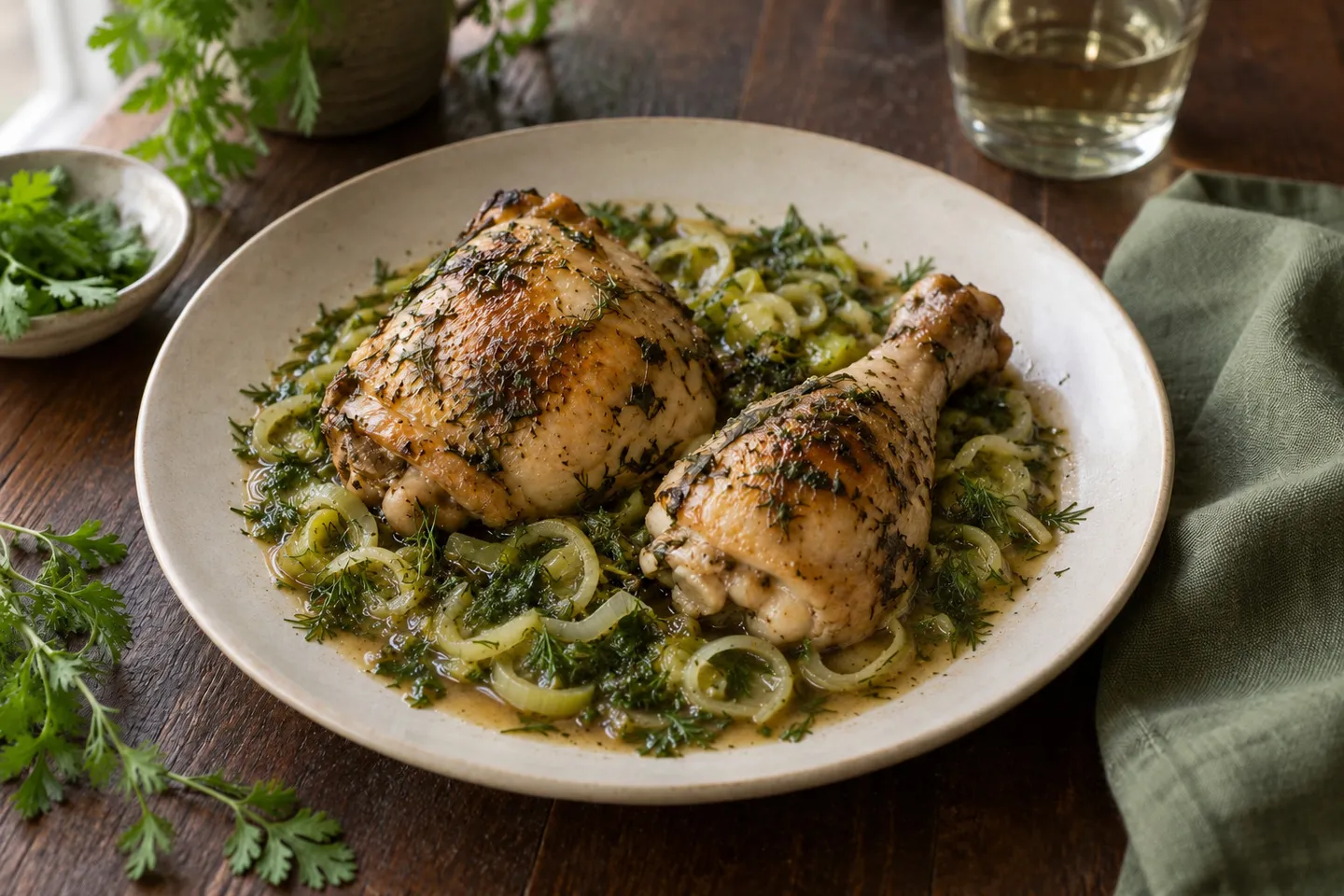
Pullum Frontonianum (Chicken à la Fronto)
Bone-in chicken braised with leeks, dill, fresh cilantro, savory, and fish sauce, then finished with grape syrup and pepper.
- Original yieldYield
- 4 servings4 servings
- PrepPrep time
- CookCook time
- TotalTotal time
Allows for browning the chicken in two batches, braising, and reducing the sauce; check every piece for a safe center temperature.
Published Updated
Original recipe: 4 servings
The story behind the recipe
Dill, leek, savory, and fresh cilantro cook around this chicken before grape syrup joins the finished juices. The herb mixture appears in the Apician source, followed by that sweet finish and pepper.
Green coriander
The source names green coriander: the leaves and tender stems usually called cilantro. Ground coriander seed would give different seasoning. Keeping the leaves with dill and savory is more useful than treating the herbs as an interchangeable handful of dried spices.
Read more about this recipe
The grape finish comes last
Pullum Frontonianum appears in Book VI of Apicius. The passage begins with partially cooked chicken, fish sauce, and oil. A bundle of dill, leek, savory, and green coriander cooks with it. The cooked bird is lifted onto a platter, coated with defrutum, and sprinkled with pepper.
The grape reduction belongs to the finish. It doesn't season the whole braise from the start. Our method keeps that distinction, stirring a little plain grape saba into the finished pot juices after the chicken has cooked.
The name refers to Fronto, but his precise identity is uncertain. The herb bundle and serving order give the dish a clearer identity than an assumed biography would. The companion Apicius article follows those ingredients alongside a sauce for eggs with pine nuts.
Choosing the herbs and seasonings
Summer savory is an herb, not a general direction to add something savory. Fresh leaves are the main choice here, with a measured dried alternative in the ingredient list. Buy the named herb and keep the cilantro leaves distinct from the coriander-seed jar.
Our chopped herbs stay among the leeks instead of being tied into the source's bundle. Bone-in portions replace an intact bird, and browning and low-sodium broth are added for the covered stovetop preparation. All amounts are chosen for this modern pot; the passage doesn't supply weights or a four-person yield.
Plain grape saba brings concentrated fruit sweetness. A balsamic glaze would introduce another acidity, so the bottle's identity matters. The fish sauce supplies salt and savory flavor beneath the herbs, with the reduced cooking juices joining the syrup in the finish.
Different pieces in the same pot
Bone-in chicken pieces don't all cook at the same rate. Thighs and drumsticks suit the longer simmer; breast pieces may be ready sooner. Removing each when it reaches the endpoint avoids making a finished piece wait in the heat for one that still needs cooking.
Keep the simmer gentle. The aim is chicken with herbs and softened leeks around it, not meat churned through a vigorously boiling sauce. Bread alongside can take up the juices without requiring another elaborate accompaniment.
The leeks and chopped herbs stay with the chicken on the plate. Spoon over the finished juices and let bread take up what remains; a separate rich sauce would compete with the one already in the pot.
Make it your wayOriginal: 4 servings
Original recipe: 4 servings
Ingredients
For 4 servings. Quantities are shown as written.
Source measurement convention: Metric. Explicit unit definitions take precedence; unconfirmed measures must be checked before conversion.
Original quantities for 4 servings.
- Chicken, cut into 8 bone-in pieces (or bone-in thighs and drumsticks)1.2 kg
- Extra-virgin olive oil30 ml
- Prepared leek, white and pale green parts, washed and thinly sliced200 g
- Fresh dill, coarsely chopped15 g
- Fresh cilantro leaves and tender stems, coarsely chopped10 g
- Fresh summer savory leaves, chopped5 gor Dried summer savory1 g
- Southeast Asian fish sauce30 ml
- Low-sodium chicken broth120 ml
- Grape saba syrup30 ml
- Ground black pepper, divided1 g
Measurement notes
Measurement notes
Original ingredients
- 1.2 kg chicken, cut into 8 bone-in pieces (or bone-in thighs and drumsticks)
- 30 ml extra-virgin olive oil
- 200 g prepared leek, white and pale green parts, washed and thinly sliced
- 15 g fresh dill, coarsely chopped
- 10 g fresh cilantro leaves and tender stems, coarsely chopped
- 5 g fresh summer savory leaves, chopped (or 1 g dried summer savory)
- 30 ml Southeast Asian fish sauce
- 120 ml low-sodium chicken broth
- 30 ml grape saba syrup
- 1 g ground black pepper, divided
Equipment
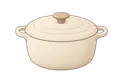 4-liter heavy Dutch oven
 Instant-read meat thermometer
Instructions
Heat the oil and season the chicken
Heat the olive oil in a 4-liter heavy Dutch oven over medium-high heat. Pat the chicken pieces dry and season with half the black pepper.
Brown the chicken in batches
Brown half the chicken skin-side down for 5 to 6 minutes, then turn and cook for about 3 minutes on the other side. Transfer to a plate and repeat with the remaining pieces. Keep space between them; lower the heat if the oil or browned bits begin to burn.
Cook the leek and add herbs and broth
Reduce the heat to medium. Add the sliced leek and cook for 3 to 4 minutes, stirring, until beginning to soften. Add the dill, cilantro, and summer savory, followed by the fish sauce and chicken broth. Scrape up the browned bits and bring to a gentle simmer.
Braise the chicken gently
Return the chicken and its juices to the pot, nestling the pieces into the leeks. Cover and simmer gently over low heat for about 30 to 35 minutes, turning once if pieces sit above the liquid. Avoid a vigorous boil.
Check each piece for doneness
Check every piece at its thickest part, away from the bone: chicken must reach at least 165°F (74°C). Remove individual pieces to a clean plate as they reach the endpoint; continue cooking larger pieces as needed.
Finish the sauce with grape syrup
With the cooked chicken out of the pot, simmer the uncovered sauce for 3 to 4 minutes if it needs reducing. Stir in the grape saba syrup, then spoon the sauce and herbs over the chicken. Sprinkle with the remaining black pepper and serve hot.
Estimated calories 490 kcal
Nutrition portion: 1/4 of recipe · Original yield: 4 servings
Source & assumptions
Ingredient-based estimate using CoFID 2021, USDA SR Legacy (2018), representative labels for Giuseppe Giusti Saba cooked grape must, Kotányi ground black pepper. About 490 kcal per nutrition portion (1/4 of the recipe). Uses the whole-chicken option, with a representative raw chicken, meat-and-skin reference weighed with bone; its calories already exclude the bones. Includes the skin, all rendered fat, cooking juices and sauce, a representative grape saba syrup, and the 1 g dried-savory option. Bone and piece proportions affect the estimate. Actual ingredients and preparation affect the estimate.
Recipe notes
Original recipe notes
These notes describe the original recipe. Quantities mentioned here do not change when you adjust servings.
Grape syrup: Use plain grape saba, not a balsamic glaze. It supplies concentrated fruit sweetness as a practical substitute for defrutum; products differ in thickness and sweetness. The syrup is stirred into the finished sauce rather than reduced throughout the braise.
Cut and scaling: Thighs and drumsticks suit the longer simmer. Breast pieces may finish sooner, so remove them individually when ready. More chicken needs extra browning batches and, if crowded, another pot; retain a gentle simmer and check every piece.
Storage: Refrigerate in shallow containers within 2 hours, or 1 hour above 90°F (32°C), at 40°F (4°C) or below. Keep for up to 3 to 4 days and reheat to 165°F (74°C), adding a little water if needed to loosen the sauce.
Read the scaling guide. Times, temperatures and equipment need their own consideration. Open the recipe tool to review and correct individual amounts.
Sources and attribution
Apicius VI.8.12: Latin passage and Vehling 1936, recipe 246. Modern portions and stovetop guidance adapt the source's herb bundle and platter finish.
For the drinking side of the Roman table, explore what Romans drank besides wine on our sister site, Forgotten Drink.
Recipe details
- Recipe tradition
- Vintage
- Course or meal
- DinnerMain course
- Cuisine
- Ancient Roman
- Historical period
- Roman
- Browse category
- Main Dishes