
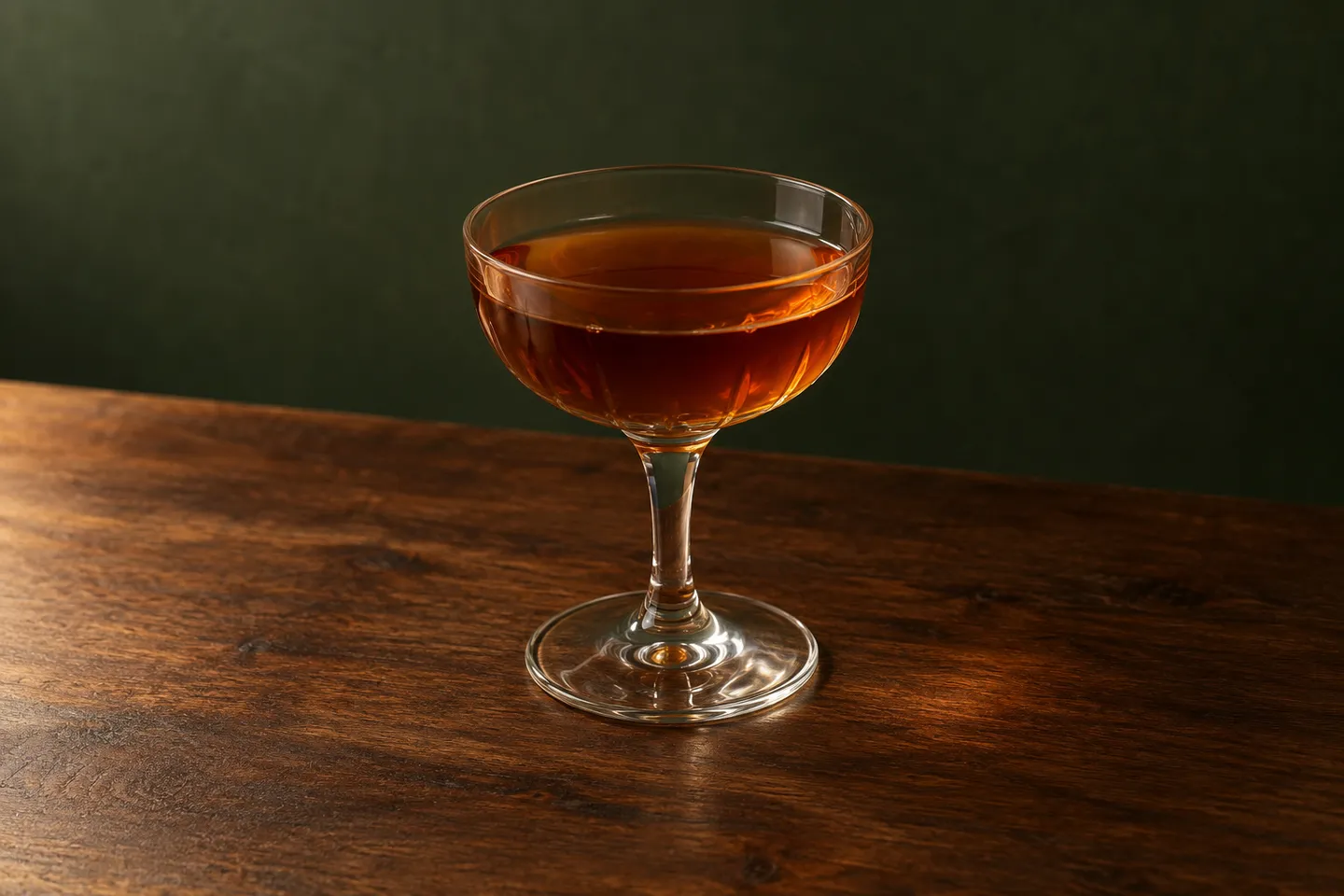
Johnson Equal-Parts Manhattan (1900)
An adaptation of Harry Johnson's equal whiskey-and-vermouth Manhattan, with gum syrup, orange bitters and an optional curaçao or absinthe accent.
- Original yieldYield
- 1 cocktail1 cocktail
- PrepPrep time
- TotalTotal time
Estimated active and elapsed time, including chilling the glass while measuring; use ready-made gum syrup.
Published
Original recipe: 1 cocktail
The story behind the recipe
Harry Johnson's Manhattan gives whiskey and vermouth equal billing. In this version, rye shares the glass with sweet vermouth's wine and botanical flavors, with orange bitters adding a citrus-bitter accent. Gum syrup supplies a little extra sweetness; the optional curaçao or absinthe takes the aroma toward orange or anise.
The choice continues over the page
In the 1900 Bartenders' Manual, the recipe begins on page 162 and continues onto page 163. Johnson leaves the choice of absinthe to the customer and tells the bartender to ask whether the drink should be dry or sweet. Even this compact formula has room for preference, with the bartender expected to find out what the person holding the glass wants.
Read more about this recipe
A generous share of wine
Johnson's ingredient lines call for half a wineglass each of whiskey and vermouth. Our adaptation selects rye and sweet vermouth, with 30 ml of each keeping the equal balance at a practical size. We retain the stirred, strained service and lemon-oil finish, using a chilled coupe and discarding the expressed peel.
Sweet vermouth is fortified wine flavored with botanicals. It brings sweetness, wine and a mixture of bitter and aromatic notes; the precise character varies by producer. In a drink with as much vermouth as whiskey, that choice deserves attention. Dry vermouth would produce a different drink even at the same 30:30 ratio, so check the style as well as the brand when choosing a bottle.
Rye gives readers a specific whiskey choice for repeating the recipe. Different rye whiskies have different proofs and flavor profiles, just as vermouths differ. Keep the same bottles while exploring the proportions and you'll have a clearer idea of what the larger share of wine contributes.
The ingredients a ratio leaves out
Gum syrup, sometimes labeled gomme syrup, is a sweetening syrup made with gum arabic. Johnson calls for only one or two dashes, and his warning to add it carefully is worth respecting. The syrup supplies sweetness alongside the vermouth. Orange bitters add a concentrated citrus and bitter accent in the same small-measure range.
The optional curaçao or absinthe is a choice between distinct flavors. Curaçao is an orange liqueur; absinthe supplies an anise-led herbal accent. Choose the one that interests you, or leave the optional dash out. Lemon peel adds its fragrant oils to the surface, giving the nose a citrus note before the first sip.
Reading a contemporary comparison carefully
The International Bartenders Association's Manhattan specifies 50 ml rye whiskey and 20 ml sweet red vermouth, with a dash of Angostura bitters and a cocktail cherry. Its principal ratio is five to two, compared with Johnson's one to one. The bitters and garnish also change, while Johnson's syrup and optional flavoring aren't listed in that specification.
Start here when the equal share of vermouth and the orange-bitters accent interest you. For a later adjustment, decide whether you want to change the whiskey-to-vermouth balance, the sweetness or the aromatic accent. They are separate controls, even when the change occupies only a few drops. Our guide to cocktail ratios through time follows that distinction through the Martini, Manhattan and Picador.
Make it your wayOriginal: 1 serving · Makes 1 cocktail
Original recipe: 1 cocktail
Ingredients
For 1 cocktail. Quantities are shown as written.
Source measurement convention: Metric. Explicit unit definitions take precedence; unconfirmed measures must be checked before conversion.
Original quantities for 1 cocktail.
- Rye whiskey30 ml
- Sweet vermouth30 ml
- Gum syrup1–2 dashes
- Orange bitters1–2 dashes
- Curaçao or absinthe, optional; choose one1 dash
- Lemon peel, for expressing1
Measurement notes
Measurement notes
Original ingredients
- 30 ml rye whiskey
- 30 ml sweet vermouth
- 1–2 dashes gum syrup
- 1–2 dashes orange bitters
- 1 dash curaçao or absinthe, optional; choose one
- 1 piece lemon peel, for expressing
Equipment
 Mixing glass
 Jigger or measuring glass
 Bar spoon
 Julep strainer
 Coupe glass
Instructions
Chill the coupe
Fill a coupe glass with ice cubes and water to chill while you prepare the drink.
Measure the ingredients and choose an accent
Measure the rye whiskey, sweet vermouth, gum syrup and orange bitters into a mixing glass. If using the optional flavoring, add curaçao or absinthe, choosing one rather than both.
Stir with ice
Fill the mixing glass with ice cubes and stir with a bar spoon until the drink is thoroughly cold, about 20 to 30 seconds.
Strain into the coupe
Empty the chilling ice and water from the coupe. Strain the drink into the glass with a julep strainer, leaving the mixing ice behind.
Express lemon oil and serve
Hold the lemon peel over the drink, colored side facing the surface, and gently squeeze to express its oils. Discard the peel and serve immediately without added ice.
Estimated calories 120 kcal
Nutrition portion: whole recipe · Original yield: 1 cocktail
Source & assumptions
Ingredient-based estimate using CoFID 2021, representative labels for The Bitter Truth Orange Bitters (39% ABV), Gualco Italian Vermouth Rosso (19% ABV), Liber & Co Classic Gum Syrup. About 120 kcal per nutrition portion (whole recipe). Uses representative rye whiskey at 40% ABV and sweet Italian vermouth at 19% ABV. Chooses two dashes each of gum syrup and orange bitters, using a representative 1 ml dash; choosing one dash or smaller pours can lower the estimate by about 7 kcal. The optional Curaçao or absinthe and discarded peel are excluded. Actual ingredients and preparation affect the estimate.
Recipe notes
When adjusting quantities
Ingredient amounts scale; stirring time, ice handling and mixing-glass capacity do not. Keep optional curaçao and absinthe as alternatives.
Original recipe notes
These notes describe the original recipe. Quantities mentioned here do not change when you adjust servings.
Start at the lower end of each 1–2-dash range if you're deciding how much syrup or bitters you prefer. Keep the same dispensing method when repeating the drink; dash sizes depend on the bottle and liquid.
Use ready-made gum syrup, rather than assuming any homemade sugar syrup has the same concentration. The method time doesn't include making syrup. Refrigerate opened vermouth according to its producer's directions.
Read the scaling guide. Times, temperatures and equipment need their own consideration. Open the recipe tool to review and correct individual amounts.
Sources and attribution
Adapted from Harry Johnson, Bartenders' Manual, 1900 edition, printed pages 162–163.
Harry Johnson, Bartenders' Manual, 1900 edition, printed pages 162–163. The contemporary comparison is the IBA Manhattan.
Recipe details
- Recipe tradition
- Vintage
- Course or meal
- Drink
- Cuisine
- American
- Source decade
- 1900s
- Browse category
- Drinks & Cocktails