
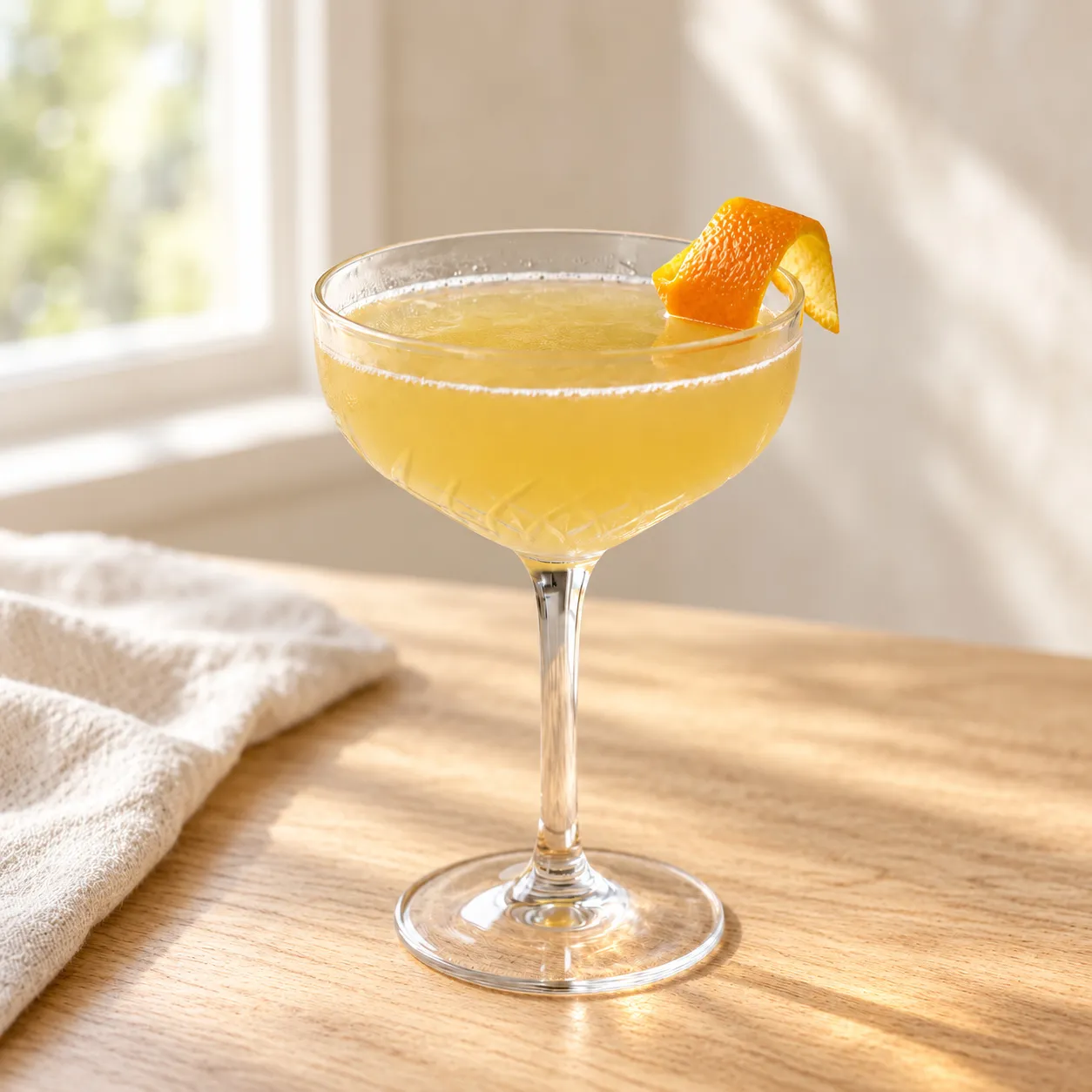
Marmalade Cocktail (1925)
Gin and lemon juice shaken with Seville orange marmalade. The preserve adds sweetness, bitter orange flavor and a cloudy amber color.
- Original yieldYield
- 1 cocktail1 cocktail
- PrepPrep time
- TotalTotal time
Published Updated
Original recipe: 1 cocktail
The story behind the recipe
Marmalade belongs beside gin surprisingly comfortably. Bitter orange peel, sugar and citrus are already cocktail ingredients; the preserving jar has simply brought two of them together. Add lemon juice and the result is a short orange-scented sour, cloudy and amber in a chilled coupe.
Breakfast before luncheon
Nina Toye and A. H. Adair included the Marmalade Cocktail in their 1925 Drinks: Long and Short. They suggested it before luncheon and named Cooper's Oxford Marmalade. Tea and coffee appear elsewhere in the book, so a breakfast ingredient wasn't out of place in their drinks cupboard.
The preserve gives the recipe a particularly domestic appeal. A host can make something worth offering from a jar that might already be open, with gin and a lemon as its companions. There is no extra syrup to cook and cool for this formula.
The authors generally wrote for six people and measured their liquids with the serving glass. On page 8, they acknowledge that glasses vary in size. That's useful context for the modern single drink, whose measures are set below without pretending every old glass held the same amount.
Read more about this recipe
Choose a bitter orange preserve
Coarse-cut Seville orange marmalade is the intended starting point. The peel contributes bitterness as well as orange flavor, and the sugar supplies sweetness. A mild, very sweet preserve would give a softer drink.
Traditional bitter orange preserves remain available. Choose by the bitterness and peel flavor you want beside gin and lemon.
Coarse rind belongs in the jar but needn't float through the finished cocktail. Double-straining keeps peel shreds and citrus pulp out of the glass while the orange flavor comes through. A slight haze is normal. A perfectly clear Martini isn't the model for a drink made with marmalade.
Lemon beside the preserve
Fresh lemon juice gives the mixture its sharpness, and gin brings botanical flavor behind the orange. The preserve also makes the texture a little fuller than a sour sweetened with plain syrup.
The single-serving formula uses a level teaspoon of marmalade. Measuring a preserve by the spoon is easier when you take a moment to level it: a heap changes both sweetness and orange flavor. The notes explain how the lemon amount differs from the estimated per-person portion in the old batch.
Loosening marmalade with citrus before the mixture gets cold helps it join the drink. Otherwise some can cling to the shaker and leave less flavor in the serving than the spoon measure suggested. That is the small preparation decision that makes this recipe especially convenient.
An orange finish
A strip of fresh orange peel above the drink supplies aroma before the first sip. Its oils meet the surface, separate from the cooked peel flavor already carried by the preserve.
The old before-luncheon suggestion gives the cocktail a pleasant setting, but it doesn't restrict the hour. Its bitter orange works just as readily when you want a small drink before dinner.
The 1925 drinks-book feature puts the preserving jar beside tea, coffee and two specialized spice liqueurs. Marmalade is the most approachable of those cupboard surprises: familiar food, measured carefully, with no need to make the glass more elaborate than the orange finish.
Make it your wayOriginal: 1 serving · Makes 1 cocktail
Original recipe: 1 cocktail
Ingredients
For 1 cocktail. Quantities are shown as written.
Source measurement convention: US customary. Explicit unit definitions take precedence; unconfirmed measures must be checked before conversion.
Original quantities for 1 cocktail.
- Dry gin1 3/4 fl oz
- Fresh lemon juice1/2 fl oz
- Coarse-cut Seville orange marmalade1 tsp
- Strip fresh orange peel (for expressing)1
Measurement notes
- dry gin, fresh lemon juice: US fl oz: 1 = 29.5735 ml (rounded).
- coarse-cut Seville orange marmalade: US tsp: 1 = 4.9289 ml (rounded).
Measurement notes
Original ingredients
- 1 3/4 fl oz dry ginUS fl oz: 1 = 29.5735 ml (rounded).
- 1/2 fl oz fresh lemon juiceUS fl oz: 1 = 29.5735 ml (rounded).
- 1 tsp coarse-cut Seville orange marmaladeUS tsp: 1 = 4.9289 ml (rounded).
- 1 strip fresh orange peel (for expressing)
Equipment
 Cocktail shaker
 Barspoon
 Hawthorne strainer
 Fine-mesh tea strainer
 Coupe glass
 Jigger or measuring glass
Instructions
Dissolve marmalade in lemon juice
Add the fresh lemon juice and coarse-cut Seville orange marmalade (measured as a level teaspoon) to a cocktail shaker and stir thoroughly with a barspoon for 10 to 15 seconds until the preserve dissolves into the citrus juice.
Add gin and ice, then shake
Add the dry gin and the cracked ice, seal the shaker firmly, and shake hard for 12 to 15 seconds until cold and frosted.
Double-strain into a chilled coupe
Double-strain through a Hawthorne strainer and a fine-mesh tea strainer into a chilled coupe glass to catch citrus pulp and shredded peel.
Express and add orange peel
Pinch the fresh orange peel over the drink to express fragrant citrus oils over the surface, then set the peel on the rim.
Estimated calories 130 kcal
Nutrition portion: whole recipe · Original yield: 1 cocktail
Source & assumptions
Ingredient-based estimate using CoFID 2021. Approximately 130 kcal per nutrition portion. Uses 40% ABV gin and a standard level teaspoon of orange marmalade. Includes all marmalade-input energy despite strained peel; the orange-peel garnish is excluded. Ingredients, brands and preparation affect values.
Recipe notes
When adjusting quantities
To mix a six-person batch matching this adapted recipe, combine 10 1/2 fl oz dry gin, 3 fl oz fresh lemon juice, and 2 tablespoons of marmalade. For the lighter 1925 original lemon profile, reduce the lemon juice to 1 1/2 to 2 fl oz. Whisk together until the preserve dissolves before shaking with cracked ice.
Original recipe notes
These notes describe the original recipe. Quantities mentioned here do not change when you adjust servings.
Toye and Adair, Drinks: Long and Short (1925), pp. 13–14. This single drink uses 1¾ fl oz gin, a level teaspoon of marmalade and more lemon than the estimated original per-person amount. The original large lemon was shared across six servings, about ¼ to ⅓ fl oz juice per person; our ½ fl oz is a chosen adjustment. Six measured teaspoons equal the two modern tablespoons in the six-person batch.
Coarse-cut Seville orange marmalade gives the intended bitter orange flavor. Frank Cooper's Oxford Marmalade is one example; a mild, very sweet preserve changes the mixture.
Loosen the preserve in the lemon juice before adding ice so it mixes evenly. Double-straining removes coarse rind and pulp, but a little haze can remain.
Read the scaling guide. Times, temperatures and equipment need their own consideration. Open the recipe tool to review and correct individual amounts.
Sources and attribution
Nina Toye & A. H. Adair, Drinks: Long and Short (London: William Heinemann, 1925), pp. 13-14.
Recipe details
- Recipe tradition
- Vintage
- Course or meal
- Drink
- Cuisine
- British
- Source decade
- 1920s
- Browse category
- Drinks & Cocktails