
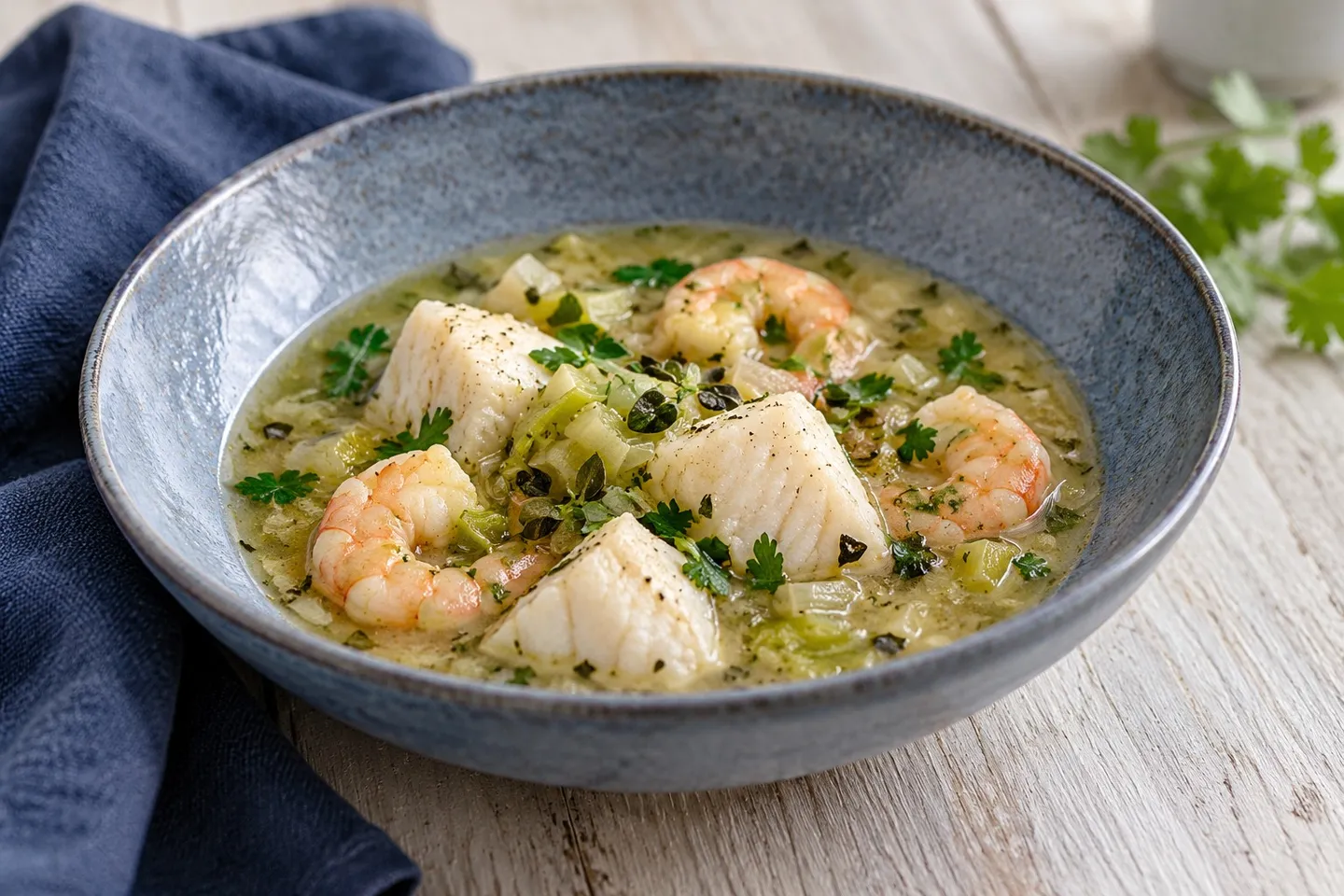
Minutal Marinum (Roman-Inspired Seafood Stew)
A simplified Apician seafood stew with white fish, shrimp, leeks, fresh cilantro, oregano, wine, and fish sauce.
- Original yieldYield
- 4 servings4 servings
- PrepPrep time
- CookCook time
- TotalTotal time
Published Updated
Original recipe: 4 servings
The story behind the recipe
The Apician seafood minutal calls for fish dumplings, pieces of cooked fish and washed sea anemones. Our version uses firm white fish and medium shrimp in a shallow wine sauce with leeks and herbs.
A sauce around the seafood
This isn't a pot intended to fill four deep soup bowls. The cooking liquid becomes a lightly thickened sauce around recognizable pieces of fish and shrimp. Fresh cilantro, oregano, pepper, and a little celery seed season it; bread can make the four modest portions into a fuller meal.
Read more about this recipe
A busy passage in Book IV
Minutal marinum begins with fish, fish sauce, oil, wine, and cooking liquid. Chopped leeks and coriander join small fish dumplings, cooked fish flesh, and sea anemones. Pepper, lovage, and oregano are pounded into a separate sauce, moistened with some cooking liquid, and returned to the pot.
At the end, crumbled tracta, a dough-based preparation, binds the liquid. Pepper is sprinkled over it. The original has several seafood textures and a sauce assembled separately before the final thickening.
That is a much bigger kitchen undertaking than today's fish-and-shrimp version. We omit the dumplings, cooked shredded fish, and anemones; add shrimp; and use cornstarch instead of tracta. Celery seed substitutes for lovage, with a different flavor, and the chopped herbs go directly into the pot. The quantities and water allowance are also modern choices. Our Apicius article compares this simplified dish with closer ingredient combinations, including chicken à la Fronto.
Pieces that keep their shape
Cod or haddock gives the recipe firm white fish that can be cut into even chunks. Small scraps would finish differently from the larger pieces, and vigorous stirring could break the fish down before serving. A gentle simmer and careful turning help keep the fish pieces intact.
Medium peeled shrimp provide the other seafood here. They aren't named in the passage, but they make this shortened assortment straightforward to buy and prepare. Both kinds of seafood need their own endpoint: opaque, flaking fish and firm, opaque shrimp, with the fish-temperature check below.
Use water for the listed cooking liquid; replacing it with extra fish sauce would make the dish much saltier. Nor does the shallow liquid have to cover every piece as though this were a deep poaching bath; the covered method accounts for that.
A little thickening
Cornstarch supplies a convenient finish to the cooking liquid, with a different character from crumbled dough. The point is to coat the seafood lightly rather than make a heavy gravy. Stirring gently matters during this stage too.
This pot belongs near serving time, while the fish is still in pieces. Lift the seafood gently into shallow bowls, then share the sauce between them. Vigorous stirring at the last moment would undo the care taken during poaching.
Make it your wayOriginal: 4 servings
Original recipe: 4 servings
Ingredients
For 4 servings. Quantities are shown as written.
Source measurement convention: Metric. Explicit unit definitions take precedence; unconfirmed measures must be checked before conversion.
Original quantities for 4 servings.
- Skinless firm white fish fillets, cut into 3 cm pieces300 g
- Raw medium shrimp, peeled and deveined200 g
- Extra-virgin olive oil30 ml
- Prepared leek, white and pale green parts, washed and finely chopped150 g
- Dry white wine150 ml
- Water (for the cooking liquid)200 ml
- Southeast Asian fish sauce15 ml
- Fresh cilantro leaves and tender stems, chopped10 g
- Dried oregano1 g
- Celery seed, finely ground0.5 g
- Cornstarch10 g
- Cold water (for the starch slurry)30 ml
- Ground black pepper, divided1 g
Measurement notes
Measurement notes
Original ingredients
- 300 g skinless firm white fish fillets, cut into 3 cm pieces
- 200 g raw medium shrimp, peeled and deveined
- 30 ml extra-virgin olive oil
- 150 g prepared leek, white and pale green parts, washed and finely chopped
- 150 ml dry white wine
- 200 ml water (for the cooking liquid)
- 15 ml Southeast Asian fish sauce
- 10 g fresh cilantro leaves and tender stems, chopped
- 1 g dried oregano
- 0.5 g celery seed, finely ground
- 10 g cornstarch
- 30 ml cold water (for the starch slurry)
- 1 g ground black pepper, divided
Equipment
 4-liter heavy Dutch oven
 Food thermometer
Instructions
Soften the leek
Heat the olive oil in a 4-liter heavy Dutch oven over medium heat. Add the chopped leek and cook for 3 to 4 minutes, stirring, until softened without browning.
Simmer the wine and herb liquid
Add the white wine, 200 ml water, fish sauce, cilantro, oregano, ground celery seed, and half the black pepper. Bring to a gentle simmer and cook for 2 minutes.
Poach the fish and shrimp
Spread the white fish pieces and shrimp evenly through the shallow cooking liquid. The liquid need not cover them completely. Cover and cook over medium-low heat for about 5 to 7 minutes, turning the pieces gently once if needed, until the fish flakes and reaches 145°F (63°C); shrimp should be firm and opaque throughout. Continue cooking any pieces that are not ready.
Thicken the sauce gently
Mix the cornstarch with the 30 ml cold water until smooth. Stir the slurry into the simmering liquid carefully around the seafood. Simmer for 1 to 2 minutes, just until the sauce thickens; avoid a hard boil that breaks up the fish.
Finish with pepper and serve
Sprinkle with the remaining black pepper. Spoon the seafood and sauce into four shallow bowls and serve promptly with bread.
Estimated calories 210 kcal
Nutrition portion: 1/4 of recipe · Original yield: 4 servings
Source & assumptions
Ingredient-based estimate using CoFID 2021 and the existing USDA and representative-label references. About 210 kcal per nutrition portion (1/4 of the recipe). Uses a conservative USDA hot-liquid model retaining 85% of the wine alcohol for this short cooking method; actual alcohol loss and ingredients vary. Not a measured alcohol or calorie result.
Recipe notes
Original recipe notes
These notes describe the original recipe. Quantities mentioned here do not change when you adjust servings.
Fish and liquid: Use firm white fish such as cod or haddock. The baseline makes a shallow sauced dish, not four large soup bowls. Added water supplies enough liquid for covered poaching without relying on full submersion in a wide skillet. Do not replace it with extra fish sauce, which would change the salinity substantially.
Scaling: More seafood may need a larger pot or separate batches. Keep the fish pieces about 3 cm across, stir gently, and judge doneness rather than multiplying the poaching time.
Storage: Refrigerate promptly in shallow containers within 2 hours, or 1 hour above 90°F (32°C), at 40°F (4°C) or below. Use within 1 to 2 days as a conservative quality choice. Reheat gently to 165°F (74°C); the fish may break up as it is stirred.
Read the scaling guide. Times, temperatures and equipment need their own consideration. Open the recipe tool to review and correct individual amounts.

Sources and attribution
Apicius IV.3.1: complete Latin passage and Vehling 1936, recipe 164. The source thickens with tracta, not amulum wheat starch.
For the drinking side of the Roman table, explore what Romans drank besides wine on our sister site, Forgotten Drink.
Recipe details
- Recipe tradition
- Vintage
- Course or meal
- DinnerMain course
- Cuisine
- Ancient Roman
- Historical period
- Roman
- Browse category
- Main Dishes