
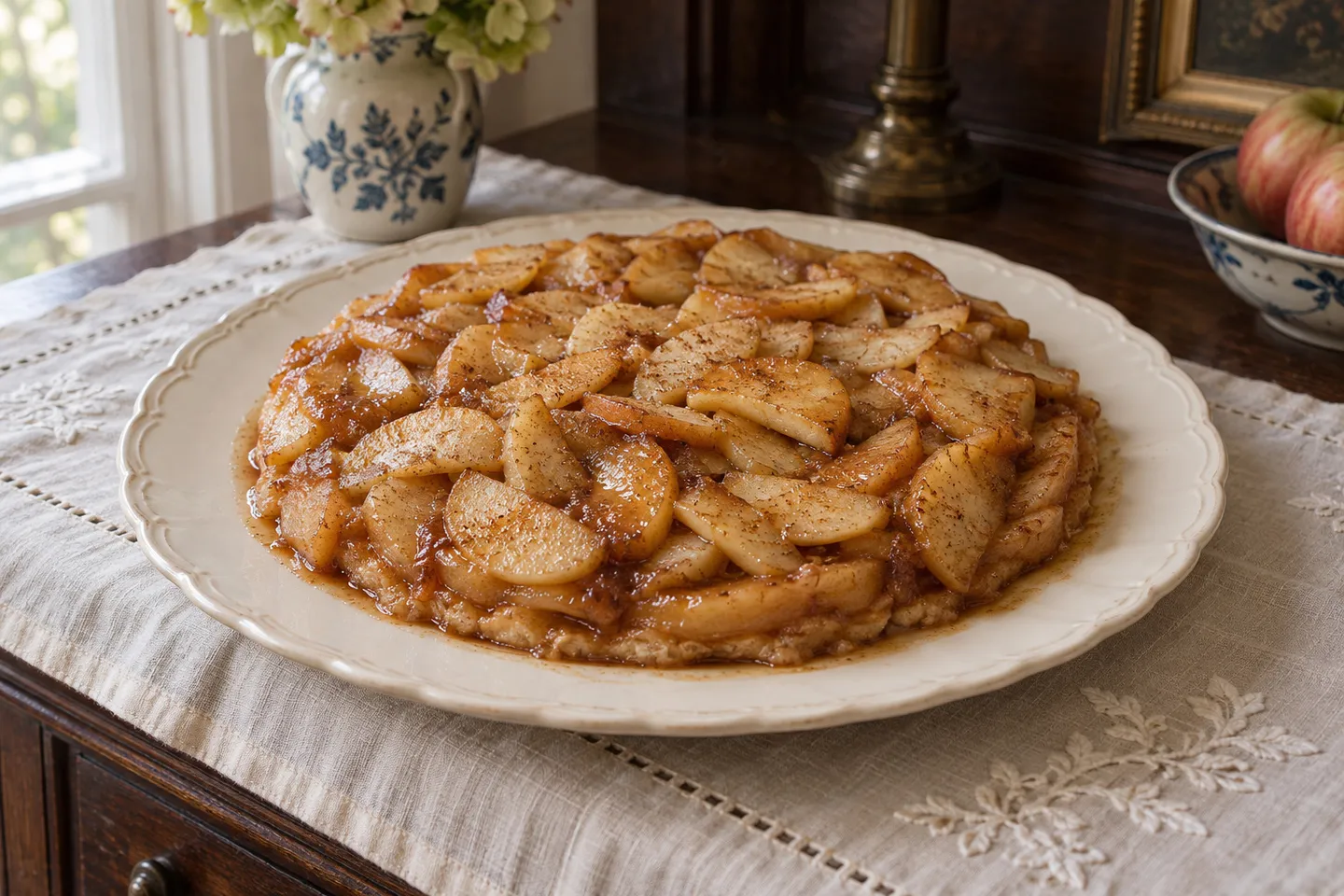
New England Apple Dowdy (1920)
Thin apple slices coated in flour and cinnamon, covered with brown sugar and a little cold water, baked under a single pastry crust and turned out onto a platter, from Mrs. Wilson's Cook Book.
- Original yieldYield
- 1 dowdy (one 9-inch deep-dish pie plate)1 dowdy (one 9-inch deep-dish pie plate)
- PrepPrep time
- CookCook time
- TotalTotal time
Total includes 30 minutes of cooling in the dish before the dowdy is inverted. Baking can run to 50 minutes; go by the doneness cues.
Published
Original recipe: 1 dowdy (one 9-inch deep-dish pie plate)
The story behind the recipe
Within two pages of her 1920 cookbook, Mary A. Wilson gives three fruit desserts that finish in the same way, with a large platter laid over the baking dish and the whole thing turned upside down. The pastry that baked on top becomes the base, and the apples, glazed in their own brown-sugar syrup, end up on the surface, where she asks for nothing more than a light dusting of nutmeg.
Flour on the fruit, sugar on top
What sets the New England version apart is the order of its layers. Every slice of apple is coated in flour and cinnamon before it goes into the dish, while the brown sugar and cold water are spread over the top instead of being tossed through, so the sweet juices run down into the floured fruit as it bakes.
Read more about this recipe
A cook who wrote as if she were talking
Wilson's title page places her at Mrs. Wilson's Cooking School in Philadelphia and describes her as Queen Victoria's former cuisinière, a domestic science instructor at the University of Virginia summer school and an instructor of cooking for the U.S. Navy. Those are the book's own credentials for its author.
Her preface explains that the heavy cookbook style is not used and that the recipes are set out as if the housewife and the author were talking over the dish together. You can hear that voice in the dowdy, where two short ingredient lists are set into sentences that start before them and carry on afterward, much as a teacher talks a class through a dish. The same book is the source of our Chicken à la King, which is written in the same conversational way.
Wilson's measures for fruit, flour and sugar
The fruit is measured by the pint, a unit that looks old-fashioned until you read Wilson's own table of equivalents, where two cups make one pint. Her two pints of prepared fruit are therefore four cups of thin slices, and the USDA's figure of about 110 grams for a cup of peeled apple slices puts that at roughly a pound.
She was firm about measuring. Elsewhere in the book she asks for level measurements and for flour sifted once before it goes into the cup, so both portions of flour here are sifted first. Her dry-measure table counts two and three-quarter cups of brown sugar to the pound, which suggests a lightly filled cup rather than the firmly packed cup most modern recipes assume, and that is why the sugar is spooned in and leveled.
A moderate oven, pinned down
The recipe asks only for a moderate oven and forty-five minutes. Wilson's chapter on oven temperature defines moderate as 350 to 375°F, while her pie pages call 300 to 350°F moderate, and modern apple pandowdies with raw fruit under pastry run roughly 375 to 425°F. This version bakes at 375°F for 45 to 50 minutes, the top of her range and the low end of theirs. Her routine for holding that heat on a gas range, with the burners lit first and then turned down, gets its own explanation in our look at slow, moderate and hot ovens.
A pastry with baking powder
The dowdy page calls simply for a crust, and its sibling recipe, the plain apple dowdy printed just before it, names plain pastry. Wilson's version, which she titles The Real Secret, is unusual to modern eyes because it includes baking powder. Her reason for handling it as little as possible is simple: as she puts it, "The minute you knead or squeeze pastry that is the moment you make it tough." Her batch makes four crusts, so this recipe uses a quarter of it.
Read the original wording
Historical reference only. Follow the ingredients and cooking steps below when cooking.
Historical ingredients
- two pints of the prepared fruit
- One teaspoon of cinnamon.
- One-half cup of flour.
- One cup of brown sugar.
- Four tablespoons cold water.
- a crust the pastry
- nutmeg
- fruit or vanilla sauce
Historical method
Apples or peaches may be used. Wash the fruit and then pare and cut into thin slices. Measure two pints of the prepared fruit and dust over it so as to thoroughly coat each piece with One teaspoon of cinnamon. One-half cup of flour.
Then pat smoothly in baking dish and cover with One cup of brown sugar. Four tablespoons cold water.
Cover with a crust the pastry and bake in a moderate oven for forty-five minutes. Let cool and then run a knife around the edge of the baking dish and loosen the crust from the dish. Place a large platter over the dowdy and then invert. Dust the dowdy lightly with nutmeg and serve with fruit or vanilla sauce.
Make it your wayOriginal: 8 servings · Makes 1 dowdy (one 9-inch deep-dish pie plate)
Original recipe: 1 dowdy (one 9-inch deep-dish pie plate)
Ingredients
For 1 dowdy (one 9-inch deep-dish pie plate). Quantities are shown as written.
Source measurement convention: US customary. Explicit unit definitions take precedence; unconfirmed measures must be checked before conversion.
Original quantities for 1 dowdy (one 9-inch deep-dish pie plate).
Plain pastry (one crust)
- All-purpose flour (sifted before measuring)3/4 cup
- Salt1/4 tsp
- Baking powder3/4 tsp
- Vegetable shortening (cold)8 tsp
- Ice-cold water2 tbsp
Apple filling
- Vegetable shortening (for greasing the dish)1 tsp
- Thinly sliced peeled apples4 cups
- All-purpose flour (sifted before measuring)1/2 cup
- Ground cinnamon1 tsp
- Brown sugar (spooned in and leveled, not packed)1 cup
- Cold water4 tbsp
To finish
- Ground nutmeg (for dusting, as needed)
Measurement notes
- all-purpose flour (sifted before measuring), thinly sliced peeled apples, brown sugar (spooned in and leveled, not packed): US cup: 1 = 236.5882 ml (rounded).
- salt, baking powder, vegetable shortening (cold), vegetable shortening (for greasing the dish), ground cinnamon: US tsp: 1 = 4.9289 ml (rounded).
- ice-cold water, cold water: US tbsp: 1 = 14.7868 ml (rounded).
Measurement notes
Original ingredients
- 3/4 cup all-purpose flour (sifted before measuring)US cup: 1 = 236.5882 ml (rounded).
- 1/4 teaspoon saltUS tsp: 1 = 4.9289 ml (rounded).
- 3/4 teaspoon baking powderUS tsp: 1 = 4.9289 ml (rounded).
- 8 teaspoons vegetable shortening (cold)US tsp: 1 = 4.9289 ml (rounded).
- 2 tablespoons ice-cold waterUS tbsp: 1 = 14.7868 ml (rounded).
- 1 teaspoon vegetable shortening (for greasing the dish)US tsp: 1 = 4.9289 ml (rounded).
- 4 cups thinly sliced peeled applesUS cup: 1 = 236.5882 ml (rounded).
- 1/2 cup all-purpose flour (sifted before measuring)US cup: 1 = 236.5882 ml (rounded).
- 1 teaspoon ground cinnamonUS tsp: 1 = 4.9289 ml (rounded).
- 1 cup brown sugar (spooned in and leveled, not packed)US cup: 1 = 236.5882 ml (rounded).
- 4 tablespoons cold waterUS tbsp: 1 = 14.7868 ml (rounded).
- Ground nutmeg (for dusting, as needed)
Equipment
 Fine-mesh sifter
 Rolling pin
 9-inch deep-dish pie plate
 Rimmed baking sheet
 Wire cooling rack
- Large rimmed serving platter
Instructions
Heat oven and grease dish
Heat the oven to 375°F (190°C) with a rack in the center. Grease a 9-inch deep-dish pie plate with the 1 teaspoon vegetable shortening for greasing and set it on a rimmed baking sheet.
Cut shortening into flour
For the pastry, sift the all-purpose flour, salt and baking powder together twice into a bowl. Cut in the cold vegetable shortening with a pastry blender, two knives or a metal spatula until the pieces are coarse, like small peas.
Mix pastry with ice water
Add the ice-cold water and keep chopping and turning the mixture with the spatula or knives until it gathers into a ball of dough. Do not knead it or squeeze it with your hands. Cover and set aside while you prepare the fruit.
Slice and measure apples
Wash, pare and core the apples, then cut them into thin slices about 1/8 inch thick. Measure 4 cups of slices, filling the cup without pressing.
Coat apples with flour and cinnamon
In a large bowl, toss the apple slices with the sifted flour for the filling and the ground cinnamon until every slice is coated.
Pat apples into dish
Tip the coated apples and any loose flour into the greased pie plate and pat them into a smooth, level layer.
Add brown sugar and water
Spread the brown sugar evenly over the apples, then sprinkle the cold water over the sugar.
Roll and lay crust
On a lightly floured surface, roll the pastry into a round about 1/8 inch thick and slightly larger than the top of the dish. Lay it over the fruit and trim it to fit just inside the rim of the dish, without crimping it onto the rim, then cut three or four short slits in the center for steam.
Bake until syrup bubbles
Bake on the baking sheet for 45 to 50 minutes, until the crust is firm and golden brown, thick syrup bubbles at the edges and through the slits, and a thin knife slipped through a slit meets tender apples.
Cool before inverting
Set the dish on a wire rack and let it cool for 30 minutes, until it is warm rather than hot. The syrup underneath the crust stays hot longer than the crust, so keep oven mitts on for the next step.
Invert onto platter
Run a thin knife around the edge of the dish to loosen the crust. Set a large rimmed serving platter upside down over the dish, hold the dish and platter firmly together with oven mitts, and turn them over in one smooth motion, away from you. Lift off the dish and spoon any apples left in it back onto the top.
Dust with nutmeg and serve
Dust the dowdy lightly with ground nutmeg, cut it into wedges and serve warm or cool.
Estimated calories 210 kcal
Nutrition portion: 1/8 of recipe · Original yield: 1 dowdy (one 9-inch deep-dish pie plate)
Source & assumptions
Ingredient-based estimate using CoFID 2021, USDA SR Legacy (2018), the Norwegian Food Composition Table. About 210 kcal per nutrition portion (1/8 of the recipe). Standard nutrition portion: one-eighth of the original dowdy. This wedge count is editorial. Includes measured shortening; excludes unmeasured nutmeg dusting. Actual ingredients and preparation affect the estimate.
Recipe notes
When adjusting quantities
Made for one 9-inch deep-dish pie plate with a fruit layer about 1 inch deep. A larger batch needs a wider dish and more pastry to keep that depth; time and temperature do not scale automatically, so check the crust and bubbling syrup.
Original recipe notes
These notes describe the original recipe. Quantities mentioned here do not change when you adjust servings.
Four cups of thin apple slices is about 1 pound of prepared fruit, usually from about 3 medium apples. The 8 teaspoons of shortening for the pastry is the same as 2 tablespoons plus 2 teaspoons.
Wilson allows peaches in place of apples. Use 4 cups of peeled, thinly sliced peaches with the same flour, cinnamon, sugar and water; ripe peaches give more juice, so expect a softer, saucier filling and rely on the bubbling syrup and golden crust rather than the clock.
Wilson serves the dowdy with fruit sauce or vanilla sauce. Cream or custard sauce, which she offers with her plain apple dowdy, also suits it.
Read the scaling guide. Times, temperatures and equipment need their own consideration. Open the recipe tool to review and correct individual amounts.
Sources and attribution
Mary A. Wilson, Mrs. Wilson's Cook Book (Philadelphia: J. B. Lippincott, 1920), Dowdy, New England Style, p. 94; pastry from The Real Secret, pp. 86–87
Mary A. Wilson, Mrs. Wilson's Cook Book: Numerous New Recipes Based on Present Economic Conditions (Philadelphia and London: J. B. Lippincott, 1920), Dowdy, New England Style, page 94; plain pastry and pie temperature, pages 86 to 88; oven temperatures, pages 6 to 7; measuring and the table of equivalents, pages 282 to 283. Checked against Cornell University Library's scan of the third printing. The oven setting, dish size, greased dish and cooling time are our modern choices, based on Wilson's definitions and comparable modern recipes.
Recipe details
- Recipe tradition
- Vintage
- Cuisine
- American
- Source decade
- 1920s
- Main ingredient
- Fruit
- Browse category
- Baking & Desserts