
Layered Orange and Berry Gelatin Ring (1927)
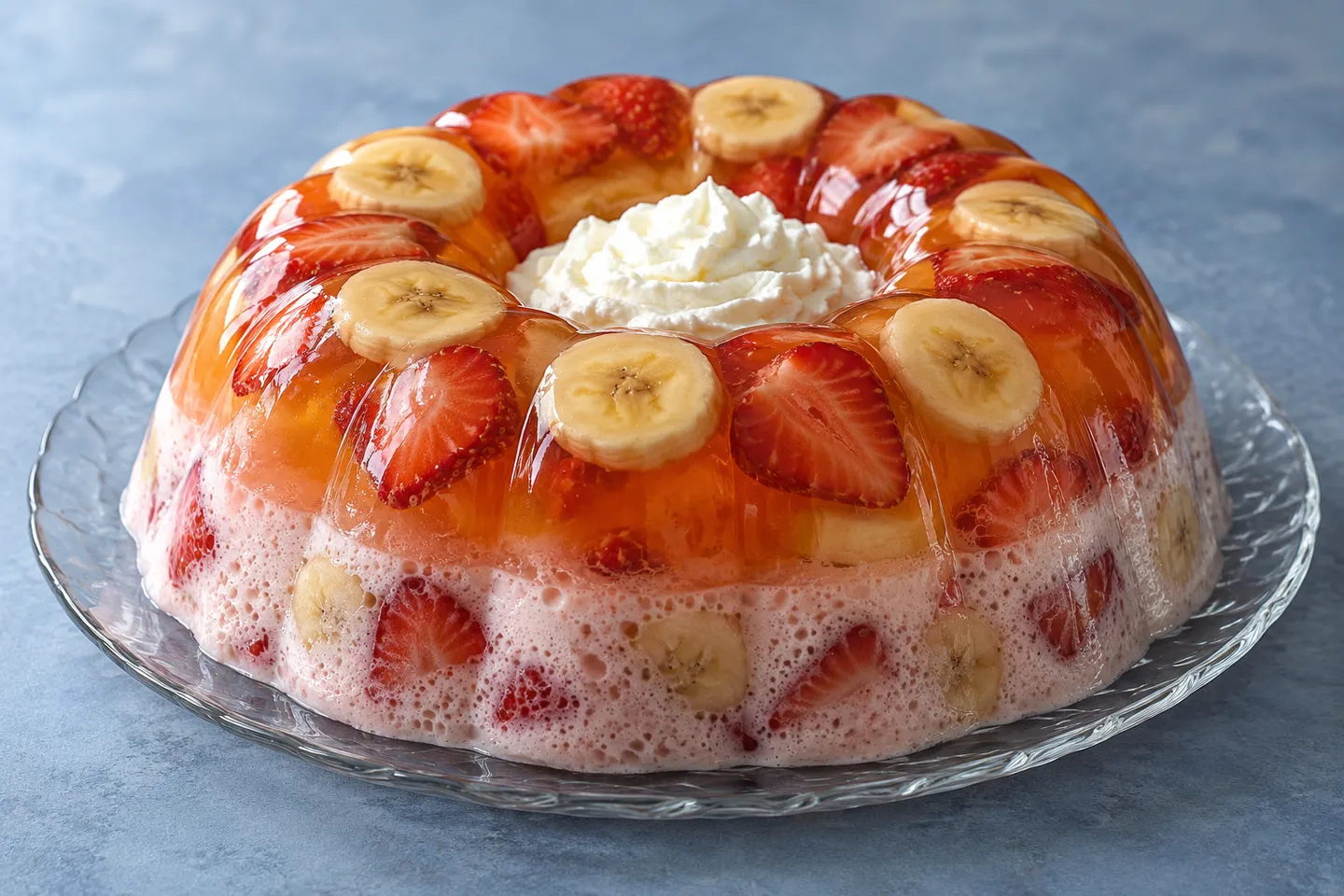
A multi-layered 1920s dessert ring combining clear citrus gelatin, fresh sliced strawberries, and a whipped fruit sponge layer, served with fresh cream.
- Original yieldYield
- 8 servings8 servings
- PrepPrep time
- CookCook time
- TotalTotal time
Allow at least 4 hours for the gelatin layers to set firmly.
Published Updated
Original recipe: 8 servings
The story behind the recipe
One citrus jelly makes two different layers. Some remains clear around strawberry and banana slices; a reserved portion is beaten into a pale fruit sponge. The ring brings them together, with whipped cream in its center after unmolding.
Pale doesn't always mean cream
The lighter layer is beaten gelatin. The serving cream is a separate preparation, sweetened and added later. Keeping those two ideas apart is the key to understanding this dessert's cut surface: clear fruit jelly, a foamy jelly layer, then cream beside the portion.
Read more about this recipe
Bradley's elaborate decoration
Alice Bradley's 1927 Electric Refrigerator Menus and Recipes includes Orange Jelly Molded in Layers with Fruit. Her arrangement is more elaborate than ours. Banana and strawberry pieces are shaped, marshmallow strips and halved pistachios join the decoration, and a quarter of the jelly is beaten light between other layers.
It is a revealing use of one mixture. The contrast doesn't need a second flavor base: beating changes the appearance and texture of some of the orange jelly already made. Bradley finishes the unmolded dessert on a glass dish with large strawberries and whipped cream.
Our ring simplifies that design. It keeps orange and lemon jelly, strawberries, banana and the beaten portion, but leaves out marshmallows, pistachios and the separate final fruit-jelly layer. Modern gelatin, mold and setting guidance give the simplified dessert its own proportions and schedule.
The fruit sits differently in the two parts. In the clear jelly, slices are visible through a translucent layer. In the sponge, fruit is folded through something opaque and light. A slice puts both on the plate, so the interest continues after the whole ring has been admired.
Catch the reserved portion between states
The jelly held back for beating needs to be slightly thickened. Still-fluid liquid hasn't reached the stage described in the recipe; fully set jelly is harder to turn into an even sponge. That intermediate state matters more than a minute marked on a timer.
Meanwhile, the jelly already in the mold is doing another job. It sets enough to support the fruit and the later layer. The recipe therefore has several short waits before its long final chill, even though the flavors all began together in the same saucepan.
This is refrigerator setting, not freezing. Compare it with Lemon Cream Sherbet, another Bradley adaptation that uses beating but needs two freezer stages. The similar pale finishes come from different mixtures and different uses of cold.
A ring with room for its finish
The center gives the whipped cream somewhere to sit without hiding the jelly. At serving, each portion can include clear fruit, sponge and a little cream, rather than a thick dairy layer built into the mold itself.
Unmolding reveals a design prepared in reverse: the first jelly poured into the ring becomes part of its visible top. Give the whole dessert its full setting time before that moment, then use the brief warm-water dip in the method. The reward is the combination of shapes and textures already built into it, rather than more decoration added to conceal them.
The ring is one of the more involved projects in our look inside Bradley's electric refrigerator cookbook, where cold can help create a serving shape as well as a temperature.
Make it your wayOriginal: 8 servings
Original recipe: 8 servings
Ingredients
For 8 servings. Quantities are shown as written.
Source measurement convention: Metric. Explicit unit definitions take precedence; unconfirmed measures must be checked before conversion.
Original quantities for 8 servings.
- Unflavored gelatin14 gOriginal recipe guidance: two 7 g envelopes.
- Cold water60 mlAuthor measures: about 1/4 metric cup (250 ml per cup).
- Boiling water240 mlAuthor measures: about 1 metric cup (250 ml per cup).
- Granulated sugar133 gAuthor measures: about 2/3 metric cup (250 ml per cup).
- Fresh orange juice (strained)240 mlAuthor measures: about 1 metric cup (250 ml per cup).
- Fresh lemon juice30 mlAuthor measures: 2 metric tbsp (1 metric tbsp = 15 ml).
- Fresh strawberries (hulled and sliced)150 gAuthor measures: about 1 metric cup (250 ml per cup).
- Ripe banana (approx. 1 medium, sliced)100 g
- Heavy whipping cream (for serving)120 ml
- Granulated sugar (for the serving cream)1 metric tbsp
- Neutral cooking oil (for the mold)1 metric tsp
Measurement notes
- granulated sugar (for the serving cream): tbsp: 1 = 15 ml.
- neutral cooking oil (for the mold): tsp: 1 = 5 ml.
Measurement notes
Original ingredients
- 14 g unflavored gelatin (two 7 g envelopes)
- 60 ml cold water (approx. 1/4 cup)
- 240 ml boiling water (approx. 1 cup)
- 133 g granulated sugar (approx. 2/3 cup)
- 240 ml fresh orange juice (strained, approx. 1 cup)
- 30 ml fresh lemon juice (2 tbsp)
- 150 g fresh strawberries (hulled and sliced, approx. 1 cup)
- 100 g ripe banana (approx. 1 medium, sliced)
- 120 ml heavy whipping cream (for serving)
- 1 tbsp granulated sugar (for the serving cream)tbsp: 1 = 15 ml.
- 1 tsp neutral cooking oil (for the mold)tsp: 1 = 5 ml.
Equipment
 6-cup ring mold
 Electric hand mixer
Instructions
Bloom the gelatin
In a small bowl, sprinkle the unflavored gelatin over the cold water and let sit for 5 minutes to bloom.
Dissolve gelatin in boiling water
Pour the boiling water over the bloomed gelatin in a saucepan and stir with a whisk until completely dissolved.
Add sugar and citrus juices
Stir in the granulated sugar, fresh orange juice, and fresh lemon juice until the sugar dissolves completely.
Set the first gelatin layer
Pour a 1 cm layer of the clear citrus gelatin into a 6-cup ring mold lightly coated with the neutral cooking oil. Place in the refrigerator for 20 minutes until just set.
Add fruit and more gelatin
Arrange half of the sliced fresh strawberries and sliced banana neatly across the firm gelatin layer. Reserve about 1/4 of the liquid gelatin for the final layer. Pour the remaining unreserved liquid gelatin over the fruit and return to the refrigerator for 20 minutes.
Beat the reserved gelatin
Take the reserved quarter of the liquid gelatin, chill until slightly thickened, and beat with an electric hand mixer on high speed for 3 to 4 minutes until it becomes light, foamy, and increases in volume into a pale fruit sponge.
Fold in fruit and fill the mold
Fold the remaining fruit into the foamy gelatin sponge, and pour over the firm fruit layer in the mold.
Chill until firm
Chill in the refrigerator for at least 4 hours until completely firm.
Unmold and add whipped cream
To unmold, dip the bottom of the ring mold into warm water for 5 seconds, invert onto a large glass serving platter, and fill the center with the heavy whipping cream whipped to stiff peaks with the granulated sugar for the serving cream.
Estimated calories 170 kcal
Nutrition portion: 1/8 of recipe · Original yield: 8 servings
Source & assumptions
Ingredient-based estimate using CoFID 2021, USDA SR Legacy (2018), representative labels for Organic Valley Heavy Whipping Cream. About 170 kcal per nutrition portion (1/8 of the recipe). Includes all sweetened serving cream and the measured oil for the mold. Actual ingredients and preparation affect the estimate.
Recipe notes
When adjusting quantities
Scale ingredients proportionally. Allow each gelatin layer to set to a soft gel before adding the next layer to ensure seamless adhesion.
Original recipe notes
These notes describe the original recipe. Quantities mentioned here do not change when you adjust servings.
Chill the reserved jelly until slightly thickened before beating. If it is still fully fluid, give it more time in the refrigerator; if firmly set, it will be harder to beat into an even sponge.
Do not use fresh pineapple, kiwi, or papaya in gelatin molds, as their natural enzymes will prevent the gelatin from setting.
Read the scaling guide. Times, temperatures and equipment need their own consideration. Open the recipe tool to review and correct individual amounts.
Sources and attribution
Alice Bradley, Electric Refrigerator Menus and Recipes (General Electric, copyright 1927; fourth edition, September 1928), p. 114
Alice Bradley, Electric Refrigerator Menus and Recipes (General Electric, copyright 1927; fourth edition, September 1928), p. 114. Fruit selection, gelatin, mold, simplified layers, oil, sweetened cream and timed setting stages are modern choices.