
Payn Fondew (Medieval-Inspired Spiced Wine Bread Pudding)
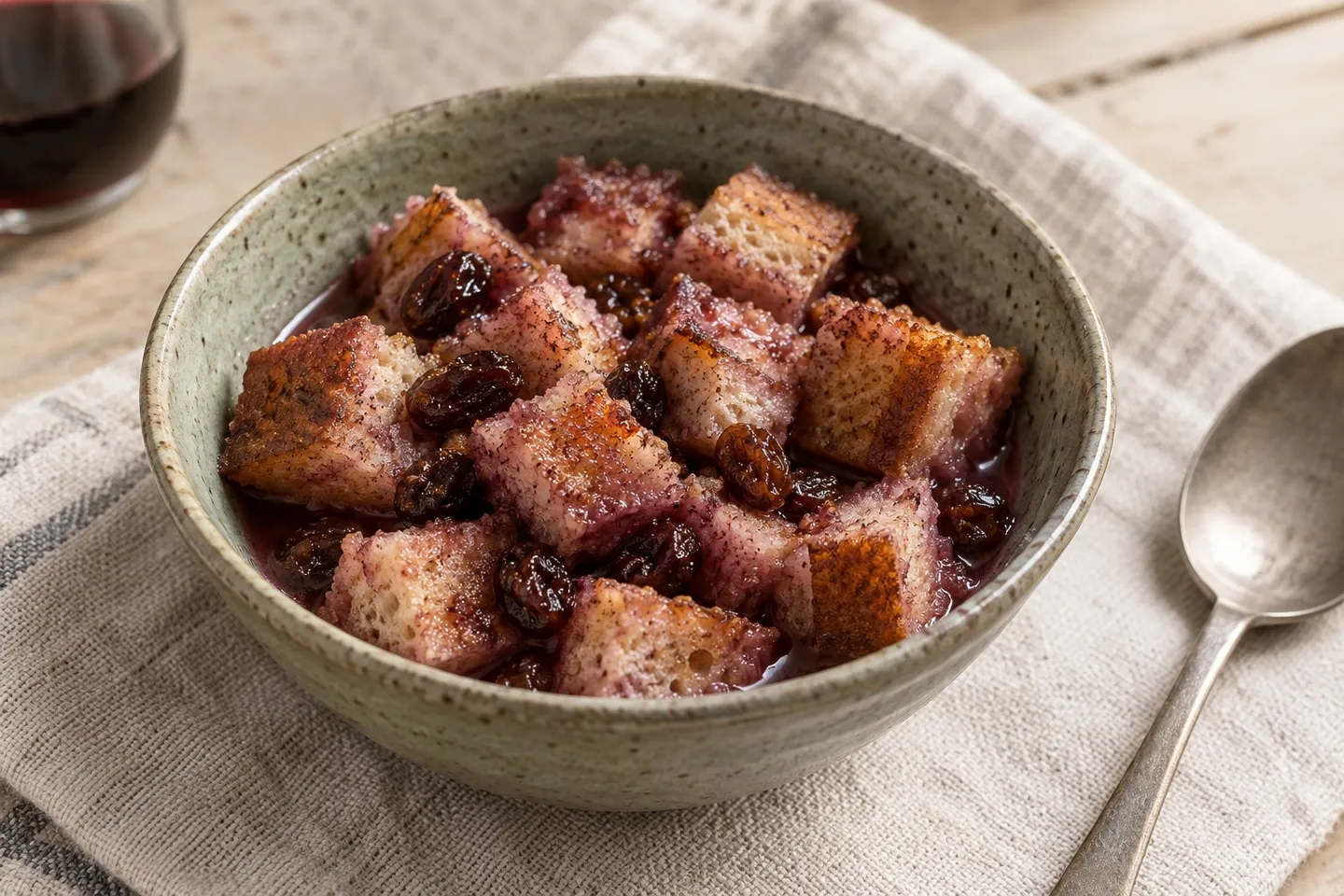
Golden fried bread cubes dressed with red wine, honey, raisins, and warm spices, adapted from medieval payn fondew.
- Original yieldYield
- 4 small dessert servings4 small dessert servings
- PrepPrep time
- CookCook time
- TotalTotal time
Published Updated
Original recipe: 4 small dessert servings
The story behind the recipe
Bread is fried before it meets red wine in payn fondew. Whole raisins and honey sweeten the loose, spiced wine sauce. Our version leaves the bread in cubes, with golden edges still visible as they take up the liquid.
A pudding without an oven
This is a small warm stovetop dessert, not an egg custard baked around bread. Its texture comes from fried edges and softened crumb. The sauce stays pourable, the raisins remain whole, and small bowls suit it better than expecting a firm slice.
Read more about this recipe
Grinding changes the old dish
The source in The Forme of Cury goes further. Bread fried in grease or oil is laid in red wine and ground with raisins. Honey is clarified with egg white and water, then mixed with the bread preparation, sugar, and spices. Salt and a consistency thick enough to stand follow, with white candied coriander as a finish.
Grinding is the difference to keep in mind when picturing that preparation. It draws the soaked bread and fruit together. Our intact cubes retain more of the bread's shape, even as their centers soften. The loose sauce and visible raisins are a chosen modern texture, not an attempt to make the original stand in a bowl.
Samuel Pegge's 1780 edition suggests a sense of dissolving in the name. The collection itself was compiled around 1390 and is associated with Richard II's master cooks. Our article on the collection follows its other short directions for pasta, tart, chickpeas, and roots.
Red wine and honey
Butter is our frying fat, and ordinary commercial honey goes directly into the saucepan. Separate sugar, salt, candied coriander, and the egg-white clarification are omitted. Cinnamon, nutmeg, and ginger supply a modern spice mixture; the passage names spices without prescribing those particular amounts.
Dry red wine is the recipe's starting point. A sweet or fortified wine would change the balance beside the honey as well as its alcohol content. Brief simmering doesn't make the dessert alcohol-free. Choose another dish if that matters for someone eating it, rather than assuming the heat has removed the alcohol.
Day-old rustic white bread offers a firm crumb to cut and fry. Small cubes give the browned faces plenty of contact with the sauce. The point isn't to preserve a crisp crouton: the bread is supposed to take up liquid, while the fried edges retain a little definition.
The few minutes after pouring
Leave time for the absorption rest before serving. Bread newly covered with sauce and bread that has had a few minutes to drink it in are different prospects in the bowl. The raisins need no blending or mashing in this version.
Serve the portions warm, with the loose sauce shared between them. Four small bowls are enough after a modest meal; the honey and wine already give a little bread a generous finish.
Make it your wayOriginal: 4 servings · Makes 4 small dessert servings
Original recipe: 4 small dessert servings
Ingredients
For 4 small dessert servings. Quantities are shown as written.
Source measurement convention: Metric. Explicit unit definitions take precedence; unconfirmed measures must be checked before conversion.
Original quantities for 4 small dessert servings.
- Day-old rustic white bread, cut into 2-cm cubes200 g
- Unsalted butter30 g
- Red wine240 ml
- Honey45 ml
- Raisins50 g
- Ground cinnamon1 metric tsp
- Freshly grated nutmeg1/4 metric tsp
- Ground ginger1/4 metric tsp
Measurement notes
- ground cinnamon, freshly grated nutmeg, ground ginger: tsp: 1 = 5 ml.
Measurement notes
Original ingredients
- 200 g day-old rustic white bread, cut into 2-cm cubes
- 30 g unsalted butter
- 240 ml red wine
- 45 ml honey
- 50 g raisins
- 1 tsp ground cinnamontsp: 1 = 5 ml.
- 1/4 tsp freshly grated nutmegtsp: 1 = 5 ml.
- 1/4 tsp ground gingertsp: 1 = 5 ml.
Equipment
 10-inch or 12-inch heavy saute pan or saucier
 Small 1.5-liter saucepan
Instructions
Fry the bread cubes
Melt the butter over medium heat in a 10-inch or 12-inch heavy saute pan. Add the bread cubes and cook for 6 to 8 minutes, turning frequently, until golden on several sides. Lower the heat if they brown before the centers warm. Transfer to a shallow heatproof serving dish.
Heat the wine, honey and spices
Combine the red wine, honey, raisins, cinnamon, nutmeg, and ginger in a small saucepan. Heat for about 3 to 5 minutes, stirring until the honey dissolves and the liquid reaches a gentle boil.
Simmer the wine sauce
Reduce the heat and simmer for 5 minutes. The raisins should begin to swell; the liquid will still be a pourable sauce, not a thick syrup.
Pour over the bread, rest and serve
Pour the hot wine mixture evenly over the bread. Rest for 5 minutes so the cubes absorb some of the sauce, then divide between four small bowls and serve warm.
Estimated calories 300 kcal
Nutrition portion: 1/4 of recipe · Original yield: 4 small dessert servings
Source & assumptions
Ingredient-based estimate using CoFID 2021 and the existing USDA and representative-label references. About 300 kcal per nutrition portion (1/4 of the recipe). Uses a conservative USDA hot-liquid model retaining 85% of the wine alcohol for this short cooking method; actual alcohol loss and ingredients vary. Not a measured alcohol or calorie result.
Recipe notes
Original recipe notes
These notes describe the original recipe. Quantities mentioned here do not change when you adjust servings.
Honey measure: 45 ml is 3 modern tablespoons of 15 ml each. Its weight is approximately 64 g, depending on the honey; the volume is the recipe's primary measure.
Wine choice: Dry red wine is the baseline; fortified or very sweet wines change both flavor and alcohol content. The source says red wine without specifying a modern variety. Simmering does not make this dessert alcohol-free.
Planning: Allow 10 minutes preparation, up to 20 minutes for sequential frying and sauce cooking, and a 5-minute absorption rest, for 35 minutes total.
Storage: Refrigerate leftovers promptly in a shallow covered container within 2 hours, or 1 hour above 90°F (32°C). Keep at 40°F (4°C) or below and use within 3 days. Reheat to 165°F (74°C); the bread will be softer.
Read the scaling guide. Times, temperatures and equipment need their own consideration. Open the recipe tool to review and correct individual amounts.
Sources and attribution
Payn Fondew, recipe 59, pp. 33–34 in Pegge's 1780 The Forme of Cury, compiled around 1390. Whole cubes, the spice blend, commercial honey, and a loose sauce are adaptations.
Curious about the drinks of the period? Our sister site, Forgotten Drink, explores medieval beer, water and the evidence behind them.