
Pickled Bananas (1914 Sweet-and-Sour Fruit Pickle)
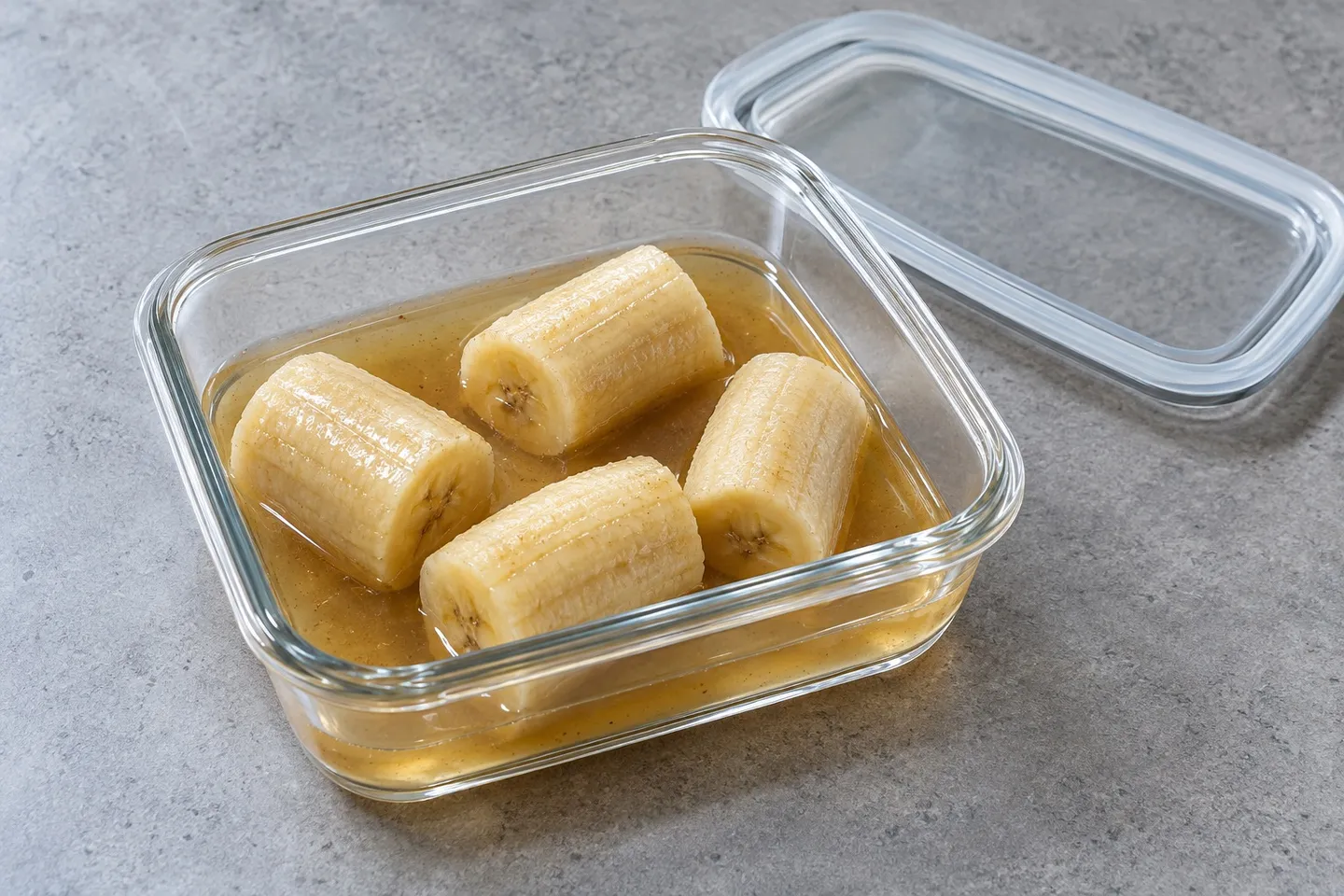
Firm banana pieces gently poached in vinegar syrup with cinnamon, mace, and cloves; a refrigerator adaptation of Marion Harris Neil.
- Original yieldYield
- 6 side servings from about 800 g prepared bananas6 side servings from about 800 g prepared bananas
- PrepPrep time
- CookCook time
- TotalTotal time
Includes 20 minutes initial cooling and at least 12 hours refrigerated curing. Cooling can continue in the refrigerator; do not leave the batch out until fully cold.
Published Updated
Original recipe: 6 side servings from about 800 g prepared bananas
The story behind the recipe
Bananas, vinegar and cloves belong on the same plate here. Thick pieces of fruit sit in a sweet, sharp syrup, ready for a small chilled helping beside ham or a wedge of sharp cheese. The familiar banana has become a pickle.
A place among the pickles
Marion Harris Neil includes the recipe in her 1914 Canning, Preserving and Pickling. Sugar supplies sweetness, vinegar brings the sharpness, and mace, cinnamon and cloves give the syrup its warm spice. Think of a sweet fruit pickle when deciding where it belongs on the table.
Start with a little beside something salty. You can add more without letting the syrup take over the plate.
Read more about this recipe
The saucepan starts without the fruit
Neil's banana recipe shares page 173 with pickled artichokes seasoned with ginger, mace and nutmeg. The title page names her as cookery editor of The Ladies' Home Journal. Here, fruit and vegetables share both a page and a spice cupboard. The companion article also looks at her watermelon-rind pickle.
Her banana directions put the powdered spices in a clean cloth. The bundle flavors the syrup while keeping most of the loose powder away from the fruit. A little fine sediment can escape; it needn't become a thick coating on every piece.
The syrup gets its own time on the heat before the bananas go in. That's an important distinction for such soft fruit. Giving the seasonings a head start lets the banana's cooking time depend on its tenderness, instead of making it stay in the pan while the spices infuse.
Choose firmness, then trust the skewer
Neil counts eight bananas but gives no peeled weight or ripeness. For the recipe below, choose firm fruit without soft patches. This isn't the place for the speckled, collapsing bananas you might mash into a loaf.
Crosswise thirds leave enough fruit to test at the center. Neil checks with a wooden skewer, and that cue is more dependable than the clock alone: it should enter easily while the piece still holds together. Stop before the edges start breaking away. Gentle handling matters once the fruit softens, because each turn or sweep of a spoon can damage it.
The finished pieces should still look like banana, with clean cut ends and enough firmness to lift out whole.
Make it your wayOriginal: 6 servings · Makes 6 side servings from about 800 g prepared bananas
Original recipe: 6 side servings from about 800 g prepared bananas
Ingredients
For 6 side servings from about 800 g prepared bananas. Quantities are shown as written.
Source measurement convention: Metric. Explicit unit definitions take precedence; unconfirmed measures must be checked before conversion.
Original quantities for 6 side servings from about 800 g prepared bananas.
- Firm bananas, peeled and cut crosswise into thick thirds800 g
- Granulated sugar400 g
- Distilled white vinegar, labeled 5% acidity240 ml
- Water120 ml
- Ground mace1 metric tsp
- Ground cinnamon1 metric tsp
- Ground cloves1/2 metric tsp
Measurement notes
- ground mace, ground cinnamon, ground cloves: tsp: 1 = 5 ml.
Measurement notes
Original ingredients
- 800 g firm bananas, peeled and cut crosswise into thick thirds
- 400 g granulated sugar
- 240 ml distilled white vinegar, labeled 5% acidity
- 120 ml water
- 1 tsp ground macetsp: 1 = 5 ml.
- 1 tsp ground cinnamontsp: 1 = 5 ml.
- 1/2 tsp ground clovestsp: 1 = 5 ml.
Equipment
 3-liter heavy saucepan
- Airtight glass container
- Clean, tightly woven cooking cloth
Instructions
Tie the spice sachet
Tie the mace, cinnamon, and cloves securely in a small square of clean, tightly woven cooking cloth. A little ground spice may escape the cloth and leave visible sediment.
Simmer the spiced vinegar syrup
Combine the sugar, vinegar, water, and spice sachet in the saucepan. Bring to a boil, stirring to dissolve the sugar, then simmer gently for 15 minutes.
Poach the banana pieces
Add the banana pieces and poach at a bare simmer for about 6 to 8 minutes, turning carefully if the liquid does not cover them. Stop when a skewer reaches the center easily and the pieces still hold together; fruit firmness may change the time.
Remove the spices and transfer the pickle
Remove from the heat and discard the sachet. Let heavy steam subside for about 20 minutes, then divide fruit and syrup between clean heatproof refrigerator containers with about 2 liters total capacity. Leave room below the lids and do not force the batch into a one-liter jar.
Refrigerate and rest before serving
Refrigerate promptly, loosely covered while cooling, then cover tightly once cold. Leave for at least 12 hours in the refrigerator before serving with a clean utensil.
Estimated calories 170 kcal
Nutrition portion: 1/6 of recipe · Original yield: 6 side servings from about 800 g prepared bananas
Source & assumptions
Rough ingredient-based estimate per one-sixth batch of banana with 15 g syrup. Models sweetening from a published drained heavy-syrup fruit analogue, with separate remaining syrup and vinegar shares; actual uptake, ripeness and syrup concentration vary. This is a modeled estimate, not a measured result.
Recipe notes
When adjusting quantities
Ingredient amounts can be adjusted; vessel capacity, cooking, cooling and curing times need their own checks.
Original recipe notes
These notes describe the original recipe. Quantities mentioned here do not change when you adjust servings.
Adaptation: Neil calls for eight bananas and 2 lb sugar. Here, the fruit is specified as 800 g peeled, the sugar is reduced to 400 g, and 120 ml water is added. The spice amounts, cloth sachet and crosswise thirds are retained; refrigeration replaces the original bottle-and-seal finish.
Fruit and capacity: About eight small to medium bananas may provide the prepared weight, but weigh after peeling. Riper fruit can soften faster; use the skewer cue. Divide the batch between heatproof refrigerator containers with about 2 liters total capacity, leaving room below the lids.
Storage: Keep refrigerated at 4°C (40°F) or below and use within four days of preparation, including the curing time. Refrigerate within two hours, or one hour if the room is above 32°C (90°F). This is a refrigerator pickle; don't can it or store it in the pantry. The four-day limit follows conservative general leftover guidance, not a measured shelf life for this recipe.
Read the scaling guide. Times, temperatures and equipment need their own consideration. Open the recipe tool to review and correct individual amounts.
Sources and attribution
Marion Harris Neil, Canning, Preserving and Pickling (1914), p. 173.