
Wartime Potato-Apple Scones (1941)
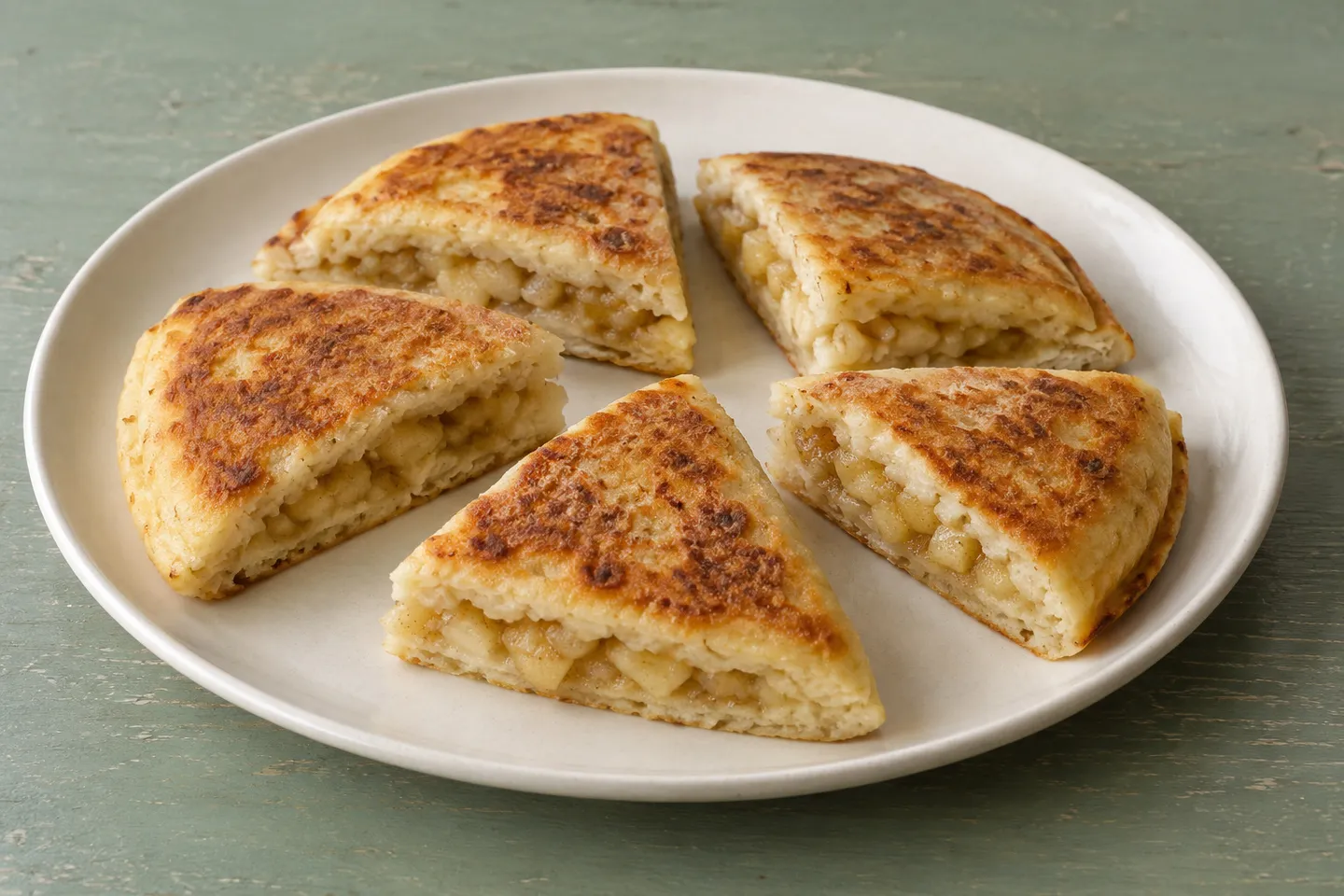
Soft, griddle-baked Irish potato scones stuffed with diced tart apples and a touch of ginger, made with hot mashed potatoes and a smaller amount of flour.
- Original yieldYield
- 8 scones8 scones
- PrepPrep time
- CookCook time
- TotalTotal time
Published Updated
Original recipe: 8 scones
The story behind the recipe
Heath's potato-apple cakes have a second filling moment. After cooking, he has the cook lift their tops, add sugar and margarine to the apple, close them and return them to the heat. It is a little ceremony inside a recipe made largely from potatoes.
Our apple goes in already sweetened
These modern griddle wedges simplify that finish. Hot mashed potato and flour make a soft dough around finely diced tart apple and sugar, with a little ginger in the dough. Both sides brown in a skillet; there is no later opening and refilling.
Read more about this recipe
Farls in the source
Ambrose Heath calls it Potato Apple Cake in his 1941 Kitchen Front Recipes and Hints and identifies it with Ireland. He describes rounds cut into triangular farls, paired around slices of raw apple, with either oven or griddle cooking.
That description places the dish somewhere different from a conventional flour scone. Potato is the main body of the dough, and the triangular shape comes from dividing a round. Our folded half-moons, cut into wedges, keep the enclosed apple idea while changing its assembly.
The source's apple finish is especially memorable. Sugar and fat go inside only after the filled cakes have cooked, followed by reheating. We mix sugar with diced apple before enclosing it, choosing a simpler stovetop project rather than pretending the two sequences are identical.
Heath paid attention to the potatoes
He asks for potatoes still hot and mashed free of lumps, then enough flour to make a pliable mixture. He warns against too much kneading and says the amount of flour depends on the potatoes. Those details give the cook something more useful than a fixed ingredient count alone.
Our recipe begins with already-cooked hot potatoes too. Boiling them from raw adds time before the short estimate below. The flour is added gradually, with the dough's pliability guiding when to stop; potato preparation and moisture matter alongside the measured starting quantity.
It is a good example of Heath explaining an ingredient he expects readers to know. Potatoes aren't all treated as interchangeable lumps. Their condition matters when they become dough, just as it matters when they become the filled shells in Deerfoot Potatoes.
An apple center in a browned wedge
Tart apple gives the enclosed fruit a distinct flavor beside the milder potato dough. Ginger stays in the dough as a small spice note, while the apple's sugar is inside. Fine dicing suits this adaptation's short griddle cook; thick raw slices would be a different filling from the one specified.
A heavy skillet or griddle gives the wedges contact with heat on both faces. The outside browns while the potato and apple stay softer within. Batch cooking keeps each piece in that direct contact rather than crowding a larger amount into the pan.
The warm wedges show another side of Heath's wartime recipes: potato can carry fruit as well as sausage, and baking can happen on the stovetop. His detailed attention to dough and filling is as interesting as the economy of the ingredients.
Make it your wayOriginal: 8 servings · Makes 8 scones
Original recipe: 8 scones
Ingredients
For 8 scones. Quantities are shown as written.
Source measurement convention: Metric. Explicit unit definitions take precedence; unconfirmed measures must be checked before conversion.
Original quantities for 8 scones.
- Hot mashed potatoes (freshly boiled and riced)450 gAuthor measures: about 1 lb.
- All-purpose flour (plus a little extra for dusting)120 g
- Melted unsalted butter (or margarine)30 gAuthor measures: about 2 metric tbsp (1 metric tbsp = 15 ml).
- Fine salt1/2 metric tsp
- Ground ginger1/4 metric tsp
- Tart apple (approx. 1 medium, peeled, cored, and finely diced)120 g
- Granulated sugar15 gAuthor measures: about 1 metric tbsp (1 metric tbsp = 15 ml).
- Extra butter (for cooking on the griddle)15 g
Measurement notes
- fine salt, ground ginger: tsp: 1 = 5 ml.
Measurement notes
Original ingredients
- 450 g hot mashed potatoes (freshly boiled and riced, approx. 1 lb)
- 120 g all-purpose flour (plus a little extra for dusting)
- 30 g melted unsalted butter (or margarine, approx. 2 tbsp)
- 1/2 tsp fine salttsp: 1 = 5 ml.
- 1/4 tsp ground gingertsp: 1 = 5 ml.
- 120 g tart apple (approx. 1 medium, peeled, cored, and finely diced)
- 15 g granulated sugar (approx. 1 tbsp)
- 15 g extra butter (for cooking on the griddle)
Equipment
 Heavy cast-iron skillet or griddle
 Potato masher
Instructions
Smooth the warm mashed potatoes
In a large mixing bowl or on a clean work surface, mash the hot mashed potatoes while still warm until completely smooth and free of lumps.
Add butter and seasonings
Pour the melted unsalted butter over the mashed potatoes, then scatter the fine salt and ground ginger over top.
Work in the flour gently
Gradually add the all-purpose flour, kneading gently with your hands for 1 to 2 minutes until a smooth, pliable dough forms. Stop kneading as soon as the dough is pliable.
Divide and roll the dough
Divide the dough into two equal balls. Roll each ball out on a lightly floured surface into a circle about 1 cm (about 3/8 inch) thick.
Toss apple with sugar
Toss the finely diced tart apple with the granulated sugar in a small bowl.
Fill, seal and cut the scones
Scatter the sweetened diced apple over half of each dough circle, then fold the empty half over the apples to create two half-moon shapes. Press the edges firmly together to seal, and gently cut each half-moon into 4 triangular wedges.
Heat the skillet butter
Place a heavy cast-iron skillet over medium heat and melt the extra butter.
Fry both sides until crisp
Add the potato scone wedges to the hot skillet. Fry for 5 to 6 minutes per side until the crust is golden brown and crisp, and the apple pieces inside are soft and steaming.
Serve hot
Serve hot directly from the skillet.
Estimated calories 150 kcal
Nutrition portion: 1/8 of recipe · Original yield: 8 scones
Source & assumptions
Ingredient-based estimate using CoFID 2021, identified manufacturer information. Approximately 150 kcal per nutrition portion. One original scone. Uses butter and plain boiled mashed potatoes; includes all 15 g of griddle butter and excludes a small unmeasured flour dusting. Ingredients, brands and preparation affect values.
Recipe notes
When adjusting quantities
Scale ingredients proportionally. Cook in batches if your skillet cannot fit all 8 wedges without crowding.
Original recipe notes
These notes describe the original recipe. Quantities mentioned here do not change when you adjust servings.
The 30-minute estimate begins with already-cooked potatoes that are still hot. Allow additional time if starting with raw potatoes. Heath notes that flour needs vary with potato type; add flour gradually to reach a pliable dough.
Granny Smith, Bramley, or any firm, tart orchard apples work best because they hold their shape during quick griddle cooking.
Read the scaling guide. Times, temperatures and equipment need their own consideration. Open the recipe tool to review and correct individual amounts.
Sources and attribution
Ambrose Heath, Kitchen Front Recipes and Hints (1941), pp. 21-22
Ambrose Heath, Kitchen Front Recipes and Hints (1941), Potato Apple Cake, pp. 21–22. Folded wedges, diced sweetened apple and the simplified griddle finish are adaptations.
Recipe details
- Recipe tradition
- Vintage
- Course or meal
- Baking
- Cuisine
- British
- Source decade
- 1940s
- Main ingredient
- Potatoes
- Occasion
- Wartime cooking
- Browse category
- Baking & Desserts