

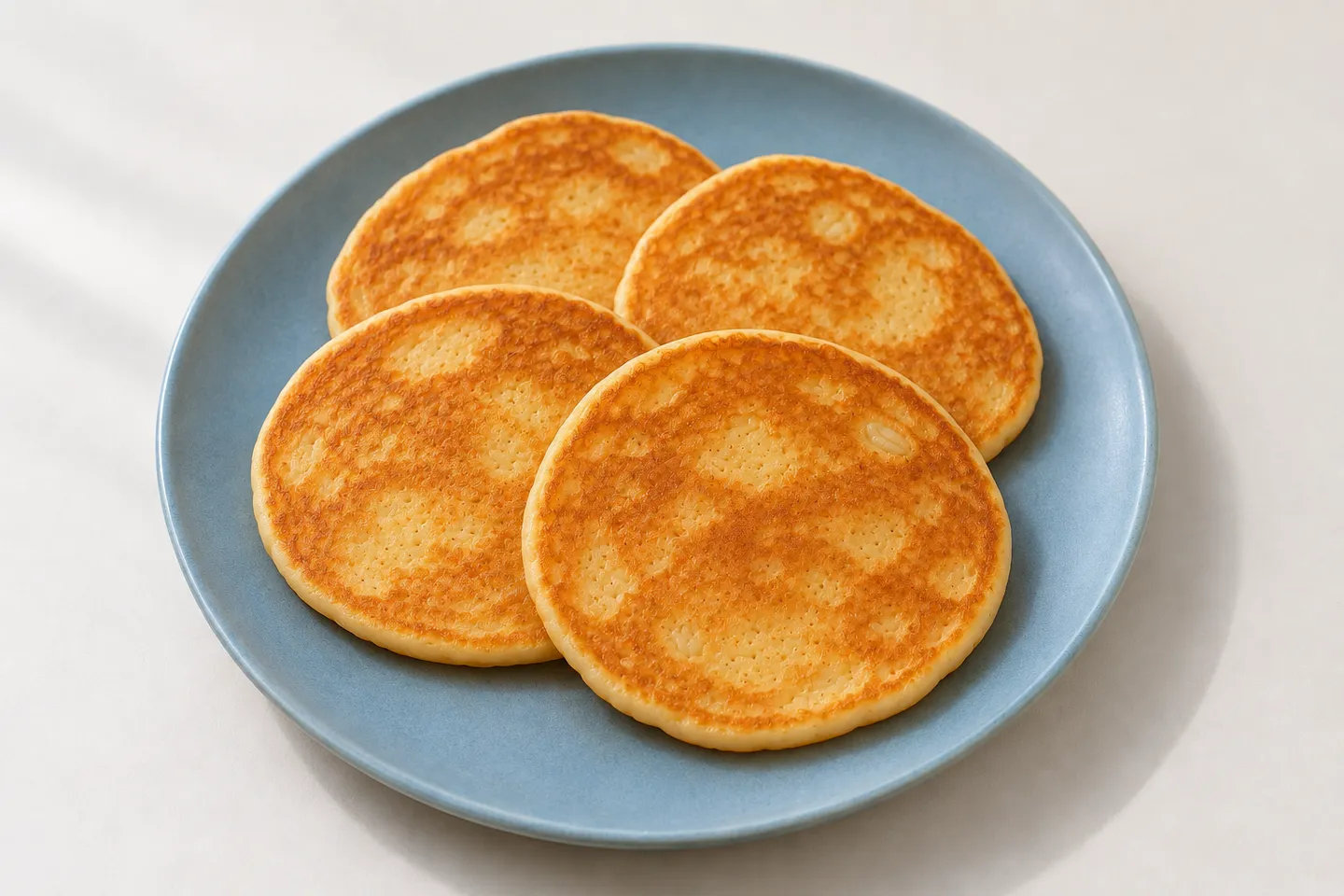
Rice Griddle Cakes (1896)
Small griddle cakes with cooked rice worked into a milk, egg and baking-powder batter, adapted from Fannie Merritt Farmer's 1896 recipe.
- Original yieldYield
- Approximately 16–18 small cakes, about 4 breakfast portionsApproximately 16–18 small cakes, about 4 breakfast portions
- PrepPrep time
- CookCook time
- TotalTotal time
Estimated with freshly boiled rice: 25 minutes for heating, boiling and drying, about 10 minutes to cool, 15 minutes preparation and 25 minutes griddle cooking in batches. Pan size affects elapsed time.
Published
Original recipe: Approximately 16–18 small cakes, about 4 breakfast portions
The story behind the recipe
Recognizable rice kernels remain in these small breakfast cakes. Farmer works cold cooked rice into a flour mixture, then adds milk, egg and melted butter to make the batter. Wheat flour still forms the larger part of the dry ingredients; the cooked rice adds grain texture within each cake.
Kernels in the mixing bowl
Farmer directs the cook to work the rice into the dry ingredients with fingertips. It's a small but telling instruction: this is cooked grain being distributed through a mixture, rather than rice flour disappearing into milk. The cakes are cooked by spoonfuls on a hot, greased surface, with butter and maple syrup offered at serving.
Read more about this recipe
Follow the instruction to the previous page
Rice Griddle-Cakes I appears in the 1896 Boston Cooking-School Cook Book. Its own method ends by telling the reader to cook the mixture like the other griddle cakes. To finish breakfast, you need the directions nearby: wait for a puffed surface, bubbles and cooked edges before turning, then cook the second side.
That borrowing makes sense in a cookbook read as a whole. On a recipe page of its own, the cooking cues need to travel with the batter. They're included below, with small portions that leave room for a turner in an ordinary skillet. A pan that browns the bottom before the edges have set needs less heat, rather than a hurried flip.
Half a cup of which rice?
The source calls for cold cooked rice. That's a prepared ingredient, with water already taken into the grains. Measuring the same volume of dry rice would give the batter a different material and leave it needing a cooking stage the griddle instructions don't provide.
The small rice component below gives you a way to begin from dry grain, but only the weighed cooked portion enters the batter. Any extra belongs outside the cake yield. If you already have plain cooked rice that was cooled quickly and kept refrigerated, you can use the listed cooked amount instead and skip that component. Don't substitute rice with an uncertain storage history just because it's heading into a hot pan.
This is another useful distinction in the ground-rice and rice-flour guide. A grain's condition matters as much as its name. Cooked kernels, dry grains and finely milled flour ask for different amounts of liquid and different cooking sequences.
A boiling pot with water to spare
Farmer's separate boiled-rice method uses abundant salted water, followed by draining, a hot-water rinse and a drying stage. The rinse is a separate addition after the first water has drained away. Neither potful becomes a measured liquid ingredient in the cake batter.
This version uses a much smaller rice pot, chooses white long-grain rice and dries it briefly off the heat. The shorter cooking estimate is guided by tenderness: check a kernel instead of assuming the clock can identify every rice. Spread the drained rice shallowly so the portion can lose its warmth while you prepare the other ingredients. It doesn't need a long afternoon on the counter.
Breakfast in several rounds
The first cakes can be served while the next batch cooks. Butter and maple syrup are optional, and keeping them at the table lets each person choose the finish without changing the batter. These aren't the same formula as our buttermilk pancakes: Farmer's version uses ordinary milk and cooked rice, with baking powder for leavening.
Larger quantities mean more rounds on the griddle. Keep the cakes small enough to turn comfortably and check the center for wet batter, particularly if the outside colors quickly. Breakfast takes the pace of the available cooking surface.
Make it your wayOriginal: 4 servings · Makes Approximately 16–18 small cakes, about 4 breakfast portions
Original recipe: Approximately 16–18 small cakes, about 4 breakfast portions
Ingredients
For Approximately 16–18 small cakes, about 4 breakfast portions. Quantities are shown as written.
Source measurement convention: Metric. Explicit unit definitions take precedence; unconfirmed measures must be checked before conversion.
Original quantities for Approximately 16–18 small cakes, about 4 breakfast portions.
Small boiled-rice component
- Dry white long-grain rice40 g
- Water, for boiling and draining475 ml
- Fine salt, for the rice water3/4 tsp
- Hot water, for rinsing and draining240 ml
Cake batter
- Cooked rice, cooled, from the component above80 g
- All-purpose flour300 g
- Baking powder3 tsp
- Fine salt1/2 tsp
- Granulated sugar50 g
- Whole milk360 ml
- Large egg1
- Unsalted butter, melted and cooled until warm28 g
- Neutral cooking oil, for the skillet10 ml
Optional serving
- Unsalted butter20 g
- Maple syrup60 ml
Measurement notes
- fine salt, for the rice water, baking powder, fine salt: US tsp: 1 = 4.9289 ml (rounded).
Measurement notes
Original ingredients
- 40 g dry white long-grain rice
- 475 ml water, for boiling and draining
- 3/4 US tsp fine salt, for the rice waterUS tsp: 1 = 4.9289 ml (rounded).
- 240 ml hot water, for rinsing and draining
- 80 g cooked rice, cooled, from the component above
- 300 g all-purpose flour
- 3 US tsp baking powderUS tsp: 1 = 4.9289 ml (rounded).
- 1/2 US tsp fine saltUS tsp: 1 = 4.9289 ml (rounded).
- 50 g granulated sugar
- 360 ml whole milk
- 1 large egg
- 28 g unsalted butter, melted and cooled until warm
- 10 ml neutral cooking oil, for the skillet
- 20 g unsalted butter
- 60 ml maple syrup
Equipment
 Medium saucepan (2-quart)
 Fine-mesh strainer
 Whisk
 12-inch non-stick skillet or griddle
Instructions
Boil the small rice component
Bring the boiling water and rice-water salt to a boil in a medium saucepan. Inspect the dry rice, then add it gradually so the water keeps boiling. Stir briefly with a fork and boil gently for about 15 to 20 minutes, until the kernels are tender. Keep the rice submerged; add a little boiling water if evaporation leaves it exposed.
Drain, rinse and portion the rice
Drain the rice through a fine-mesh strainer, then pour the separate hot rinse water through it and drain well. Return the rice to the warm empty saucepan, cover off the heat for 3 minutes, then spread in a shallow dish. Let it lose its warmth, aiming for about 10 minutes rather than leaving it out for hours. Weigh the listed cooked-rice portion for the batter. If short, prepare a little more rice; don't add dry grain to make up the weight. Refrigerate any unused rice promptly, ideally within 1 hour of cooking.
Sift dry ingredients and distribute rice
Sift the flour, baking powder, batter salt and sugar together through the clean, dry fine-mesh strainer into a large bowl. Work the cooled cooked-rice portion into the dry ingredients with clean fingertips, distributing the kernels through the mixture.
Mix the cake batter
Beat the egg in another bowl, then whisk in the milk and warm melted butter. Add to the dry mixture and stir just until evenly combined. Don't taste the raw batter. For a fractional egg, beat it first and weigh the required fraction, using approximately 50 g without shell as the baseline for one large egg.
Cook the first side in batches
Heat a 12-inch skillet or griddle over medium heat. Brush with a little of the oil, reserving the rest for later batches. Drop about 50 g batter for each cake, leaving space to turn; cook two or three at a time as space permits. Cook for about 2 to 3 minutes, until bubbles appear, the edges set and the underside browns. Reduce the heat if the bottom colors before the edges set.
Turn and finish the cakes
Turn the cakes and cook about 1 to 2 minutes more, until browned on the second side and set in the center with no wet batter. Cook the remaining batter in batches, lightly greasing from the measured oil as needed. Keep the cake size the same when changing the batch quantity; allow additional batches rather than longer cooking for each cake.
Serve with optional toppings
Serve freshly cooked, dividing the optional serving butter and maple syrup between portions if using. If you began with previously cooked, chilled rice, eat the cakes promptly and don't save them for another reheating.
Recipe notes
When adjusting quantities
Weigh only the listed cooked-rice portion into the batter. Keep cakes about 50 g of batter each and allow more batches when making more. Beat and weigh fractional eggs. Keep rice submerged while boiling; do not multiply cooking times.
Original recipe notes
These notes describe the original recipe. Quantities mentioned here do not change when you adjust servings.
The dry rice, boiling water, rice-water salt and rinse water form a preparation component. Only the listed cooked-rice portion enters the batter; the water is drained and any extra rice is outside the cake yield. Alternatively, omit that entire component and use the listed weight of plain cooked rice, cooled quickly and refrigerated for no more than 24 hours.
Farmer's source amounts are 2 1/2 cups flour, 1/2 cup cold cooked rice, 1 tablespoon baking powder, 1/2 teaspoon salt, 1/4 cup sugar, 1 1/2 cups milk, 1 egg and 2 tablespoons melted butter. The working weights here use modern ingredient-specific assumptions, rather than claiming to reproduce weighed historical cups. Pan oil, topping quantities, long-grain rice, portion size and times are supplied for this version. Baking soda isn't a direct replacement for the baking powder.
The cakes contain wheat, milk and egg. Cook the batter through and don't taste it raw; see the FDA's flour safety guidance. For rice, the Food Standards Agency advises rapid cooling, refrigeration for no more than a day and only one reheating. Use freshly cooked rice promptly; if saving rice or cakes made from fresh rice, cool in small portions and refrigerate ideally within 1 hour, eat within 24 hours and reheat only once until steaming hot throughout.
Storage
Use freshly prepared rice promptly, or rice cooled quickly and refrigerated for no more than 24 hours. Serve the cakes freshly cooked. Do not save cakes made with previously cooked, chilled rice for another reheating.
Read the scaling guide. Times, temperatures and equipment need their own consideration. Open the recipe tool to review and correct individual amounts.
Sources and attribution
Fannie Merritt Farmer, The Boston Cooking-School Cook Book (Boston: Little, Brown, and Company, 1896), Rice Griddle-Cakes I, p. 78; griddle method p. 77; Boiled Rice p. 88.
Adapted from Rice Griddle-Cakes I, p. 78, with the griddle method on p. 77 and Boiled Rice on p. 88 of Farmer's 1896 cookbook.
Recipe details
- Recipe tradition
- Vintage
- Cooking method
- Stovetop
- Browse category
- Breakfast & Brunch