
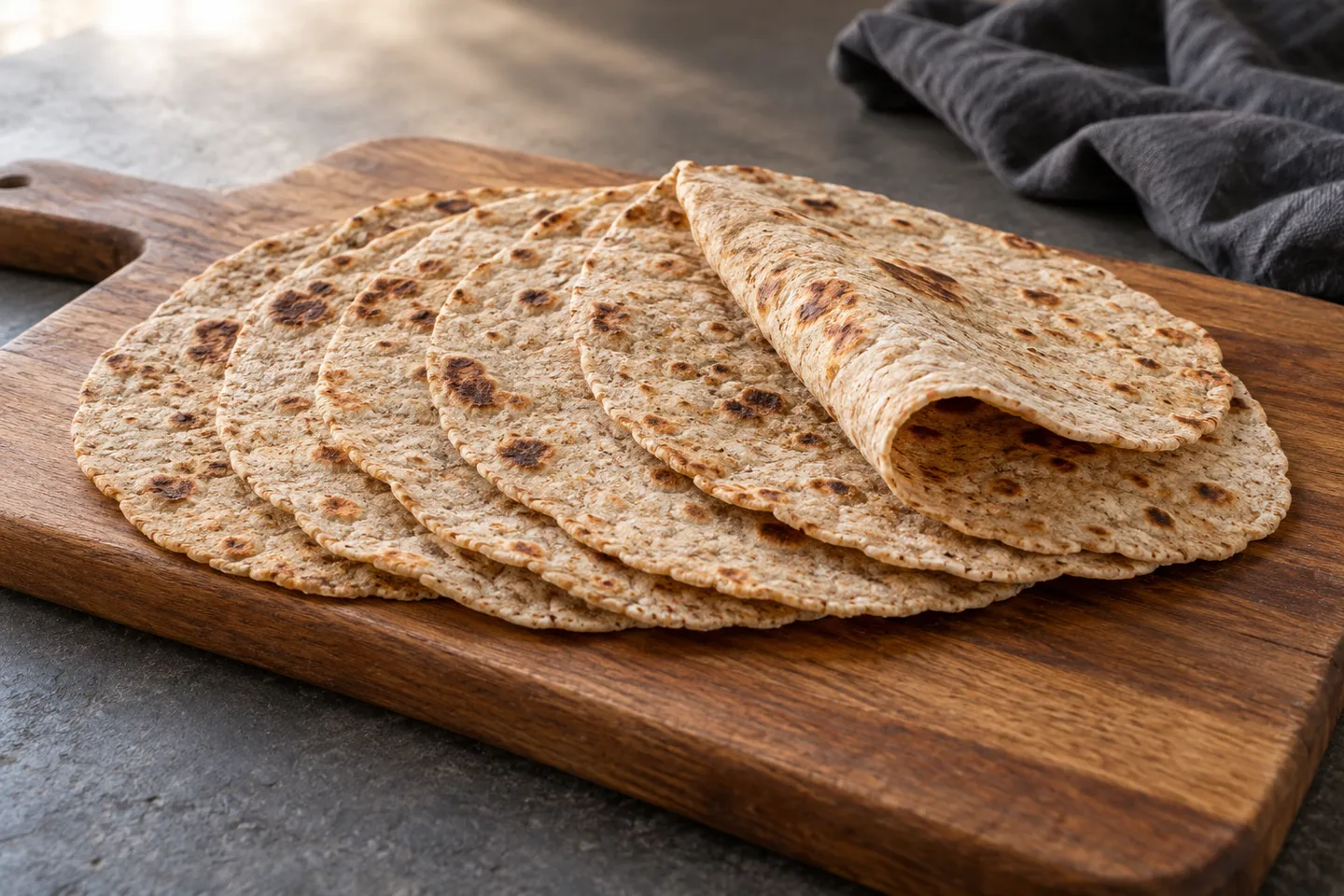
Skillet Barley Flatbreads
Thin, unleavened flatbreads made with barley flour and whole-wheat flour, rolled small and cooked in a skillet.
- Original yieldYield
- 6 small flatbreads; 6 side portions6 small flatbreads6 side portions
- PrepPrep time
- CookCook time
- TotalTotal time
Estimated: 15 minutes mixing and rolling, 20 minutes resting, and about 30 minutes cooking six breads one at a time.
Published
Original recipe: 6 small flatbreads; 6 side portions
The story behind the recipe
These barley flatbreads are small enough to turn with one spatula and thin enough to cook through in a skillet. Whole-wheat flour makes up most of the dough; barley supplies its own grain flavor without having to hold the bread together alone.
Flour, not a bowl of barley grains
Use whole-grain barley flour, not pearl barley, barley flakes or malted barley powder. The dough contains ordinary whole-wheat flour as well. It has no yeast or baking powder, so expect a thin bread with toasted patches rather than a puffy pocket.
Read more about this recipe
A mixed-grain dough
The Swedish History Museum's food display describes barley, oats and hulled wheats among bread ingredients. Those remains connect bread to the grain cupboard as well as to the hearth.
Two parts barley flour to three parts whole-wheat flour give this dough a wheat majority. Wheat contributes the cohesion needed to roll the rounds and lift them into the pan; removing it would call for a different formula.
Both flours bring bran into the dough. A short rest allows the mixture to hydrate before it is rolled. The dough won't rise, but it should become easier to handle as the flour takes up the water.
Small rounds suit the skillet
Large, thin sheets are harder to lift without tearing, especially in a dough with barley. A round roughly seven inches across leaves space around the edge of a ten- or twelve-inch skillet. You can get a spatula underneath it without folding the whole bread against the pan's sides.
Thickness matters as much as diameter. A bread that is brown outside can still have a wet flour layer in the middle. Rolling to roughly three millimeters makes the center accessible to the heat before the outside scorches. The finished bread should be cooked through, with some flexibility while warm.
The heat should produce scattered brown patches, not an instantly black surface. Adjust the burner as the pan warms between batches. A thin film of oil helps with contact; these breads aren't meant to swim in fat.
A pan beside the hearth
The Viking Ship Museum's teaching material includes a modern reconstruction in which flour and liquid are made into small breads and cooked on a pan. A small bread needs a hot cooking surface instead of a large oven. That is the connection we can bring to an ordinary domestic stove.
A heavy skillet holds heat between batches, though it can also grow hotter as the cooking continues. Watch the bread, and lower the burner if the brown patches turn black before the center cooks.
Eat them while they're supple
Let the breads lose their fiercest heat on a rack, then wrap them in a clean cloth for serving. Trapping a little warmth keeps the first ones pleasant while the last round cooks. Left spread out for a long time, thin breads lose moisture and become firmer.
Serve alongside a bowl of grain and fish or use a piece to scoop a soft topping. Tear them while warm, when they're at their most supple.
Explore the historical background and companion recipes in The Viking Winter Pantry: Preserved Fish, Grain and Dairy.
Make it your wayOriginal: 6 servings · Makes 6 small flatbreads; 6 side portions
Original recipe: 6 small flatbreads; 6 side portions
Ingredients
For 6 small flatbreads; 6 side portions. Quantities are shown as written.
Source measurement convention: Metric. Explicit unit definitions take precedence; unconfirmed measures must be checked before conversion.
Original quantities for 6 small flatbreads; 6 side portions.
- Whole-grain barley flour120 g
- Whole-wheat flour180 g
- Water200 ml
- Fine salt1/2 tsp
- Whole-wheat flour, for rolling15 g
- Sunflower oil, for the skillet10 ml
Measurement notes
- fine salt: US tsp: 1 = 4.9289 ml (rounded).
Measurement notes
Original ingredients
- 120 g whole-grain barley flour
- 180 g whole-wheat flour
- 200 ml water
- 1/2 US tsp fine saltUS tsp: 1 = 4.9289 ml (rounded).
- 15 g whole-wheat flour, for rolling
- 10 ml sunflower oil, for the skillet
Equipment
 Heavy cast-iron skillet (10 or 12-inch)
 Rolling pin
 Wire cooling rack
Instructions
Mix the barley dough
Mix the barley flour, 180 g whole-wheat flour and salt. Add the water and knead briefly until the dough holds together, about 2 minutes. Cover and rest for 20 minutes.
Divide and roll the dough
Divide into six equal pieces at the original yield. Use the 15 g rolling flour sparingly to roll each piece into a round about 3 mm thick, roughly 18 cm across. Let the thickness guide you rather than forcing every round to an exact diameter. Keep the waiting dough covered.
Heat and oil the skillet
Heat a heavy skillet over medium heat. Wipe a little of the sunflower oil over the surface, using the measured amount across the batches.
Cook the flatbreads in batches
Cook one bread at a time for 2 to 3 minutes on the first side and about 2 minutes on the second. It should have brown patches and a dry, cooked center without a raw dough line; reduce the heat if the outside darkens too fast. Continue a little longer if needed.
Cool briefly and serve
Transfer briefly to a rack, then wrap in a clean cloth while cooking the remaining breads. Serve warm.
Estimated calories 190 kcal
Nutrition portion: 1/6 of recipe · Original yield: 6 small flatbreads; 6 side portions
Source & assumptions
Ingredient-based estimate using CoFID 2021, USDA SR Legacy (April 2018). Approximately 190 kcal per nutrition portion. One original flatbread. Includes all measured skillet oil and rolling flour. Ingredients, brands and preparation affect values.
Recipe notes
When adjusting quantities
Roll each bread about 3 mm thick; expect roughly 18 cm across. Make more breads rather than thicker ones; pan size and cooking time per bread do not scale.
Original recipe notes
These notes describe the original recipe. Quantities mentioned here do not change when you adjust servings.
A contemporary mixed-flour recipe inspired by pan-cooked breads. The pan-cooking connection is discussed in the Viking Ship Museum's teaching resource, pp. 3–5. King Arthur's skillet flatbread method provides a modern cooking comparison; this dough changes the flour blend and omits its baking powder and dough oil, making this a different dough.
Barley and wheat contain gluten. Don't substitute pearl barley for the barley flour, or remove the wheat without using a separately developed recipe. Serve these soft breads freshly cooked.
Read the scaling guide. Times, temperatures and equipment need their own consideration. Open the recipe tool to review and correct individual amounts.
Sources and attribution
Recipe details
- Cooking method
- Stovetop
- Browse category
- Baking & Desserts