

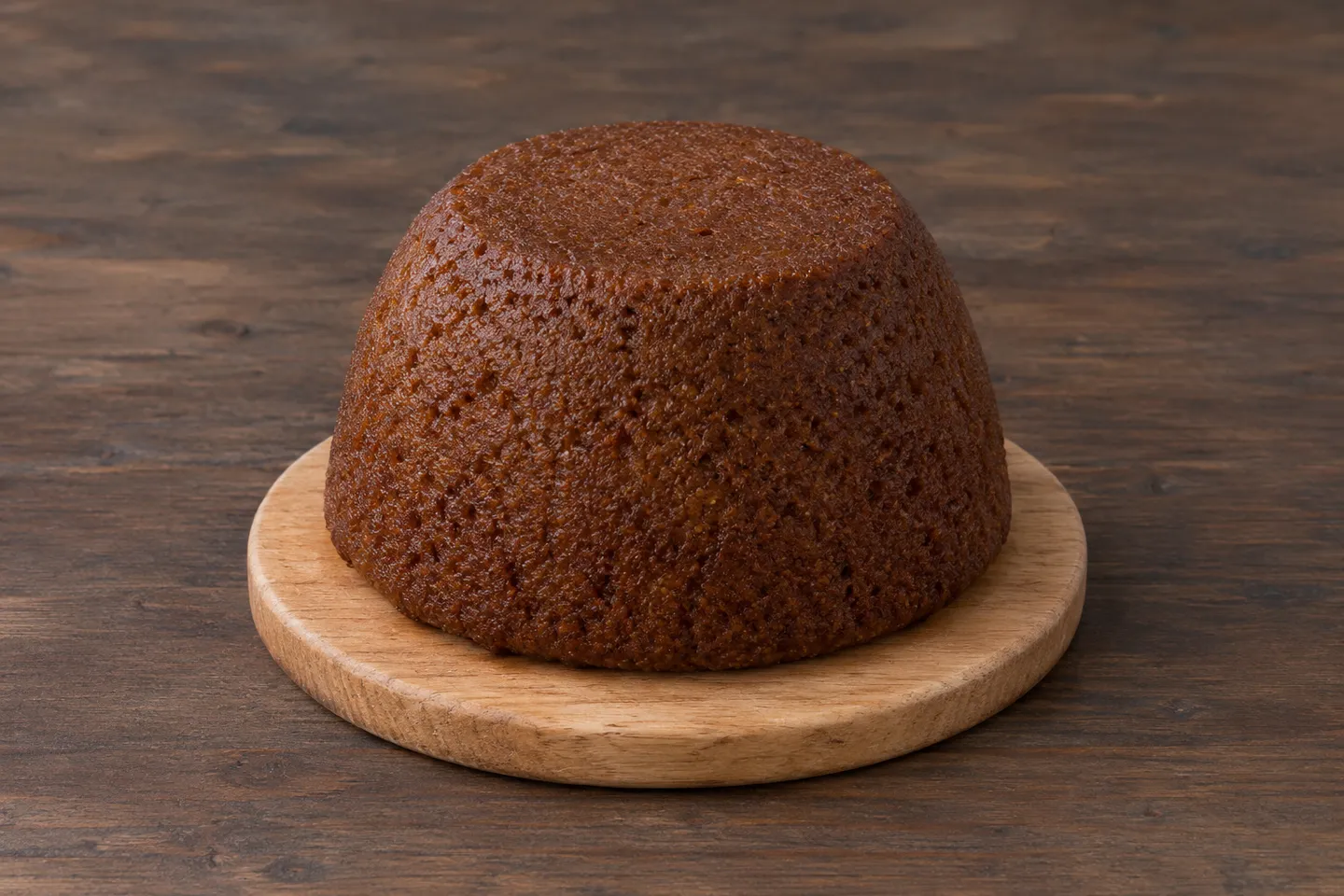
Steamed Boston Brown Bread (1909)
A molasses bread of rye meal, whole wheat and cornmeal, continuously steamed in a basin, adapted from Margaret J. Mitchell's 1909 recipe.
- Original yieldYield
- Approximately 8 small slices, deliberately divided into 8 portionsApproximately 8 small slices, deliberately divided into 8 portions
- PrepPrep time
- CookCook time
- TotalTotal time
Estimate allows preparation, up to 10 minutes heating the pot, 2 to 2 1/2 hours continuous steaming and a 10-minute rest; total uses the longer steam estimate.
Published
Original recipe: Approximately 8 small slices, deliberately divided into 8 portions
The story behind the recipe
This brown bread cooks in a covered basin over a steady simmer. Rye meal, whole-wheat flour and cornmeal give it three grain ingredients, with molasses and cultured buttermilk mixed through them. Cut small slices for soup or a simple meal; there is no oven-browned top to judge while the basin is covered.
A bread inside a pot
A steamed loaf asks for different attention from a tray of rolls. The pan around the basin needs enough hot water to maintain steam, and the loaf needs room above the mixture. Check the pot during cooking rather than leaving a long timer to look after its water level.
Read more about this recipe
The original spent hours in a box
Margaret J. Mitchell's 1909 Fireless Cook Book gives Boston Brown Bread a short initial boil followed by five hours in a hay-box. Its mold sits inside a cooker pail, with warm water partway up the side. The book relies on retained heat for the long second stage. This modern version instead stays over gentle, continuous steam.
That change matters more than replacing an old container. The source's timetable describes its own insulated apparatus; it isn't a timetable for a saucepan on the stove. The method below keeps active heat under the pot and uses a larger modern basin. It makes no claim to save fuel or reproduce the source's crust.
Three grains, three shopping decisions
The historical list names rye meal, Graham flour and cornmeal. Whole-wheat flour is the chosen replacement for Graham flour here; fine plain cornmeal gives the corn ingredient a definite grind. Buy plain meal rather than a self-rising mixture that would add another leavener.
Cornstarch isn't another name for that meal. Nor does every bag marked corn flour contain the same product. The cornflour and cornmeal comparison separates starch from milled grain before shopping. A precise weight can't correct a choice of the wrong ingredient category.
Milk changes the directions
Mitchell offers sour milk, sweet milk or buttermilk in different listed amounts. Her continuation changes the leavening for sweet milk: add cream of tartar, or replace soda with baking powder. Those alternatives belong to the full recipe, rather than permitting any milk with any spoonful of leavener.
This version selects commercially cultured buttermilk and a stated baking-soda amount. Don't sour milk by leaving it on the counter or swap in sweet milk while ignoring those different directions. Milk and leavener belong to the chosen formula together, even though the bread's name doesn't mention either.
Leave room beneath the cover
The source's six-quart pail is the outer cooker, not a six-quart water addition or the loaf mold's capacity. Separating those vessels makes the instructions clearer. Our basin is the inner container; the surrounding pot must fit it, a stable trivet, water and a lid.
Leave space below the rim, with a pleat in the cover for expansion. If a changed batch exceeds that headroom, use additional suitable basins instead of packing everything into the original one. The center must be cooked before turning out. A larger ingredient total isn't a reason to make a deeper loaf and assume the same steaming schedule. Water around each basin and room inside each one remain separate checks.
Make it your wayOriginal: 8 servings · Makes Approximately 8 small slices, deliberately divided into 8 portions
Original recipe: Approximately 8 small slices, deliberately divided into 8 portions
Ingredients
For Approximately 8 small slices, deliberately divided into 8 portions. Quantities are shown as written.
Source measurement convention: Metric. Explicit unit definitions take precedence; unconfirmed measures must be checked before conversion.
Original quantities for Approximately 8 small slices, deliberately divided into 8 portions.
- Rye meal100 g
- Whole-wheat flour120 g
- Fine plain cornmeal140 g
- Fine salt1 tsp
- Baking soda1 1/2 tsp
- Baking molasses240 g
- Commercially cultured buttermilk420 ml
- Unsalted butter, for greasing5 g
- Water, as needed for the steaming pot
Measurement notes
- fine salt, baking soda: US tsp: 1 = 4.9289 ml (rounded).
Measurement notes
Original ingredients
- 100 g rye meal
- 120 g whole-wheat flour
- 140 g fine plain cornmeal
- 1 US tsp fine saltUS tsp: 1 = 4.9289 ml (rounded).
- 1 1/2 US tsp baking sodaUS tsp: 1 = 4.9289 ml (rounded).
- 240 g baking molasses
- 420 ml commercially cultured buttermilk
- 5 g unsalted butter, for greasing
- Water, as needed for the steaming pot
Equipment
- 1.5-liter heatproof pudding basin
 Large deep pot with lid, sized to fit the pudding basin
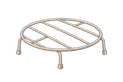 Stable trivet for the steaming pot
 Mixing bowls
Instructions
Prepare the basin and pot
Grease a 1.5-liter heatproof pudding basin with the listed butter. Fit a stable trivet in a deep lidded pot and check that the basin fits with space around it. Prepare a pleated baking-parchment and foil cover, with kitchen string for securing it.
Mix the three-grain batter
Mix the rye meal, whole-wheat flour, cornmeal, salt and baking soda thoroughly, breaking up lumps. Whisk the molasses into the buttermilk, then gradually stir into the dry mixture until evenly combined. Don't taste the raw mixture.
Fill and cover the basin
Transfer to the basin, leaving at least one-third of its capacity empty. If the mixture exceeds two-thirds full, divide between additional suitable basins. Secure the pleated cover to the rim, keeping it above the water level, and make a string lifting handle.
Steam continuously
Set on the trivet. Carefully pour hot steaming water around the basin to about two-thirds up its side, below the rim and cover. Put on the pot lid, bring to a gentle simmer and maintain continuous steam for about 2 to 2 1/2 hours. Check periodically and replenish with boiling water as needed; don't let the pot boil dry.
Check the center
Begin checking near 2 hours. Lift carefully with heatproof gloves, keeping face and hands away from escaping steam. The loaf should be set throughout, with no wet batter on a central skewer. Re-cover and continue steaming if needed. Different basin sizes may need different times; elapsed time alone doesn't establish doneness.
Rest and slice
Lift out, rest about 10 minutes, remove the cover and loosen carefully. Turn out onto a plate or board and slice warm or cool. Divide the original batch into approximately 8 small slices as 8 portions; preserve similar slice size with changed quantities rather than making the loaf deeper.
Recipe notes
When adjusting quantities
Fill each basin no more than two-thirds full. Use additional basins for more mixture and check each loaf; ingredient multiplication doesn't select a new vessel or cooking time.
Original recipe notes
These notes describe the original recipe. Quantities mentioned here do not change when you adjust servings.
Whole-wheat flour replaces Graham flour, and fine cornmeal is selected. Working weights assume 100 g rye meal, 120 g wheat flour and 140 g cornmeal per modern cup; these aren't measured historical densities. Molasses uses an assumed 320 g per cup, giving 240 g for three-quarters of a cup. The 420 ml buttermilk follows the 1 3/4-cup branch using an editorial 240 ml cup. These are ingredient-specific assumptions.
Baking soda is deliberately reduced from the source's 3/4 tablespoon, nominally 2 1/4 modern teaspoons, to 1 1/2 US teaspoons. The larger 1.5-liter basin, continuous steam, estimated times and modern cues also change the preparation. The resulting lift, texture and final yield aren't established by the historical directions. The sweet-milk alternatives aren't a simple liquid swap.
Outer-pot water is an as-needed cooking medium, not a measured bread ingredient. Maintain headroom and water level with changed quantities; a different basin needs its own cooking judgment.
Wheat, rye and milk are present. Cook fully and don't taste raw mixture; see FDA flour guidance. Cool leftover slices promptly in small portions and refrigerate within 2 hours, or 1 hour above 90°F (32°C), following FDA food handling. Don't hold leftovers in a warm insulated box.
Storage
Cool leftovers promptly in small portions and refrigerate within 2 hours, or 1 hour above 90°F (32°C); never use a warm insulated box as storage.
Read the scaling guide. Times, temperatures and equipment need their own consideration. Open the recipe tool to review and correct individual amounts.
Sources and attribution
Margaret J. Mitchell, The Fireless Cook Book (New York, 1909), Boston Brown Bread, pp. 155–156.
Margaret J. Mitchell, The Fireless Cook Book (New York, 1909), Boston Brown Bread, pp. 155–156.
Adapted from Boston Brown Bread, pp. 155–156, in Margaret J. Mitchell's The Fireless Cook Book (1909).
Recipe details
- Recipe tradition
- Vintage
- Course or meal
- Baking
- Source decade
- 1900s
- Cooking method
- Stovetop
- Browse category
- Baking & Desserts