

- Ingredient comparisons
- Historical ingredients
- Baking & desserts
Cornflour, Cornstarch or Cornmeal? What to Buy for the Recipe
Separate corn starch from milled corn, read ambiguous cornflour labels and choose the right grind for sauces, muffins and cornmeal biscuits.
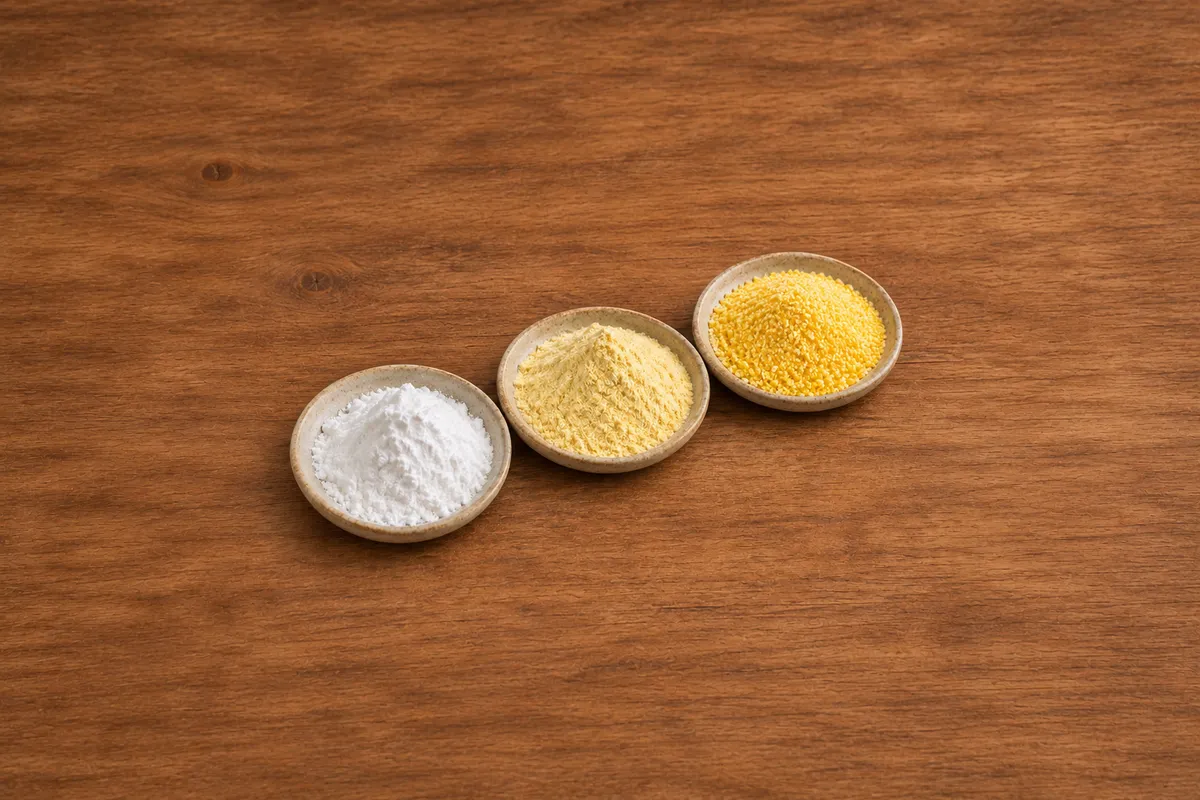
A box of cornflour can belong beside the gravy pan; a bag of corn flour can belong in the cornbread. The space between the words doesn’t settle which one you’ve found. Both names appear on corn products, but one may be a starch thickener and the other a finely ground grain.
For a recipe calling for cornstarch, buy the starch product. For our cornmeal gems, buy plain medium-grind yellow cornmeal. If the recipe says only cornflour, establish what its writer means before choosing either. A familiar-looking name is less useful than the ingredient list and the job the ingredient has to do.
In the photograph, left to right: cornstarch, whole-grain corn flour and medium-grind cornmeal.
First separate starch from grain
Cornstarch is made from the starchy endosperm of the corn kernel. Bob’s Red Mill lists its product’s ingredient simply as cornstarch and describes uses including sauces, puddings and pie fillings. It isn’t whole corn ground to a very fine texture. Bob’s Red Mill Cornstarch
The same maker’s Organic Corn Flour is finely ground whole-grain corn, retaining the germ, bran and endosperm. Its Medium Grind Cornmeal also contains whole-grain corn, with the germ and bran retained. Those two products differ in grind while both remain milled grain products. The starch is a different ingredient category. Organic Corn Flour, Medium Grind Cornmeal
That gives you two questions to ask at the shelf: is this starch or milled grain, and, if it’s grain, how has it been ground or prepared? Looking only for the finest powder misses the first question.
| Product wording | What to establish | Shopping decision |
|---|---|---|
| Cornstarch or maize starch | The ingredient is starch, rather than whole-grain corn | Choose it when the recipe specifies corn starch for thickening or baking |
| Cornflour or corn flour | Whether the maker means starch or milled grain | Read the ingredients and product description before buying |
| Whole-grain corn flour | Finely milled grain with its grain components retained | Choose it for a recipe specifying that flour, rather than for a starch slurry |
| Fine, medium or coarse cornmeal | The grind, and whether it is plain meal | Match the recipe’s specified grind and formulation |
| Masa harina corn flour | Corn prepared with limewater before grinding | Buy it for a recipe calling for masa harina |
| Self-rising cornmeal mix | Which flour, leavener and other ingredients are already included | Use it in a recipe written for that mix |
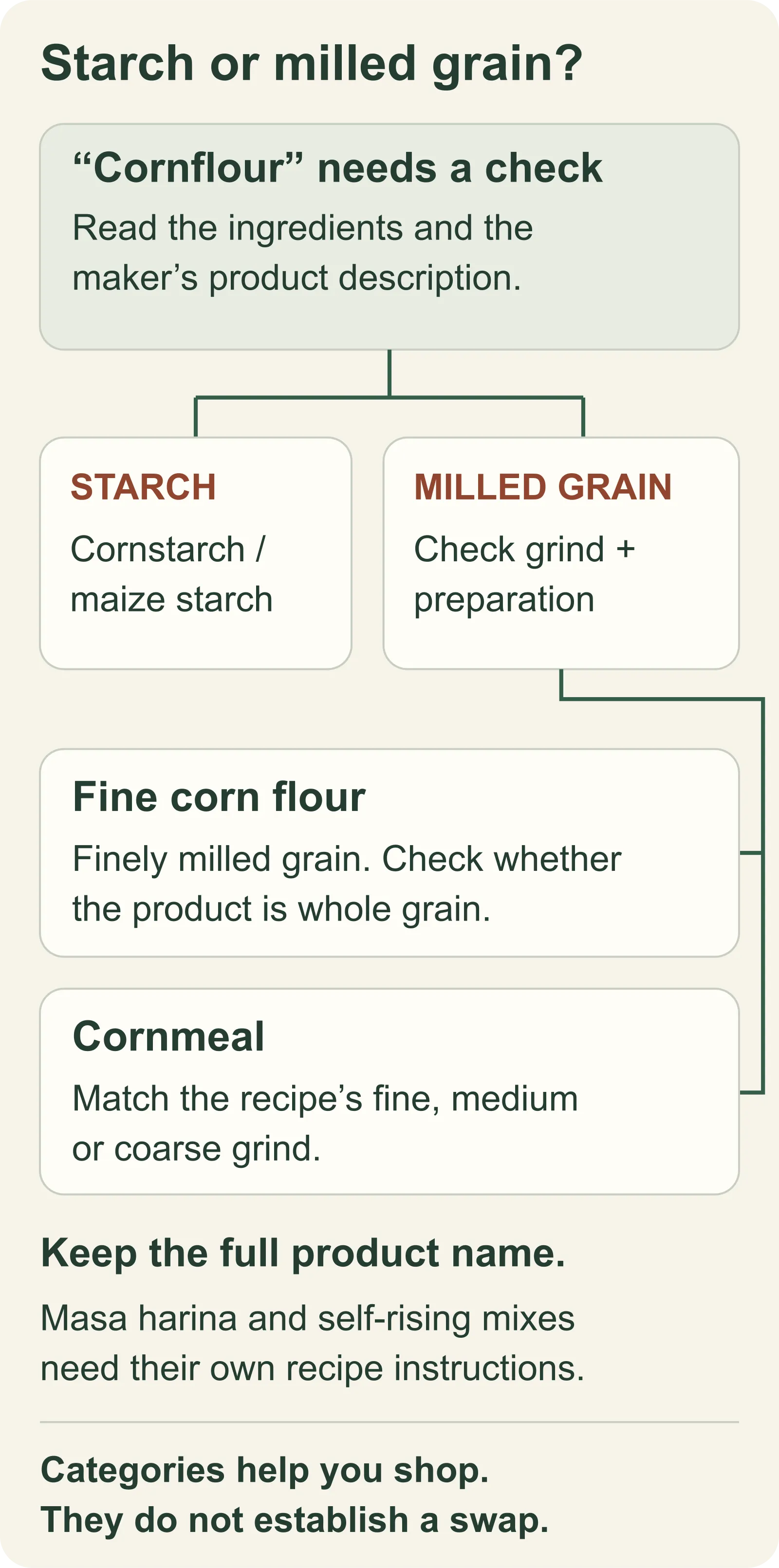
Choose the ingredient category before comparing grinds. Diagram: TuneMyRecipe.
Cornflour needs a maker’s explanation
The UK’s FREEE explicitly distinguishes its white Gluten Free Cornflour, used for thickening, from its yellow whole-grain Organic Maize Flour. Its explanation identifies corn starch, corn flour as commonly named in the UK, and maize starch as thickening powders. This is useful evidence for reading that maker’s products, rather than a reason to treat every package sold in a country as identical. FREEE flour FAQs
An Australian example adds another reason to turn the box around. McKenzie’s Corn Flour lists maize corn flour and a sulphite processing aid. The maker describes thickening sauces and custards, alongside baking uses. Its label supplies information that the words corn flour alone leave out. McKenzie’s Corn Flour
Compare those with Bob’s whole-grain corn flour and the spelling shortcut falls apart. Use the recipe’s place of publication as a clue, then confirm it against an actual product description. If an online recipe links its intended ingredient, follow that link. If it names a brand, check the particular product rather than another bag from the same company.
For an older recipe with neither clue, read beyond the ingredient line. Does it describe a cold-liquid paste that thickens a sauce, or a substantial measure of corn mixed with flour for bread? The method helps frame the question. It doesn’t recover an exact historical grind by itself.
A sauce and a muffin ask different things of corn
A starch-thickened sauce uses the powder to change the body of the liquid. Argo advises mixing its cornstarch with cold liquid until smooth before adding it to the hot mixture. Its cooking guidance also warns that substantial overcooking can cause thickened mixtures to thin as they cool. Follow the recipe’s heating stage; adding powder and getting it wet isn’t the whole operation. Argo cooking FAQs
A cornmeal muffin starts from a different formula. Our Cornmeal Gems use half a cup of medium-grind yellow cornmeal with a cup of all-purpose flour, milk, egg, baking powder and small amounts of sugar and butter. The meal is part of the bread’s grain mixture. Buying starch in its place changes that mixture, even if both packages have corn in their names.
The gems’ measuring directions also tell you to return any meal caught in the sieve. Sifting breaks up lumps and combines the dry ingredients; it isn’t an instruction to discard the larger corn particles until the meal resembles flour. Those particles belong in this version of the recipe.
Our Cornmeal Ragged Robins offer another shopping choice: plain fine- or medium-grind yellow or white cornmeal. Their formula has a cup and a half of meal to a cup of bread flour, with milk and fat but no egg. Cream of tartar and baking soda are measured separately. A self-rising mix would introduce ingredients the cook is already measuring, so the recipe explicitly excludes it.
Cornmeal can belong in steamed bread, too
Steamed Boston Brown Bread
Margaret J. Mitchell’s 1909 Boston Brown Bread combines rye meal, Graham flour and cornmeal with molasses and milk. The modern version chooses fine cornmeal and continuous steaming in a basin. Here corn contributes to a three-grain bread; starch sold as cornflour wouldn’t preserve that ingredient mixture merely because the bread cooks over water.
Cook: Steamed Boston Brown Bread (1909)
The 1909 formula also offers different leavening directions for sweet milk. The companion feature Baking Soda, Baking Powder and Cream of Tartar examines that separate choice. First settle the corn product; then follow the complete recipe’s leavener rather than treating a self-rising mix as plain meal.
Read: Baking Soda, Baking Powder and Cream of Tartar
Finer grinding doesn’t make a neutral exchange
Even within milled grain, a change of grind can be a deliberate change of texture. Bob’s suggests using its corn flour in place of some or all of the meal in cornbread and describes the resulting texture as softer and denser. That is the manufacturer’s advice for its product and a particular kind of bake; it isn’t evidence that any flour can replace any meal in every recipe. Bob’s Organic Corn Flour
Masa harina needs a separate decision. Bob’s describes its Organic Masa Harina as corn cooked and soaked in limewater before grinding. The word flour doesn’t erase that preparation. If you are shopping for a masa harina recipe, look for that name and preparation rather than choosing ordinary corn flour by color or fineness. Organic Masa Harina Corn Flour
Once a recipe specifies medium meal, finely milled whole-grain flour or masa harina, keep the whole description on your shopping list. Shortening all three to corn flour recreates the problem at the store.
Weigh the ingredient you actually chose
Equal cup measures don’t establish equal weights. Bob’s current product pages list a quarter-cup serving of Organic Corn Flour as 31 g and a quarter-cup serving of Medium Grind Cornmeal as 38 g. These are the maker’s label quantities for those products, not a conversion rule for every corn flour or meal. They show why one generic grams-per-cup figure is inadequate. Corn flour label, Cornmeal label
Weighing doesn’t settle substitution either. Replacing 38 g of meal with 38 g of starch preserves the scale reading while changing the ingredient. A weight is precise about how much you have; it doesn’t establish what that amount will do in the recipe. Our cups-and-grams guide explains why ingredient form belongs beside a conversion.
For the gems, keep the recipe’s stated cornmeal amount and measuring method together. For a sauce, follow its specified starch and liquid quantities. If you want to bake with a different corn product, start with a formula written for it. That gives the new ingredient an intended role before you start adjusting the numbers.