
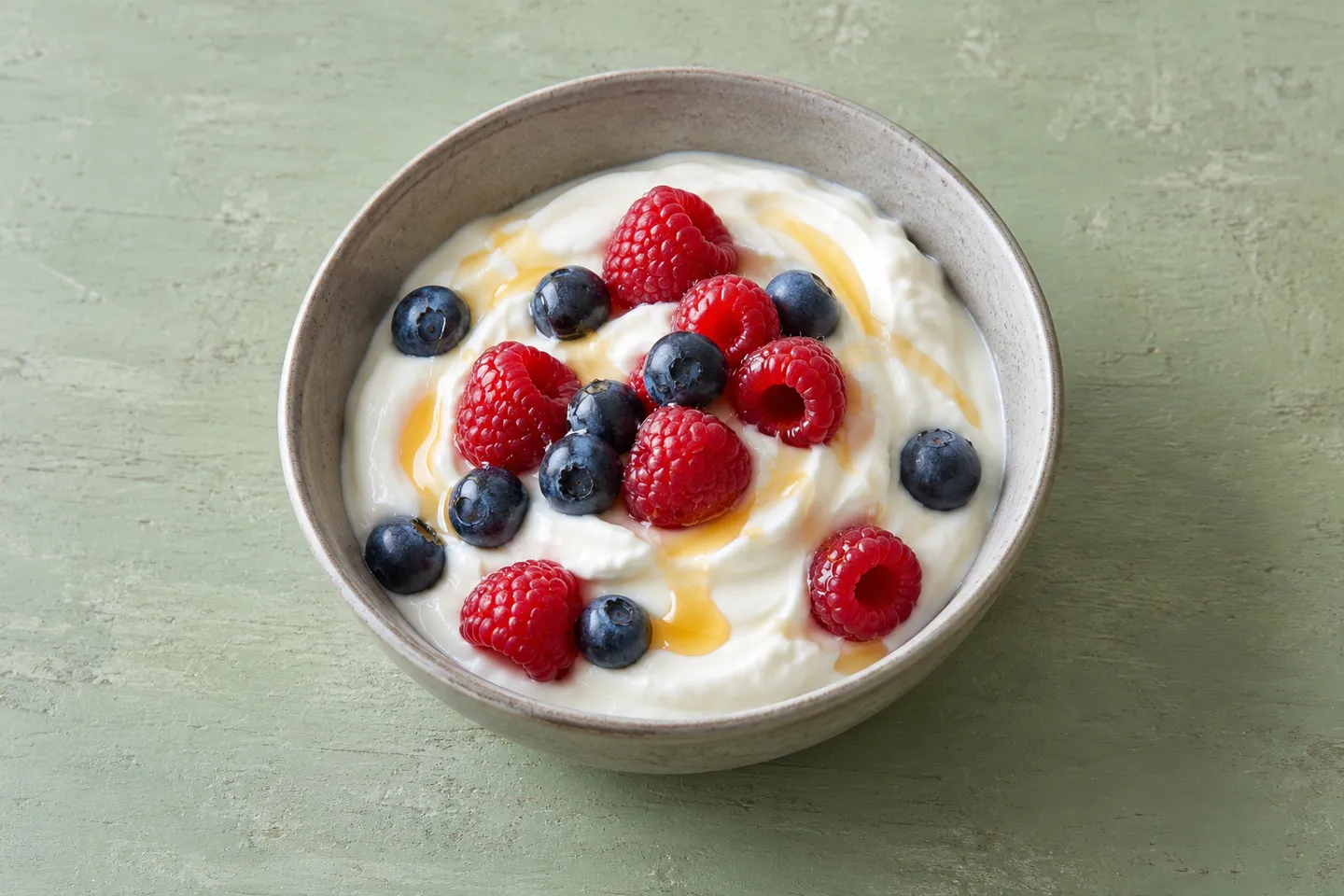
Strained Yogurt with Honey and Berries
Purchased plain yogurt drained in the refrigerator until thick and spoonable, then served with honey and fresh berries.
- Original yieldYield
- 4 bowls; drained yogurt weight varies4 bowlsdrained yogurt weight varies
- PrepPrep time
- TotalTotal time
10 minutes active preparation plus 8 to 12 hours refrigerator draining. The total allows 12 hours; check the texture earlier.
Published
Original recipe: 4 bowls; drained yogurt weight varies
The story behind the recipe
Some of the yogurt leaves the bowl as liquid. What stays in the cloth becomes thicker and holds a spoon's trail, ready for a little honey and a handful of berries. There is no milk to heat or culture to start: the recipe begins with purchased yogurt.
Give the liquid somewhere to go
Have clean food-safe cheesecloth or a closely woven straining cloth ready before starting. A strainer needs to sit above the collected liquid, rather than soaking in it. Line it with a clean food-safe cloth, set it over a deep bowl and let the refrigerator do the waiting. The yogurt should finish thick enough to spoon, not so dry that it must be rolled into balls.
Read more about this recipe
Tanginess before sweetness
Plain whole-milk yogurt has a cultured tang before honey is added. Draining changes its body by removing some whey; it doesn't turn an unfermented ingredient into a fermented one. The culture has already done its work in the yogurt you bought.
That is why the ingredient list says plain. A sweetened or flavored yogurt would change the balance before you reach for the honey. Use a product without added fruit, starch or gelatin for the clearest version of the method. Manufacturers vary, so the amount of whey and final weight will vary too.
Some brands release more whey than others. Divide the finished yogurt between four bowls; the starting kilogram won't all reach the table.
Milk kept in another form
The National Museum of Denmark's account of Viking-Age dairy describes milk being made into butter and cheese. Processing could make a seasonal supply useful in another form. That is the historical thread behind this modern bowl.
The strainer makes separation visible: liquid collects underneath while the soft dairy food becomes more concentrated above it. Beginning with pasteurized-milk yogurt lets us explore that change using a familiar cultured ingredient.
Labneh, the established Middle Eastern strained-yogurt preparation, offers a modern comparison for the method. Here the yogurt stays soft enough to spoon and receives sweet toppings instead of the salt in the published labneh example.
Fruit on top, not hidden inside
The berries stay separate until serving. Their juice would otherwise tint and loosen the yogurt while it drains. Drying them after washing also prevents a puddle around the finished bowl.
Raspberries are soft enough to break under the spoon; blueberries keep a firmer skin. Use either or both within the stated weight. Scatter the fruit over the surface just before eating.
Honey is easier to distribute in a thin drizzle than in a single heavy spoonful. Leave some white yogurt visible, so each mouthful can contain a different amount of fruit and sweetness. The yogurt's tang should still be apparent.
Keep the bowl cold
Draining overnight belongs in the refrigerator. Set aside refrigerator space before you line the strainer, including enough height for the bowl collecting the whey.
Serve the four bowls after adding their toppings. Keep any remaining yogurt covered and refrigerated within the original package's use-by and opened-pack instructions; draining doesn't restart that clock.
Explore the historical background and companion recipes in The Viking Winter Pantry: Preserved Fish, Grain and Dairy.
Make it your wayOriginal: 4 servings · Makes 4 bowls; drained yogurt weight varies
Original recipe: 4 bowls; drained yogurt weight varies
Ingredients
For 4 bowls; drained yogurt weight varies. Quantities are shown as written.
Source measurement convention: Metric. Explicit unit definitions take precedence; unconfirmed measures must be checked before conversion.
Original quantities for 4 bowls; drained yogurt weight varies.
- Plain whole-milk yogurt made with pasteurized milk1 kg
- Fresh raspberries and blueberries, rinsed and dried200 g
- Honey40 g
Measurement notes
Measurement notes
Original ingredients
- 1 kg plain whole-milk yogurt made with pasteurized milk
- 200 g fresh raspberries and blueberries, rinsed and dried
- 40 g honey
Equipment
 Fine-mesh strainer
- Clean, food-safe cheesecloth or closely woven cloth
Instructions
Set up the refrigerated strainer
Set a fine-mesh strainer over a deep bowl with room beneath it for liquid. Line with a clean, food-safe cheesecloth or closely woven cloth. Spoon in the yogurt, cover and refrigerate at 40°F (4°C) or below for 8 to 12 hours, until thick and spoonable. Empty the collected liquid as needed so it stays below the strainer.
Drain the yogurt
Transfer the drained yogurt to a clean container, leaving the liquid behind. Divide into four bowls at the original yield.
Divide and add the toppings
Top with the berries and drizzle with the honey. Serve immediately, or keep the yogurt and toppings separately refrigerated until serving.
Estimated calories 180 kcal
Nutrition portion: 1/4 of recipe · Original yield: 4 bowls; drained yogurt weight varies
Source & assumptions
Ingredient-based estimate using USDA SR Legacy, CoFID 2021 and a published home-straining analogue. About 180 kcal per original bowl, one-quarter of the batch with all honey and berries. Models about 500 g soft strained yogurt from 1 kg whole-milk yogurt, subtracting 500 g of representative acid whey; uses equal raspberry and blueberry weights. Yogurt, cloth, drainage and berry mix change the result. This is a comparable-process estimate, not measured yield or nutrition.
Recipe notes
When adjusting quantities
Use additional strainers for larger quantities rather than a very deep layer. Keep the yogurt refrigerated throughout; draining time doesn't multiply with servings.
Original recipe notes
These notes describe the original recipe. Quantities mentioned here do not change when you adjust servings.
A contemporary preparation using purchased pasteurized-milk yogurt. Arla's straining guidance supplies the 8-to-12-hour soft-texture comparison. This dessert omits the salt used in its labneh example and adds measured honey and fruit.
Contains milk. Keep the dairy cold throughout preparation and service. Follow FoodSafety.gov's refrigeration guidance and the yogurt package's limits. Honey isn't suitable for children under 12 months.
Read the scaling guide. Times, temperatures and equipment need their own consideration. Open the recipe tool to review and correct individual amounts.

Sources and attribution
Recipe details
- Cooking method
- No-cook
- Browse category
- Breakfast & Brunch